Zubin, picture this. It's 1966.
A young engineer named Dee Hock is sitting in a conference room in Seattle.
He's staring at a problem nobody else wants to touch.
Credit cards exist, but there's no network connecting them.
Every bank runs its own paper-based system. Fraud, it's rampant.
Settlements, they take weeks.
The whole thing is held together with carbon paper and a prayer.
So what was Dee Hock's solution? A payments network.
A decentralised co-op of banks that would trust each other enough to honour each other's plastic.
He called it BankAmericard, which eventually became Visa. It took six years to build.
It's become the most valuable financial network in human history.
Sixty years later,
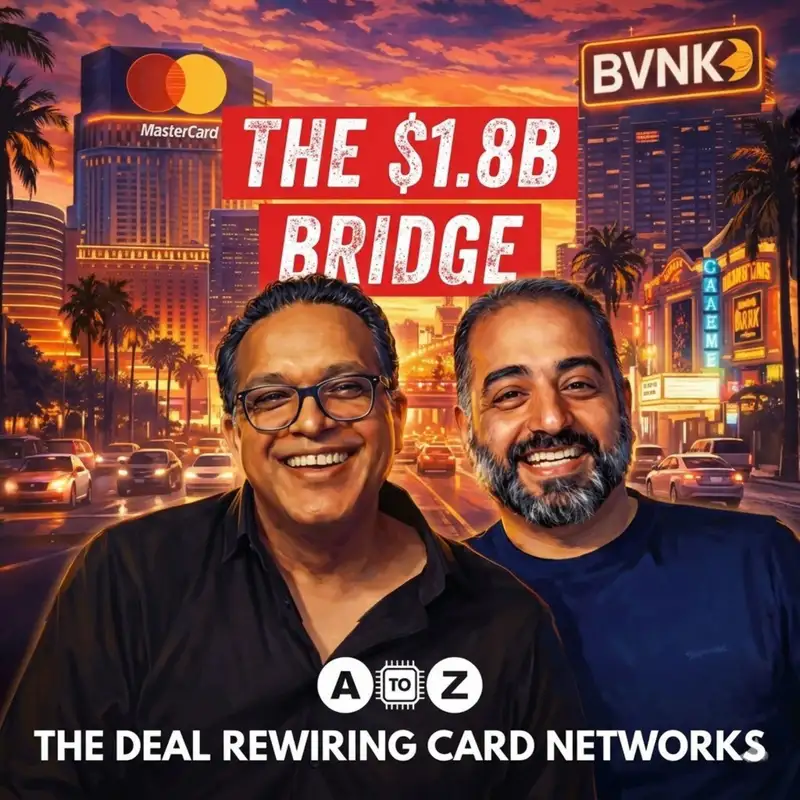
Mastercard just spent 1.8 billion to make sure the next version of that network has its name on it,
not somebody else's.
And the asset they bought, a five-year-old company most people haven't even heard of.
That's not a deal. That's a declaration of war.
Welcome back to A to Z Fintech, the podcast where we break down the world of finance, tech,
and payments, one letter at a time.
I'm Aman, back in Singapore after what can only be described as a whirlwind tour of India.
Delhi, Pune, Mumbai. Three cities, three weeks, minimal downtime.
And I'm Zubin, your payments provocateur, freshly deposited back in the Bay Area from Las Vegas.
And before you ask, no, I didn't leave my savings at the blackjack table.
But I did walk past enough neon-lit crypto billboards on the Strip to know that stablecoins have officially graduated from white papers to primetime advertising.
Las Vegas and India.
We've gone from a Moroccan desert and Japanese powder to a casino and the subcontinent.
Globetrotters gotta keep globetrotting.
It's a lifestyle, not a choice.
But before we get to the deal, Aman, I have to ask: you were in India this time last week.
How was the trip?
Zubin, I could talk about this for an hour.
I've written about it in my blog, shameless plug. But here's what struck me.
Beyond the obvious, the highways, the flyovers going up almost as fast as the new cars filling them,
India's convenience revolution is staggering.
As people who built Google Pay once upon a time and watched it go from a feature to a verb across the country,
I thought I'd seen everything, but this trip took it a decade further.
I was at my parents' house in Pune and I needed a USB-C drive.
I opened Zepto, this quick commerce app. I tapped on the pay button with Google Pay.
And I went to make a drink at my dad's old bar.
And by the time I was back at my seat, I hadn't even sat down.
The delivery guy, six minutes, he delivered that USB-C drive.
It's unbelievable what's happening.
You know, we should probably do an episode, maybe call it The Convenience Economy.
That's a whole episode on its own.
But six minutes is faster than most credit card authorisations used to take in the 70s, which is absolutely insane.
You know, you're absolutely right, Zubin. And we should do that episode.
And that's the point. India hasn't just caught up on payments infrastructure.
In many ways, it's lapped the West.
UPI processed over 16 billion transactions just last month.
Companies like Zepto, Blinkit, Swiggy Instamart, these quick commerce platforms,
they've just collapsed the last mile to single-digit minutes, all running on these rails.
Yeah, and those rails are exactly what today's episode is about.
Because if India's UPI is what real-time domestic payments look like at a billion-person scale,
stablecoins are the bet on what real-time cross-border payments look like at the global scale.
Precisely, which is why this transaction matters so much, Zubin.
No 80s music this time, no WHAM framework. Just two men, a deal, and the future of money.
I don't know, I was starting to enjoy the WHAM framework, but let's keep on.
Straight to the table. No bluffing. But Aman, one more thing.
When this deal dropped, I was sitting at the Aria in Las Vegas.
I saw that push notification come through,
looked up and realised I was actually standing in front of a Capital One lounge that is bigger than most bank branches.
And the irony wasn't lost on me. But we'll come back to that in a bit.
We will.
A reminder: this podcast is for information and entertainment purposes only.
Our views are our own, not those of any organisations we're linked with.
We're definitely not offering any financial advice.
If you decide to build your retirement strategy around the stablecoin infrastructure M&A cycle based on a podcast recorded by two dudes riffing,
that's on you and your regulator.
So stay smart, and don't go all in on anything that hasn't survived at least two market cycles and a major rebrand.
Right, let's lay out the hand, Zubin.
On Tuesday, March 17th, Mastercard announced a definitive agreement to buy BVNK,
the UK-based stablecoin infrastructure company, for up to $1.8 billion.
That's $1.5 billion fixed plus $300 million in contingent earn-out payments tied to performance milestones.
For context, that makes this the largest stablecoin acquisition in history.
It eclipses what we thought was the largest not so long ago: Stripe's $1.1 billion purchase of Bridge,
which closed in February last year.
And here's the plot twist that makes this story irresistible.
Just four months ago, Coinbase walked away from a $2 billion deal to buy the same company.
Let me say that again, because the sequence matters.
Coinbase and Mastercard were both circling BVNK through most of 2025.
Coinbase got to exclusivity in October. Lawyers were drafting, diligence was underway.
And then in November, radio silence. The engagement was off.
Mutual agreement not to proceed. No public reason given.
You know, BVNK spent four months as the hottest free agent in stablecoin infrastructure.
And since we're on a Vegas theme, it's really a broken engagement and an open dance card.
And that's like saying you're getting the jitters at the altar and then marrying someone richer at the after-party.
I love it.
Two guys who have been married for a lot longer than they care to admit talking about all of this stuff.
And, you know, arguably better looking. Because this isn't a consolation prize for BVNK.
Being embedded inside Mastercard's 210-country,
$9.5 trillion payment network is a fundamentally different growth story than sitting inside a crypto exchange.
You know, better looking was the key. I mean, we both got it right the first time around.
And yes, the key part of this deal, right? The velocity is staggering.
Going back in that chronological order, BVNK raised its Series B at a $750 million valuation in December 2024.
And just 15 months later, it's being acquired for $1.8 billion, with a B.
That's not normal M&A. That's essentially an arms race with an accelerating clock.
Which raises the first provocation.
Why did Coinbase fold, and what did Mastercard see that Coinbase didn't, Zubin?
You know what, let's forensically unpack the Coinbase decision.
Now, nobody has confirmed the exact reason the deal collapsed, but the market consensus,
and this is supported by some Axios reporting that we read, is that Coinbase was fixated on revenue.
The last we read, BVNK had roughly $40 million in annualised revenue at that point.
Paying $2 billion for $40 million is what, a 50x revenue multiple?
Even in the crypto M&A market where things are inflated,
that's a number that makes any Wall Street analyst reach for their blood pressure medication.
And Coinbase had already been on a spending spree.
They'd closed the $2.9 billion Deribit acquisition earlier in 2025, the crypto derivatives exchange,
plus $375 million for Echo, the fundraising platform.
The M&A tab was getting long.
The board likely said: we love the asset, we just don't love the price.
Let's keep that Vegas theme, man. Classic poker move.
They looked at the hand, calculated the pot odds, and they folded.
And here's where Mastercard played a different game entirely.
Mastercard wasn't buying revenue. They were buying capability and optionality.
Their Chief Product Officer, Jorn Lambert, said on the conference call,
and I'm paraphrasing: our card business doesn't have a problem to be solved.
This is about expanding into new addressable markets. Remittances, B2B, cross-border.
For Coinbase, BVNK was an acquisition of adjacency, bolting stablecoin infrastructure onto a crypto exchange.
For Mastercard, BVNK is an acquisition of insurance, making sure that as money moves on-chain,
Mastercard is the network that facilitates it.
The strategic logic is entirely different, Zubin.
And that's why Mastercard could absorb $1.8 billion on a $453 billion market cap,
less than 0.4% of its value, without blinking.
Yeah, and you know, as a commercial leader, I love when you think about how they structured it.
This $300 million is contingent. That's a risk-sharing mechanism.
If BVNK doesn't hit its targets, the total price drops.
Coinbase was reportedly looking for a flatter, higher upfront number.
Mastercard was more disciplined. More TradFi in its deal architecture.
Yeah, and it tells you something about the cultural DNA of the acquirer.
Mastercard has been running a payments network for what, six decades?
They know how to buy infrastructure and integrate it. They did it with Vocalink.
This is what they do.
Right, and Coinbase, for all its ambitions, is still just a decade-old company that has been public for five years.
Completely different muscle memory.
You know, and having been in India just last week, I can give you the concrete version of why this matters.
India's inbound remittance market, let's take that alone, and then Mexico, Philippines, Egypt,
collectively hundreds of billions of dollars more.
Current remittance costs run at about 7 to 10% through traditional corridors.
Stablecoins can do that at near zero.
I was paying for everything via UPI in a six-minute delivery window, we talked about that.
And yet cross-border into the same country still crawls through correspondent banking chains at 19th-century pace.
Mastercard just bought the infrastructure to fix that. That's not a tech bet.
That's a market-access play with observable, massive demand.
Yeah, honestly, second time's a charm for BVNK too.
They came out of the Coinbase breakup and landed a partner with 210 countries of reach,
regulatory relationships in every major jurisdiction,
and the balance sheet to invest for the long term.
Honestly, I'll take that over a crypto exchange in a heartbeat.
Wouldn't you?
It's like being dumped by the lead singer and ending up with the stadium owner.
Yeah, except this stadium owner owns the ticketing system, the parking lot, the broadcasting rights,
and everything in between.
Let's talk about the elephant in every boardroom in stablecoin-land since, let's say, February 2025.
The Stripe-Bridge effect. Because this deal doesn't really happen without that.
So true, so true. I totally agree with you.
Stripe buys Bridge for $1.1 billion,
and overnight every independent stablecoin infrastructure company wakes up the next morning and asks the same question.
If the largest private fintech in the world just acquired our direct competitor, can we stay independent?
Yeah, and I think the answer is no. And here's why. Stripe didn't just buy Bridge.
They operationalised it at a speed nobody predicted. Let's play this out.
Within three months, they launched Stablecoin Financial Accounts in 101 countries.
By May 2025, which was Stripe Sessions last year,
they unveiled the AI foundation model for payments, powered partially by Bridge's infrastructure.
And then by October, they launched Open Issuance,
letting any business create its own stablecoin with just a few lines of code.
Phantom launched CASH on that platform. MetaMask launched mUSD on that platform as well.
The momentum has been staggering.
So Bridge went from a quiet startup to core infrastructure of the largest private payments company on earth in under a year.
If you're BVNK, sitting there with similar technology but without that distribution,
the clock is suddenly ticking very loudly.
Yeah, and let's look at the other play in the room.
Visa, which had already made that strategic investment in BVNK in May 2025,
went and announced a massive expansion of its stablecoin card programme with Bridge.
Stablecoin-linked cards in over 100 countries.
So your own investor is now building with your competitor's acquirer.
And that's the moment BVNK's board looked at the chessboard and said: we cannot outrun this alone.
We need a network partner with global scale, regulatory relationships, and the balance sheet to invest.
Yeah, and Mastercard has also been talking to Zerohash, I think they were at what, $1.5 to $2 billion?
That deal fell through. So Mastercard has been actively shopping.
BVNK was actively needing. This match was almost gravitational.
In poker terms, Zubin, everybody at the table could see the community cards.
The only question was who would push all in first.
But here's where it gets really, really interesting for anyone who thinks about the broader payments architecture.
Let's go around the table, because every major player just had their strategic calculus altered.
Yeah, let's start with Visa, Zubin. The 800-pound gorilla in crypto card volume.
Some estimates suggest that over 90% of on-chain crypto card volume runs through Visa.
They've partnered with Bridge. They've invested in BVNK.
They launched with Phantom and MetaMask on stablecoin cards.
Visa's strategy has been partner, don't acquire.
That's worked beautifully, until this transaction.
That's right. Because now Mastercard owns the infrastructure, Visa rents it.
And in payments, ownership of the rails is the ultimate moat.
So Visa is facing this very uncomfortable choice.
Does it go and buy its own BVNK equivalent, and honestly, there aren't many left out there?
Or does it double down on its partnership strategy and essentially risk being dependent on infrastructure controlled by competitors?
Yeah, in my view, Visa makes an acquisition within 12 months. They have to.
Rain, which just raised at a $1.95 billion valuation, is one target.
Zerohash, you mentioned them, is another.
But the independent targets are thinning out fast.
Every quarter Visa waits, the price goes up and the options narrow.
That's right. And you're just taking the Stripe-Bridge, Mastercard-BVNK.
We're definitely looking at exponential growth, but let's shift gears. Let's look at Amex.
Amex has been remarkably quiet on stablecoins in general.
Their model has always been premium, high-spend, high-margin.
Crypto infrastructure doesn't obviously fit in with the Amex brand.
But I think the important one we might be missing is cross-border commercial payments.
That is a massive Amex business, and that's really where stablecoins eat the biggest fees.
You know, I think Amex is the most vulnerable card network right now because they're the furthest behind.
Every quarter they don't act, the gap widens.
The question for Amex isn't whether stablecoins matter.
It's whether they'll have a seat at the table when the music stops.
Yeah, and this is my favourite one. Capital One. And this is a non-obvious one, really.
I'm standing in front of that Capital One lounge in Vegas, bigger than a bank branch.
That's not a credit card company any more. We've covered this before.
Capital One completed their $35 billion, with a B, acquisition of Discover, giving it its own payments rails.
And then early this year, it bought Brex for what, $5.15 billion?
Which incidentally closed yesterday.
Interesting. And here's the insight.
Brex announced native stablecoin payments back in September 2025.
Figure, Solana, Alchemy were all on the waitlist.
So Capital One, through two acquisitions, Discover for the network and Brex for the tech,
has quietly assembled a stablecoin-capable, full-stack, network-owning payments platform.
Nobody's talking about Capital One as a stablecoin player. They should be.
Alright, Aman, that's the stealth move of the cycle, really.
And then JPMorgan, Zubin. Jamie Dimon's kingdom, playing a completely different game.
Their Kinexys unit launched JPM Coin, a deposit token, not a stablecoin, on Coinbase's Base network.
They process roughly a billion dollars a day through JPM Coin already.
And their CFO, Jeremy Barnum, made his position crystal clear on the earnings call.
Stablecoin yield offerings are, in his view, a parallel banking system without the safeguards.
Yeah, so JPMorgan's pitch is: you want digital, always-on, programmable money? Here it is.
It just happens to be a bank deposit with FDIC protection,
not a stablecoin backed by Treasuries with no deposit insurance.
For institutional money, it's a compelling argument, I would argue.
It's brilliant positioning. They're not fighting the technology.
They're fighting the regulatory wrapper.
And in finance, the wrapper often matters more than what's inside it.
You just described every luxury brand in existence.
Alright, let's pivot to the crypto-native players,
because this deal sends shockwaves through the entire stablecoin ecosystem.
And most banking products, if we're being honest. Yeah, let's start with Coinbase, Zubin.
They walked away from BVNK, and now their direct competitor in the infrastructure layer owns it.
That stings. But Coinbase is a $50 billion-plus company.
They have Deribit, they have Base, JPMorgan launched JPM Coin, as we just mentioned, on Base.
They're not out of the game. But they've missed the infrastructure acquisition window.
Yeah, and Circle is the one I'm watching most closely. They went public in 2025.
USDC is the second-largest stablecoin.
And suddenly the two largest card networks,
Mastercard through BVNK and essentially Visa through its partnership with Bridge,
are building stablecoin infrastructure that is agnostic to which stablecoin flows through it.
Circle makes USDC.
But Mastercard and Visa, especially Mastercard-BVNK, decide how and where USDC moves.
The power shifts to the orchestration layer.
You know, it just gives me a thought.
We should do an episode on our predictions at the end of last year.
I think we'll come across as pretty clairvoyant on this.
Totally, we should.
In fact, there was a little BVNK-Mastercard ask, stablecoin on-chain settlements for the major networks.
Yeah, we should do that.
Yeah, pat ourselves on the back.
But look, in media, we learned that distribution eats content.
In payments, the same logic applies. Circle is the content.
Mastercard is the distribution.
And if history tells us everything we know, which side of that equation captures more value over time?
Yeah. Another one is Paxos.
This is the regulated infrastructure provider behind PayPal's PYUSD.
They have the New York trust charter.
They're white-labelling stablecoin issuance for banks and fintechs.
In some ways, Paxos is the arms dealer in this war, supplying everybody.
But the question is, does every arms dealer eventually have to pick a side?
Or get acquired by one. Paxos, Zerohash, Rain.
These are the remaining independent infrastructure pieces, if you'd like.
And after this transaction, every one of them just got more expensive and more strategically important.
The acquisition window is closing.
Yeah, and this is the part of the poker tournament where the blinds go up and the short stacks start sweating.
And the big stacks start eyeing each other's chips.
Yeah, you know what, Aman, I feel like there's a mic drop coming.
The neon lights of Vegas are dimming, Singapore is settling in for the night.
Let's bring it home.
Okay, here's what I keep coming back to.
For 50 years, Zubin, Visa and Mastercard bundled four things into a single, elegant, enormously profitable package.
The network, the rails, the trust, and the settlement.
You swiped a card in Singapore,
and those four things worked in concert to move money from a bank in London to a merchant in Tokyo.
It was invisible. It was instant.
And it generated margins that would make a sovereign wealth fund go green with envy.
Stablecoins unbundle all four. The network becomes the blockchain.
The rails become the smart contract. The trust becomes the regulatory framework.
Settlement becomes instant. Not T plus two, not next day, but now.
Yeah, and the only thing the card networks have left, essentially,
is the brand trust and the merchant acceptance footprint.
And that's precisely why they're buying.
Not to defend a business, but to re-bundle on their own terms, before somebody else does it for them.
But here's the deeper point, Aman.
It isn't about Mastercard or Visa or stablecoins or even money.
It's about what happens when infrastructure becomes invisible. Let's go back to 1966.
Dee Hock built Visa because nobody trusted a piece of plastic from a bank they'd never heard of.
Trust was scarce. Infrastructure was the solution.
In 2026, the infrastructure has caught up to that trust.
Smart contracts execute without counterparty risk. Settlement is atomic.
The technology doesn't need a middleman to vouch for it.
So I guess the real question, the one that will define the next decade of finance, isn't who owns the pipes.
It's who owns the relationship that sits on top of them.
Because every time in history that infrastructure has become invisible,
the infrastructure provider has become replaceable.
Telcos built the networks, Apple and Google captured the value.
Electricity companies wired the world, but the appliance and software companies made all the money.
The card networks know this. That's why this deal isn't really about stablecoins at all.
It's about this existential question of finance.
When the plumbing works perfectly, who needs the plumber?
Mastercard just spent $1.8 billion on the answer.
You become the architect, not the plumber. You own the blueprints, not the pipe.
Whether they pull it off is the trillion-dollar wager. But I'll say this.
In a world where the infrastructure is becoming invisible, the smartest move isn't to build a bigger pipe.
It's to make sure your name is on the building.
And I want to close this out to our listeners.
The deal doesn't close till mid-2026, obviously subject to regulatory approvals.
What happens between now and then will really tell us, and tell all our listeners,
whether this is really a stablecoin, a crypto story, or a payments story.
My bet, Zubin, is payments story.
By December, we'll look back at this transaction as the inflection point.
Talking of weeks, Aman, what are you hitting next?
Zubin, I'm just trying to keep up with you.
I'm trying to rendezvous with you, as you know, in London, potentially the US.
Where are you going?
You know what, at least for the next month, I'm going to stay put in the Bay Area,
which for me is practically, I think, settling in.
By the way,
a man who was in a Moroccan desert a month ago is calling San Francisco "settling down." Meanwhile,
I've done India, three weeks, and I'm calling Singapore home.
That tells you everything you need to know about 2026.
It does indeed, my friend. It does indeed.
So from the only man who has a poster of Dee Hock in his study, and me, stay purposeful.
And of course, stay stablecoin-curious, even if your bank isn't.