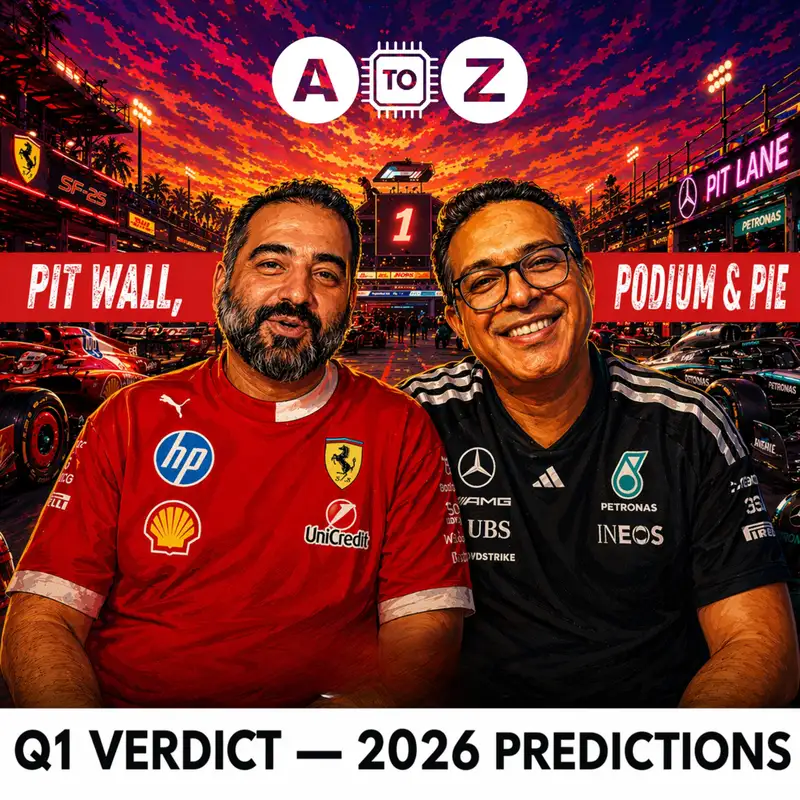
Click here to watch a video of this episode.
Ninety days ago we made ten fintech predictions on this podcast for 2026. Today we graded them in public. Four have already played out fully. Three are directionally correct. One is spectacularly wrong. One is still waiting on a phone call from Ben and David at Acquired.
This is the Q1 2026 fintech scorecard, recorded at the quarter-pole of the season. Mastercard's $1.8 billion acquisition of BVNK and Visa Direct's $3.5 billion in annualised stablecoin settlement volume closed out the card networks' capitulation to stablecoins. The OpenAI-Microsoft partnership restructured through a $250 billion Azure commitment and effective compute autonomy for OpenAI. Compute nationalism went mainstream, with sovereign cloud tracking towards $80 billion in 2026. And the Ive-Altman hardware prototype leaked to reviews that, politely, read as paperweight.
Aman Narain and Zubin Vandrevala break down all ten fintech predictions: the four on the podium, the three directionally correct, the one spectacularly wrong (JPMorgan-Nubank), and the one still pending. They diagnose why the misses happened, and publish the Q2 to Q4 watchlist: stablecoin integration speed, agentic liability, Nubank's US charter, and the PayPal endgame.
Key takeaways:
1. Mastercard's $1.8 billion BVNK acquisition and Visa Direct's $3.5 billion in annualised stablecoin volume confirm the card networks have stopped fighting stablecoins and started operating them.
2. The OpenAI-Microsoft restructuring, a $250 billion Azure commitment paired with compute autonomy for OpenAI, is a conscious uncoupling dressed as a partnership renewal.
3. The UK Competition and Markets Authority made businesses fully liable for their AI agents' actions, building the legal framework for agentic commerce through liability rather than licensing.
4. The fintech predictions that paid off were structural reads of institutional behaviour. The one that missed mistook a neat story for the system's actual logic.
5. GPU clusters are now held by sovereign states the way central banks once held gold, with sovereign cloud spending tracking towards $80 billion in 2026.
Topics covered:
- The four podium finishes: Visa and Mastercard on-chain, compute nationalism, the OpenAI-Microsoft divorce, the Ive-Altman paperweight
- The directional hits: the CUDA killer through open standards, AI-agent liability in the UK, the Q-Day quantum scare, AI in F1
- The dead-wrong call: JPMorgan-Nubank, and why the symmetric story was the wrong one
- The reverse-merger trend: neobanks buying distressed regional banks for the licence and the deposits
- The Q2 to Q4 fintech watchlist: corporate treasurers on stablecoins, global agentic liability, Nubank's US charter, the PayPal endgame
- The pattern beneath the scorecard: why structural reads beat narrative reads, and how to tell the difference
Chapters:
Referenced in this episode: Season 1 finale predictions (December 2025); Mastercard / BVNK definitive agreement (March 2026); Visa Direct stablecoin settlement volumes; Gartner sovereign cloud forecast; OpenAI / Microsoft restructured partnership and $250 billion Azure commitment; Huawei Ascend 950PR and Atlas 350; Google OpenXLA; UK Competition and Markets Authority AI-agent guidance; Q1 post-quantum cryptography research reducing qubit requirements for RSA-2048 from 20 million to under 1 million; Mercedes x Microsoft F1 AI partnership; Red Bull x Oracle AI strategy agent; JPMorgan Q1 commentary; Acquired with Ben Gilbert and David Rosenthal.
Related episodes: the Season 1 finale predictions; the Mastercard-BVNK deep dive; The Purple Revolution on Nubank; the PayPal endgame.
Hosted by:
Aman Narain writes at amanwhoblogs.substack.com. Zubin Vandrevala is your payments provocateur.
Enjoying A2Z Fintech? Leave a rating and review on Apple Podcasts. It is the single biggest signal to the Apple algorithm and how new listeners in our world find us.
For information and entertainment only. Not financial advice.
Transcript:
Ninety days ago we made ten fintech predictions on this podcast for 2026. Today we graded them in public. Four have already played out fully. Three are directionally correct. One is spectacularly wrong. One is still waiting on a phone call from Ben and David at Acquired.
This is the Q1 2026 fintech scorecard, recorded at the quarter-pole of the season. Mastercard's $1.8 billion acquisition of BVNK and Visa Direct's $3.5 billion in annualised stablecoin settlement volume closed out the card networks' capitulation to stablecoins. The OpenAI-Microsoft partnership restructured through a $250 billion Azure commitment and effective compute autonomy for OpenAI. Compute nationalism went mainstream, with sovereign cloud tracking towards $80 billion in 2026. And the Ive-Altman hardware prototype leaked to reviews that, politely, read as paperweight.
Aman Narain and Zubin Vandrevala break down all ten fintech predictions: the four on the podium, the three directionally correct, the one spectacularly wrong (JPMorgan-Nubank), and the one still pending. They diagnose why the misses happened, and publish the Q2 to Q4 watchlist: stablecoin integration speed, agentic liability, Nubank's US charter, and the PayPal endgame.
Key takeaways:
1. Mastercard's $1.8 billion BVNK acquisition and Visa Direct's $3.5 billion in annualised stablecoin volume confirm the card networks have stopped fighting stablecoins and started operating them.
2. The OpenAI-Microsoft restructuring, a $250 billion Azure commitment paired with compute autonomy for OpenAI, is a conscious uncoupling dressed as a partnership renewal.
3. The UK Competition and Markets Authority made businesses fully liable for their AI agents' actions, building the legal framework for agentic commerce through liability rather than licensing.
4. The fintech predictions that paid off were structural reads of institutional behaviour. The one that missed mistook a neat story for the system's actual logic.
5. GPU clusters are now held by sovereign states the way central banks once held gold, with sovereign cloud spending tracking towards $80 billion in 2026.
Topics covered:
- The four podium finishes: Visa and Mastercard on-chain, compute nationalism, the OpenAI-Microsoft divorce, the Ive-Altman paperweight
- The directional hits: the CUDA killer through open standards, AI-agent liability in the UK, the Q-Day quantum scare, AI in F1
- The dead-wrong call: JPMorgan-Nubank, and why the symmetric story was the wrong one
- The reverse-merger trend: neobanks buying distressed regional banks for the licence and the deposits
- The Q2 to Q4 fintech watchlist: corporate treasurers on stablecoins, global agentic liability, Nubank's US charter, the PayPal endgame
- The pattern beneath the scorecard: why structural reads beat narrative reads, and how to tell the difference
Chapters:
Referenced in this episode: Season 1 finale predictions (December 2025); Mastercard / BVNK definitive agreement (March 2026); Visa Direct stablecoin settlement volumes; Gartner sovereign cloud forecast; OpenAI / Microsoft restructured partnership and $250 billion Azure commitment; Huawei Ascend 950PR and Atlas 350; Google OpenXLA; UK Competition and Markets Authority AI-agent guidance; Q1 post-quantum cryptography research reducing qubit requirements for RSA-2048 from 20 million to under 1 million; Mercedes x Microsoft F1 AI partnership; Red Bull x Oracle AI strategy agent; JPMorgan Q1 commentary; Acquired with Ben Gilbert and David Rosenthal.
Related episodes: the Season 1 finale predictions; the Mastercard-BVNK deep dive; The Purple Revolution on Nubank; the PayPal endgame.
Hosted by:
Aman Narain writes at amanwhoblogs.substack.com. Zubin Vandrevala is your payments provocateur.
Enjoying A2Z Fintech? Leave a rating and review on Apple Podcasts. It is the single biggest signal to the Apple algorithm and how new listeners in our world find us.
For information and entertainment only. Not financial advice.
Transcript: