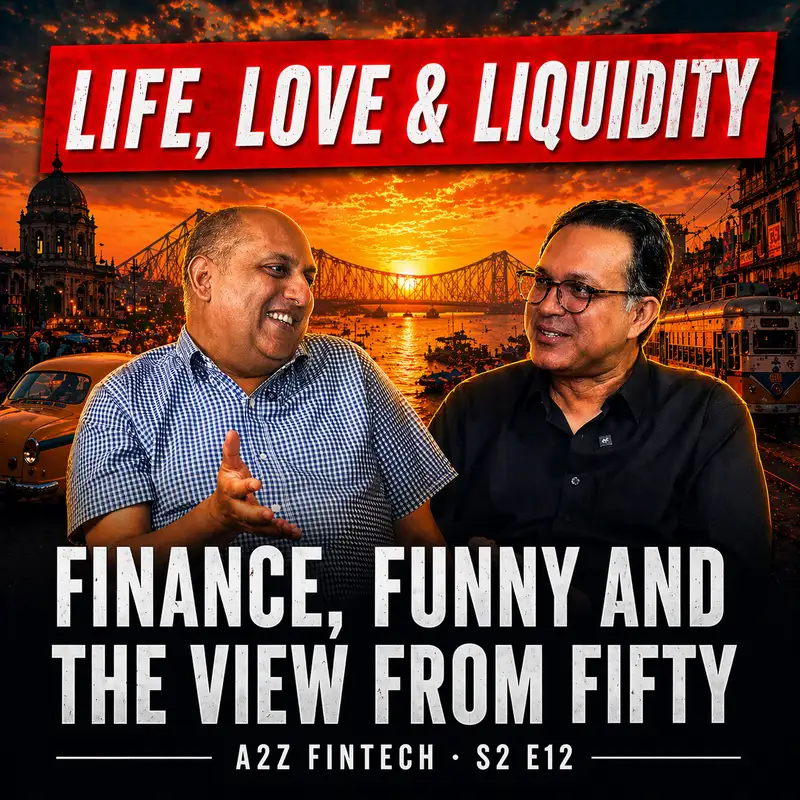
Click here to watch a video of this episode.
Two best friends from an accounting class in Ohio, both turning fifty this year. One spent the next thirty years inside the world's largest banks. The other made fun of them. Both just watched their first careers become obsolete in twelve minutes.
This is a different kind of A2Z Fintech episode. Recorded in Mumbai during a long working swing across India, Aman Narain sits down with his oldest friend, the comedian and screenwriter Anuvab Pal, for the first long-form conversation on the show with a guest from outside fintech. They met in August 1995 in an eight-in-the-morning accounting class at Ohio Wesleyan. Anuvab interned at the Federal Reserve, then spent eleven years at Reuters and Thomson Reuters before writing his way out into stand-up, plays, and films. Aman went to Standard Chartered in London, INSEAD, Singapore, ran the bank's first internet, mobile and digital channels in thirty countries, then joined Caesar Sengupta at Google Pay during the India launch.
Aman Narain and Anuvab Pal break down what fintech actually feels like from the inside of a transformed life. The conversation moves from a Calcutta school in the 1980s to a dorm room at Ohio Wesleyan in 1995, to the Reuters basement in lower Manhattan, to Fontainebleau, to the launch of Google Pay India, to the Industrial-Age rails on which Intelligence-Age money still travels in 2026. It is a fintech episode in disguise.
Key takeaways:
1. The investment-banking pitch book Anuvab spent his early years at Reuters producing — and a meaningful slice of what he sold for a decade after — is now made in twelve minutes by an LLM, end to end.
2. Money has moved into the Intelligence Age while the rails carrying it remain Industrial Age plumbing. The unfinished work of fintech is the next layer: a "new interchange" that prices the data attached to a payment, not the payment itself.
3. GPay in India is a different animal from GPay anywhere else because the India Stack — UPI plus Aadhaar plus a national phone-number messaging layer — does not exist in the West. State-led public digital infrastructure has overtaken bank-led open banking on every measurable axis.
4. The Indian consumer-tech wave (Zomato, Swiggy, BookMyShow) succeeded by solving one specific problem: how to let an Indian transact in India without having to confront India. The fintech parallel is more direct than it looks.
5. The career playbook our generation followed — pick an institution, climb the ladder, mind the title — is the last one that worked. For anyone starting now, the job is to build something with their name on it.
Topics covered:
- The Calcutta-to-Ohio childhood and a 1995 accounting class that produced a fintech operator and a comedian
- Conrad Kent's Rites of Passage class and the lifelong utility of being able to bullshit confidently
- Joseph Musser, Mark Gingrich, and what an American liberal-arts education actually does
- Anuvab's path: the Federal Reserve, Reuters, Thomson Reuters, then writing his way into stand-up and film
- Aman's path: Standard Chartered London, internal communications, INSEAD, Singapore, internet banking in 2006, Google Pay India
- The pitch book Claude now produces in twelve minutes; the Reuters data sales job that no longer exists
- David Ogilvy: "how big do we have to get before we start to suck?"; Bezos's two-pizza rule
- Industrial Age rails, Intelligence Age money: how value moves, why a "new interchange" is overdue
- Programmable money, agentic commerce, and Aman's ChatGPT named Moneypenny
- UPI, Aadhaar, and why the state-led India Stack has overtaken bank-led open banking
- The four-minute viral clip economy and what it means for live comedy in 2026
- What the two of them would tell their 25-year-old selves now
Chapters:
Referenced in this episode: Ohio Wesleyan University; Conrad Kent's Rites of Passage and Erik Erikson's Gandhi's Truth; Joseph Musser; Mark Gingrich; Corinne Lyman; Alice Simon; Thomas Friedman's The Lexus and the Olive Tree; J.D. Salinger's The Catcher in the Rye; Isaiah Berlin; Tim Halford and Ben Hung at Standard Chartered; Jan Verplancke; Caesar Sengupta and the launch of Google Pay India; Matt Brittin (Google EMEA, now BBC commissioner); INSEAD and the origin of Wise; David Ogilvy; the Bezos two-pizza rule; Tom Glocer at Thomson Reuters; the Lark Play Development Center; Don Ward and The Comedy Store, London; Shane Allen and Stephen Fry (BBC, 2020); Anuvab Pal's Chaos Theory, Loins of Punjab, and The President Is Coming; the Our Last Week podcast.
Related episodes: [TBD — prior A2Z episodes on programmable money, UPI / India Stack, or agentic commerce that cross-link naturally].
Hosted by:
Aman Narain writes at amanwhoblogs.substack.com. Anuvab Pal is a comedian, screenwriter, and playwright based in Mumbai, co-host of the Our Last Week podcast, and the only person who has known Aman long enough to disagree with him on the record.
Enjoying A2Z Fintech? Leave a rating and review on Apple Podcasts. It is the single biggest signal to the Apple algorithm and how new listeners in our world find us.
For information and entertainment only. Not financial advice.
Transcript:
Two best friends from an accounting class in Ohio, both turning fifty this year. One spent the next thirty years inside the world's largest banks. The other made fun of them. Both just watched their first careers become obsolete in twelve minutes.
This is a different kind of A2Z Fintech episode. Recorded in Mumbai during a long working swing across India, Aman Narain sits down with his oldest friend, the comedian and screenwriter Anuvab Pal, for the first long-form conversation on the show with a guest from outside fintech. They met in August 1995 in an eight-in-the-morning accounting class at Ohio Wesleyan. Anuvab interned at the Federal Reserve, then spent eleven years at Reuters and Thomson Reuters before writing his way out into stand-up, plays, and films. Aman went to Standard Chartered in London, INSEAD, Singapore, ran the bank's first internet, mobile and digital channels in thirty countries, then joined Caesar Sengupta at Google Pay during the India launch.
Aman Narain and Anuvab Pal break down what fintech actually feels like from the inside of a transformed life. The conversation moves from a Calcutta school in the 1980s to a dorm room at Ohio Wesleyan in 1995, to the Reuters basement in lower Manhattan, to Fontainebleau, to the launch of Google Pay India, to the Industrial-Age rails on which Intelligence-Age money still travels in 2026. It is a fintech episode in disguise.
Key takeaways:
1. The investment-banking pitch book Anuvab spent his early years at Reuters producing — and a meaningful slice of what he sold for a decade after — is now made in twelve minutes by an LLM, end to end.
2. Money has moved into the Intelligence Age while the rails carrying it remain Industrial Age plumbing. The unfinished work of fintech is the next layer: a "new interchange" that prices the data attached to a payment, not the payment itself.
3. GPay in India is a different animal from GPay anywhere else because the India Stack — UPI plus Aadhaar plus a national phone-number messaging layer — does not exist in the West. State-led public digital infrastructure has overtaken bank-led open banking on every measurable axis.
4. The Indian consumer-tech wave (Zomato, Swiggy, BookMyShow) succeeded by solving one specific problem: how to let an Indian transact in India without having to confront India. The fintech parallel is more direct than it looks.
5. The career playbook our generation followed — pick an institution, climb the ladder, mind the title — is the last one that worked. For anyone starting now, the job is to build something with their name on it.
Topics covered:
- The Calcutta-to-Ohio childhood and a 1995 accounting class that produced a fintech operator and a comedian
- Conrad Kent's Rites of Passage class and the lifelong utility of being able to bullshit confidently
- Joseph Musser, Mark Gingrich, and what an American liberal-arts education actually does
- Anuvab's path: the Federal Reserve, Reuters, Thomson Reuters, then writing his way into stand-up and film
- Aman's path: Standard Chartered London, internal communications, INSEAD, Singapore, internet banking in 2006, Google Pay India
- The pitch book Claude now produces in twelve minutes; the Reuters data sales job that no longer exists
- David Ogilvy: "how big do we have to get before we start to suck?"; Bezos's two-pizza rule
- Industrial Age rails, Intelligence Age money: how value moves, why a "new interchange" is overdue
- Programmable money, agentic commerce, and Aman's ChatGPT named Moneypenny
- UPI, Aadhaar, and why the state-led India Stack has overtaken bank-led open banking
- The four-minute viral clip economy and what it means for live comedy in 2026
- What the two of them would tell their 25-year-old selves now
Chapters:
Referenced in this episode: Ohio Wesleyan University; Conrad Kent's Rites of Passage and Erik Erikson's Gandhi's Truth; Joseph Musser; Mark Gingrich; Corinne Lyman; Alice Simon; Thomas Friedman's The Lexus and the Olive Tree; J.D. Salinger's The Catcher in the Rye; Isaiah Berlin; Tim Halford and Ben Hung at Standard Chartered; Jan Verplancke; Caesar Sengupta and the launch of Google Pay India; Matt Brittin (Google EMEA, now BBC commissioner); INSEAD and the origin of Wise; David Ogilvy; the Bezos two-pizza rule; Tom Glocer at Thomson Reuters; the Lark Play Development Center; Don Ward and The Comedy Store, London; Shane Allen and Stephen Fry (BBC, 2020); Anuvab Pal's Chaos Theory, Loins of Punjab, and The President Is Coming; the Our Last Week podcast.
Related episodes: [TBD — prior A2Z episodes on programmable money, UPI / India Stack, or agentic commerce that cross-link naturally].
Hosted by:
Aman Narain writes at amanwhoblogs.substack.com. Anuvab Pal is a comedian, screenwriter, and playwright based in Mumbai, co-host of the Our Last Week podcast, and the only person who has known Aman long enough to disagree with him on the record.
Enjoying A2Z Fintech? Leave a rating and review on Apple Podcasts. It is the single biggest signal to the Apple algorithm and how new listeners in our world find us.
For information and entertainment only. Not financial advice.
Transcript: