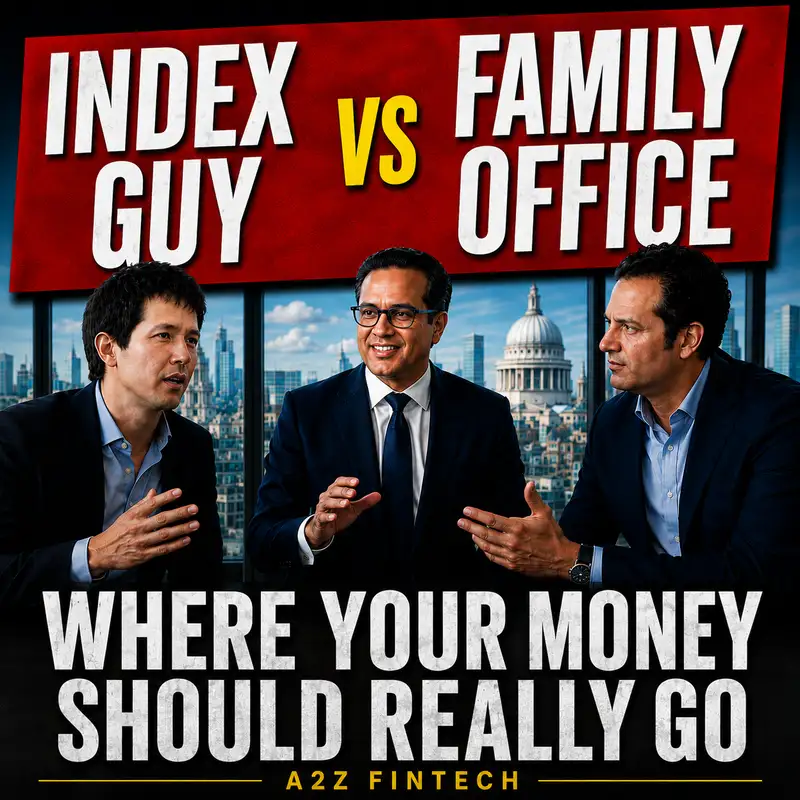
Picture this. It's March
twenty sixteen, and London has,
for once, bothered to show
up bright. One of those rare,
hard, clear afternoons where the
light comes straight off the glass.
On the top floor of an office in the
city, behind a wall of windows nobody
is looking at, a little under a
dozen men are taking their seats.
Dark suits in every available shade
of dark. The only diversity in the
room is the ties, the hairlines,
and two South Asian faces,
which in that room, in that
year, counted as radical.
This is the global distribution
leadership of one of the most storied
names in money management. The men
who face off against private banks,
retail banks, insurers,
and fund platforms.
One of those two South Asian men
is new. He's handed the floor,
and he's genuinely curious,
so he asks a simple question:
"How many of you own ETF index trackers
in your own personal portfolio?"
Every hand in the room goes up,
every single one. So he pushes,
"Keep your hands up if it's more
than twenty percent of your money."
The hands stay up. Forty. Still up.
Sixty percent of your own money sitting
in the cheap passive funds
you do not sell to anyone.
The hands are still up, and
the room has gone quiet.
Across the table, the man who hired
him is giving him a look that says
very clearly, "Enough. You
made your point." So he stops,
but he has never stopped wondering
what that number really was.
That man was me. The firm was Schroders,
two hundred and twenty-two years
old this year. I had been hired for
an almost impossible job to drag
it into the digital age. I lasted
a year, and then I left for Google,
possibly the first person at the firm
ever to make that particular move.
Almost certainly the last.
This is A to Z Fintech. Non-obvious
insights. This is A to Z Fintech.
Word before I bring the guests
in. I'm flying solo this week,
though I'm in very good company,
as you're about to hear.
But Zubin is the one who
normally reads the legal bit.
So today you've got me, and here it
is. This podcast is for information
and entertainment only. Our views
are our own, not those of anyone we
work for, and none of
it is financial advice.
And fair warning, there is more real
investment talk in this one hour
than we usually allow ourselves. So
if you take three former Schroders
men pontificating on a podcast and turn
that into your own actual portfolio,
that's on you, not us.
Stay smart. Now, these two.
I am not going to introduce
my two guests the normal way,
because normal would bury the point.
These two men once sat on the same
floor as me inside the same old house.
Then they walked out of the same
door and turned in exactly opposite
directions. One of them now spends
his days telling ordinary people to
ignore men like the other one. The other
spends his days being very deliberate,
the man you cannot afford to ignore
once your wealth gets large enough.
Tim Phillips, Zal Devitre,
welcome to A to Z.
Thanks for having me.
Thank you so much.
Tim, you have a delightfully
confusing, uh, passport,
right? So British father, mother
from Hong Kong, raised in Hong Kong,
A levels at the Island School in
Hong Kong... Mandarin in Beijing.
What was it? Uh, history at Leeds.
History at Leeds, yeah.
...and then somehow you
wash up in Singapore. Zal,
uh, was sort of amazingly may
even, uh, top that, right?
So, uh, he comes from a Parsi
family, so professional migrants,
uh, unlike amateurs like us. Um, father
who had a storied career at Philip
Morris, which meant that you lived in
departure lounges around the world.
Um, went to school in
Massachusetts, then Georgetown,
then Columbia, and yes, again, here
in Singapore, and we all ended up
working for the same firm
once upon a time. So Tim,
in your words, what is
it that you do nowadays?
I create financial content
for educational purposes,
and I think I really identified a
gap in the market for just measured,
responsible investing content that
really focuses on stuff that is simple.
It's just boring. Investing shouldn't
be something that's really exciting,
but all the content out there right
now tries to tell you that it needs
to be exciting. It needs to be massive
gains. But the slow and steady,
the boring stuff wins. So I wanted
to take that message that I had sort
of learnt over the years in
finance and try and bring that to,
uh, the mass market, because I
think anyone can invest well.
They just need to have the right
mindset, the right approach,
and the consistency to do it.
So you're Chasing Boring on the
internet. You joined Avestar this year.
Who are they, and what made you join?
Avestar is a global multifamily
office headquartered in New York,
and we have offices in
India and Singapore as well.
We cater to ultra-high-net-worth
individuals who typically have complex
multi-jurisdictional lives,
families, money, et cetera.
So we really help them manage their
investments across the spectrum,
while also keeping a keen eye on
their tax and estate planning needs,
their legacy planning, really
the full gamut of their lives.
Awesome. So before we jump into talking
about one of the favourite instruments
of modern times, mutual funds, I wanted
to just do a quick history lesson,
because we love history on the show
almost as much as we love technology,
and I know you do too, Zal.
Eighteen sixty-eight, London.
Philip Rose launches the Foreign
and Colonial Government Trust.
Straight from the prospectus, "To
give the investors of moderate means
the same advantage as the large
capitalists." Nineteen twenty-four,
Boston. The Massachusetts Investor
Trust makes it tradable every day.
The modern mutual fund is
born. Nineteen-seventies,
the pension quietly dies. The risk of
your old age slides off your employer
and onto you. You did not get
a vote. You got a portfolio.
Nineteen seventy-five, New York.
May Day kills fixed commissions.
Chuck Schwab halves his rates,
and the discount broker is born.
Nineteen seventy-six, the next year,
Jack Bogle launches the first index
fund to near universal ridicule.
Two decades almost later,
nineteen ninety-three, State
Street lists SPY, the first ETF.
A fifth of one percent, when
active funds charged up to two.
Today, the most traded security on
Earth. Two thousand and twenty-four,
the punchline. Passive overtakes
active in America for the first time
ever, nearly twenty-one trillion
to eighteen. Over the last decade,
only one in ten active US funds beat
the dumb machine they were built
to embarrass. One in ten. That is the
world the three of us walked into,
and the world we now serve
from three different doors.
We grew up in the mutual funds
industry, or at least many of us did.
Your reaction to this sort of change?
Well, look, Aman, I mean, I think
that the passive wave has really been
irresistible, and I think it's
been irresistible for two reasons.
One is, you know, passive vehicles
and investment products are typically
lower in cost than actively managed
products, and their performance has
been just as good, if not better. So
bottom line, net returns from passive
investing have been for the most part
better than active in many categories.
Of course, there are exceptions.
There are exceptions where active does
outperform, but in many categories
passive has done better,
and the money goes where
the performance is better.
So we on the show talk about five
primitives in financial services,
predominantly in banking. Essentially,
banks do five things for you.
They help you see your money, move
your money, borrow your money,
and protect your money. But
the one thing that they do,
which both of you talk a lot
about, is grow your money.
That's sort of the combination
of hope and greed, right?
Like the other stuff is just
hoping that you don't lose it.
Greed, you guys sort of help people
manage what they want to be and where
they want to go. Tim, somebody comes
to you with a hundred thousand dollars.
It's half their net worth. And they've
been sitting in fixed deposits.
How do you... walk us through how you
would explain they go about getting
off that and getting onto
presumably a different escalator.
Tim: I think first off you kind of
have to establish that every individual
is gonna have a different risk appetite,
a different investing time horizon
as well. So if they are going to be
investing for the next 20 to 30 years,
that should be going into
equities, right, effectively.
But you have to be aware of
people who are in their late 40s,
50s approaching retirement
and sequence of returns risk,
et cetera, et cetera. There
are lots of things to consider.
So I can't just say, "This
is a one-size-fits-all.
Just go out and, like, lump
sum it and buy, you know,
global equities via an
ETF." But for someone young,
that's pretty much what the
data says you should do.
Because if you lump sum it, technically
that beats dollar cost averaging
two-thirds of the time.
How young is young?
Someone in their mid-20s, 30s. I'd
say if you're thinking about your
time horizon, there's never been a
negative 20-year return on a rolling
returns basis for the S&P 500. So
if you're thinking about the worst
periods, yes, 2000 to 2009 it was
negative. In the sort of '80s there
was a negative period. But if you're
thinking about 20-year rolling returns,
never been a negative period
in the history of the S&P 500.
So you can use global
equities as a proxy for that.
It'll be positive. So if
you've got at least 20 years...
there've been dry spells, right?
There have been dry spells.
There've been flash lines.
Yeah, there have been dry spells, but
I think timing the market or trying
to second guess when that dry spell's
gonna be is just a fool's errand,
basically. There's no point
in anyone trying to do that.
But you have to be responsible in
how you approach allocating it when
you're older, because of sequence
returns risk. So I think there are
lots of things to consider. But for
someone young with 20 years ahead
of them, that really should just go
into a global equities low-cost ETF,
and then just leave it.
So, let's take that and let's go to
Zal on this. Just asking for a friend,
you know, somebody who
comes to you saying they're,
you know, got close to 10
mil. They're in their 50s.
They've been massively, maybe not
fixed deposits, they're hugely into
bonds, but they need a little
bit more yield. They've not,
they wanna kind of retire in 10 years'
time. How do you work with them?
Well, what I'd say, Aman, is first
of all, we begin with the first frame
that Tim just talked about. Understand
the client's investment time horizon,
understand their risk tolerance,
what their goals may be,
what their needs for cash in
the next couple years may be.
And once we've done that, we
then go to our second layer,
which is really understanding their
tax and estate planning needs,
as well as where they are now
and how we can optimise that.
So for our strata of clients, that's
a very important analysis to do.
Once we understand really where
tax and estate planning needs are,
we then establish a plan for you,
and only then do we actually place
your assets into the right
structures given that plan.
So when we take that multi-stage
process to investing for our clients,
we really allow their money to
grow well and grow most optimally.
The final step we take is really
choosing the actual instruments that
go into each asset class. And
here we may use some active,
and we may use some passive,
depending on the market.
So, but I mean, if you're in the same
situation, but you don't have 10,
you have a million, you're kinda screwed?
No. Not at all.
How would you...
I mean, they're not gonna
have access to... I mean,
I like to say this a lot when we
talk about ultra-high-net-worth.
I think people in their hundreds of
millions, maybe they have a lot of
tax, as Zal was saying, like cross-border
issues that they have to think
about. Trust businesses, and
cross-border tax liability.
So those are things that I think
you really need to think about.
For 99% of the people who
have maybe, like, even 5 mil,
10 mil, and they have one tax
residency, they don't need to overthink
it and overcomplicate it. I think
this is... this is what we'll get onto
later, but a lot of the
products that are out there,
they use complexity to disguise
high fees. I always like to say this
with investment products: complexity
equals high fees in disguise.
That is what it is. Because
usually there's a story to tell,
there's a narrative to weave, to
tell you, "This is what you need,
and I'm gonna tell you why," and
I'm gonna weave a whole story around
it.
But is that true, is that true at the
bottom of the pyramid and the middle
of the pyramid?
It's true throughout, I'd say. I
mean, if you're an accredited investor
in Singapore, I always say
this, don't announce it.
Don't tell people, don't tell your bank
that you're an accredited investor,
'cause all you're gonna get pitched
to you is worse products than you're
gonna get. Leverage, structured products,
things that are not gonna outperform
a global equities index
tracker over 10, 20 years,
pretty much. And so for me it's always
simplicity equals optimal returns.
But is that true? Like, I'll give you
an example. Right now there's this
trade, they're calling it the Indian
carry trade. You know what I'm talking
about?
That's right.
So, essentially, are
you familiar with this?
No, but tell me the story.
I wanna hear the narrative.
So actually, why don't
you explain what the...
Okay, look, from time to time,
you know, the Indian government,
the Reserve Bank of India, feels that
the country needs foreign exchange,
and there are episodic periods during
which, because they need foreign
exchange, they actually give very
attractive deposit rates to non-resident
Indians. These may be Indians
living abroad, et cetera.
And these are actually not bonds,
these are literally fixed deposits.
Like 6% on the US dollar.
Yeah. It's like the
yen-dollar carry trade, right?
Pretty much. It's just... with Indian
money, and you can lock in your
tenure, and you can actually get
pretty attractive leverage from banks,
because they understand,
look, these are Indian banks,
these are fixed deposits.
Up to nine times, to give you, like,
a 15% yield from what somebody was...
What's the incentive? What's the
incentive from the bank's perspective?
For the bank it's a bit of a foolproof
deal, because it's government
backed. But I'm saying what is the
fee incentive? This is something that
we never talk about from
the consumer perspective.
Actually, in this case, is
there... there is minimal fees.
What the banks, again,
correct me if I'm wrong, and,
like, we're ganging up on you,
like, bank gang. But the...
I mean, they're getting deposits,
right? They're getting tier one capital
into...
But if they're selling you leverage,
really they're getting you something
from that, aren't they?
I think this is a very episodic
case. And I think that every...
this is a case where pretty
much everyone makes money.
And it's a case where the
risk is relatively mitigated.
You can never say there's no risk.
In this case, the banks will make
money on their lending
spread. The clients will make,
if they hold onto this for three
years, a pretty handsome return.
And, you know, the Indian banks
will get foreign exchange.
But this is a pretty unique
scenario you've just painted.
I digress. But let me come back. So
Tim, let me ask you a really direct
question, right, on this
one, which is that, you know,
if in gene sequencing nowadays you
can edit a gene and you can sort of
stop a behaviour, like,
you know, diabetes off...
Not yet there. I'll take
that up when it does.
But if you had to go to the banking
gene and say, "Stop selling that
product," what's the... I'll
come to you on that, Zal,
too, I promise. What's the one
product you would say take it off the
shelves?
Structured products, structured notes.
So I think basically what private
banks hawk a lot of. I've seen a
lot of people lose a lot of money in
structured notes, in structured products.
Sure, there may be niche situations
where it can serve a purpose
for hedging, et cetera,
et cetera. But on the whole, I come
back to the great Charlie Munger
quote, "Show me the incentive, and I
will show you the outcome." In banking,
in the investment industry,
it comes down to that quote.
That's pretty much what it comes
down to. Show me the incentive and I
will show you the outcome.
So things get sold.
Why?
Pricing.
Got it. Fees. That's the one
you would take off. Okay,
Zal?
Look, having spent quite a few years in
the retail banking space in Singapore,
I actually agree very much
with what Tim just said.
The product I'd choose is
a dual currency account,
or premium accounts, as they're often
known. These are essentially accounts
which have options embedded in them,
which then give you enhanced yield,
and you may then get delivered
an alternative currency.
I've watched clients invest in
these sort of across the cycle,
and invariably they lose or
make very, very little money.
So, in some respects, what you're
saying is that actually it gets
overcomplicated, but if
they've got a good advisor,
they can actually... it's a bit
better. But what you're saying is that
your individual investor really doesn't
have anybody who's incentivised.
In your case, at the top end of the
customer, they are actually paying
for advice, and it's a
clearer, cleaner relationship?
No, I think what I was saying, Aman,
is there are some products that,
for the most part, I would
avoid. And in this case,
I actually would almost
invariably, almost all the time,
avoid a dual currency investing.
Once in a while, once in a while,
it may be appropriate, because
you may actually want to take...
but the problem is knowing when that...
Exactly. And the problem is doing
it episodically and stopping.
And that brings... so this brings
me to the next area that I wanna go,
'cause I'm sort of raring to go
there, is that I've worked in retail
banking, private banking,
and then asset management.
And one of the challenges I
have, and is, as you said,
Tim, the incentives. I mean,
they're good people running this.
I was literally in a retail
bank in India recently,
and I was walking out, and the
person literally came to me and said,
"You know, sir, could you buy a mutual
fund? I need to meet my year-end
target." It's like... I'm sticking
with India, but this is true elsewhere.
There is, you know, people
going to elderly parents...
before this call, we had my mom calling
me, telling me that there's this
RM telling her to invest in something
because somebody else is doing
it. How do we fix that?
How do we fix that system?
Because you can't have access to sort
of like Zal until you've made it,
unless you become his friend, which
kind of works out for some of us.
How do you reconcile that?
I think it's education. I think
first off you have to establish that
in Asia the distribution model
is really focused around banks.
Like, they distribute the products, and
it's a very product-centric ecosystem
in Asia, and I think that's
just the history of the market.
Isn't the US the same?
I think the US does a lot more RIAs,
registered investment advisors,
who have fiduciary duty to
give you the best advice,
et cetera, et cetera. And it's not
really driven by commissions and trailer
fees, but I think in Asia the
ecosystem is very much driven by that,
and that's just the way that it's
set up. So I think trying to change
that, and trying to get it through the
regulatory system and the political
capital required to do that, is
just... there's a much bigger question
to ask, right?
'Cause whenever I talk to people
in the industry they said,
"People in Asia don't wanna pay for
advice." That's something you hear
again and again. So like,
lie to me about the fees,
but don't tell me that
you're charging it to me.
But, thinking it from a government
perspective, how are you going to
transition from a commission
trailer-driven model to fee only,
and have a lot of people still employed?
It's a very difficult transition.
So I think that's a really
difficult question to ask.
So I think for consumers, the best
you can do is really educate yourself
on the options, which is part
of what I'm trying to do,
is just say, if you wanna go to the
bank and see an ILP in front of you,
or whatever products in
front of you, that's fine.
They give you their pitch, but I wanna
give you the pitch of the low-cost
pitch, the investing pitch for ETFs,
because no one talks about that
stuff, because it doesn't make any
money. If, unless you're an iShares,
a Vanguard, a Spider, a State Street,
you're the ones who can make it,
because you have 10 trillion AUM
and you're earning 10 basis points.
Everyone else, they don't
make money from that system.
So I think for me it's more about
education. Be aware of the choices
that are out there. Look at
the data, look at the history.
I'm a history guy, but I'm
a data-driven guy as well.
I want to understand the
data behind the performance.
I don't wanna hear the story. I
wanna understand what the data tells
me. You're telling me, "This is a
great story," but what does the data
show me? Net of fees, what
am I getting back, right?
So, is... I mean, we've worked in
the industry, are mutual funds like
a no-no for all of you? Neither of
you said mutual funds when you talked
about a product you would take off
the shelves, but you're sounding like
it. Would you take a mutual fund off
the shelf, or is there a situation
where mutual funds make
total sense? What are they,
Zal?
In my view, in my company's
view, and in my experience,
markets that are very efficient, look
at the US large cap equity space,
for instance, it's very difficult for
active managers to outperform market
beta, market ETFs, because they're
very low cost, and it's just very
difficult.
And with super tight, well,
for the moment, governance,
so no edge.
No edge. Now, there are markets,
whether they be geographic markets where
investing may not be as efficient,
where there may still be edge for
active management. I'll
think of an India, a China.
Indonesia on a good day.
So typically we look at markets like
that, or we may look at some very
esoteric investment kind of strategies
and asset classes where active
also does make sense. But I agree
with Tim, and frankly we embrace this
philosophy ourselves, that for
super efficient asset classes,
we actually use ETFs and market
beta, because that's the most optimal
way for our clients to
access that asset class.
'Cause I found it really interesting
in my one-year cameo at Schroders
to realise that actually most mutual
funds comprise of a large number
of ETFs. It was sort of like
a mixologist with your ETFs,
and as we said at the top of the
show, not only are they sort of mixing
the drinks with it, they're
chugging it, in many places.
Zal, talk to me about private banking.
You were in the wealth and private
banking space prior to Schroders,
with a fairly storied brand.
How is private banking any
different from a retail RM?
Are they just a better paid retail RM
who serves you truffle oil to virtue
signal instead of, like, taking you
for a burger, and gets you tickets
to the F1 race?
Yeah, I mean, but again, going
back to that lie-to-me thing...
okay, so jokes aside, let's step
back and take a big picture.
I think if you look at the private
banking model, it has been under pressure
and ongoing pressure. Margins are
being squeezed. The proposition that
private banks could get access to
very rarefied and exclusive product
is no longer really the case, because
there really is democratisation
of access to even specialised private
assets. The cost to serve that
private banks have as well
are very high, you know?
So if you add all that up,
the model is under pressure.
Having said that, there are plenty of
clients who actually still do benefit
from private banks. However, I think
that those that benefit again have
to have specific needs that are
being met. Needs, for instance,
in the tax planning and structuring
space, or even frankly needs to just
control their worst
impulses and instincts.
And their children?
Which would then benefit their
children, because the money can last a
long time.
Yeah, I find that sort of the best
private bankers seem to sort of be
like counsellors to the family. You
know, when you think about the Swiss
names, they've been there
for as long as the kids have.
Absolutely. I would say it's
very relationship driven.
I think I've spoken to a lot of
wealth managers who say that actually
the investment performance, returns
rather, are actually not that important,
because I think once you get
to like 100, 200 million,
you're in a wealth preservation
sort of mindset typically,
unless you're really shooting for
the stars, which you probably aren't.
But if you've got 100,000 or a million,
you're still gonna be accumulating
wealth. So I think the mindset
definitely does shift the further you
go up the spectrum. I mean,
if you're worth 100 million,
you could put it into T-bills
and live perfectly happily.
You don't need to take on risk. So
I think that's the key distinction.
So, a lot of people who leave
and then become family office,
run family office or multifamily
offices, you kind of did a little bit
of that as well, right, and
then you joined a larger one.
Can you talk a little bit
about the flip side of that,
which is sort of like the private
banker of one, and why that makes,
or doesn't make, sense?
Sure. First of all, I think you do
see a general direction of travel
of many people who may have previously
been in the private banking industry,
having moved on to either being,
working at multifamily offices or RIAs,
or as external asset managers. And
usually what you do see is these new
models embrace a few characteristics
that are differentiated from private
banks. Typically more transparency
in terms of a fee structure.
Typically more alignment with the
client in terms of how money is charged
and how client assets are managed.
So, are you talking about the mid
ones, or are you talking about the
private bankers who leave
and start their own shop?
What I personally experienced was
that trying to do a one-man show was
a bit tough, because you do need
the resources of a firm behind you.
You need custody, you need due
diligence, you need brokerage.
A lot of things that are just
difficult to do on your own,
despite the fact that in this
modern day and age you can.
You need the sausage-making machine.
Much more helpful to have that within.
You can offer all the
transparency with no machine,
and then there's no sausage.
So my experience, go to a smaller
firm that's still very client-focused,
entrepreneurial in spirit,
but aligned with clients,
is where I've landed
now, and where I'm happy.
Okay. Tim, the industry that you're
in is right now going through,
it's breaking through, right? You
just have to go to your YouTube site,
and anybody who's in the podcasting
business would be green with envy,
hypothetically. But you're doing,
you know, it's going great.
Congratulations on that. There's
some people who are massive in this
space and are starting to
get called out on sort of,
calling their own book, giving
advice that is not necessarily,
you know, good, and at scale, and
unregulated. Is this sort of financial
advisor on tap on the internet
the next vice, if you like?
Are you gonna become the... in 10
years' time, are people gonna look
at your cohort and say, "Christ,
these guys are as bad as the bankers"?
I hope not, but I think, just like
any tool, I think it needs to be used
responsibly. You need to really take
it at face value and then go and
do your own research. So even if
an advisor tells you something,
you also need to go and educate
yourself on the matter before you invest
anything. You really need to understand
what you're putting your money
into, right? So I think, me
personally, I am trying to be a reason,
a voice of reason out there. Something
that is really just talking about
simplicity equals compounding,
and it's boring. Because I think,
coming from the investment industry,
all three of us probably agree,
there are lots of people who talk
about, "You need to know this company's
got this amount of operating cash
flow, and it's trading at a 12-time
valuation." But I keep saying
to people, in my industry,
99% of people out there don't
care about free cash flow,
they don't care about operating cash
flow, they just wanna make money.
They want to grow their wealth. And
the best, most reliable way to grow
wealth is in low-cost ETFs. That
is just what the data tells you,
'cause 90% of the large cap...
I think you've said that already.
Yeah, 90%. And I'm gonna
keep banging on about it.
Let's bang on about it.
No, I'm... 'cause you keep
challenging me, so let's get into it.
Just for the record, I'm a
faithful customer of IBKR.
You own ETFs. They're not sponsoring
this show. I don't think...
yeah, I own some stocks,
but most of them are ETFs.
No, I mean, I'm just... I wanna go
out there and just get that message
out there to people, as many people
as I can. And also because financial
influencers in the US, it's all
very US-centric. It's all Roth IRAs,
401ks, and invest in VOO.
No, do not invest in VOO.
If you're not American, do
not put your money into that.
This is because you don't like
anything that doesn't have UCITS before
it?
If it doesn't have UCITS before it,
no, it does not deserve to belong
in your portfolio if you're not
American. If you're American,
go for it. Go out all out on VOO.
So what do you do if you don't buy VOO?
You're buying UCITS European regulated
ETFs, which give you a much more
tax efficient structure to invest,
and I don't care whether you're from
Singapore...
Well, they give you
the same access as VOO?
They give you the same access.
All the underlying is the same.
It's just structured...
What, like VWRA, or...?
VWRA, you know, or CSPX, SPYL. It's
all structured tax efficiently.
So whether you're from Singapore,
whether you're from China,
whether you're from the UK...
See, and this is the challenge, right?
This is the challenge, this
is what you need to invest in.
The world needs more people to...
I'm glad to have you talking about
this stuff. Because actually,
you know, my retail banking
RM never talked about it.
When I moonlighted with a private
banking RM, they didn't talk about
it, they talked about the
truffle oil and the F1.
Incentive.
Well, show me the incentive. That's
why I keep coming back to you.
This is why... or just get
good friends, right? Aman:
Let's talk a little bit about
money, wealth, and advice,
good and bad. Zal, what is rich? I'll...
it's... this sounds like a statement,
it's a question. I was sitting down
yesterday prepping for the show with
a friend of mine, ex-Googler, went
to a big name in Southeast Asia.
They IPO'd, and, you know, on paper
they were doing incredibly well,
and they've sort of gone
south. He defined this to me.
He said there are three kinds of
wealth, I'm gonna read this out.
There's life-changing wealth, or
what is popularly known as FU money.
That applies to you, as in it frees
you up to do whatever you want to.
I can fly business class,
go to the Michelin Star,
whatever I want to do. There
is generational wealth,
which is like I can do that and my kid
can become a ballerina or something
else, whatever, not that
ballerinas don't make money,
but last I checked, or
fashion designers in my case.
And then there's the third, which
is like society-changing money,
which is sort of stuff that
Gates or Peter Thiel has,
and you could argue and
debate on how they use that,
right. Is that the three definitions
for you? How would you define rich?
Well, I think I know what you may
be alluding to, the other day on the
All In podcast, they were sort
of discussing the same lens.
I may have heard it there as well.
Let me say a couple things. I
think that the ability to say,
"Look, for the rest of my life,
this is the lifestyle my family,
I'd like my family to live with,
and I want to have enough financial
resources to make sure that lifestyle
is covered." I think that's a terrific
goal, and many clients who are
engaged would say this to us.
And certainly, I enjoy working in
this industry, because I can say to
clients, "Look, this is what you
have to do to achieve that goal.
This is what you have to do to maybe
save enough and protect enough for
your kids to be able to
have that flexibility." Now,
that amount will differ greatly if
you're in Singapore or Sierra Leone,
and whether you are paying US
taxes on capital gains or not.
So for each woman or man, that
amount is gonna be a different level,
and at different stages in their
life will have different needs.
But I think the important thing is
to go in with your eyes wide open,
and to be able to say, "This
is what I want to achieve.
This is how much money I'd like
to have, given my lifestyle needs,
or given my legacy plans,
and therefore I have to do X,
Y, and Z to try to hit that goal."
See, this sounds like a very
sensible answer. I got 10 bucks,
100 bucks, and a billion,
were the three thresholds.
But that's a hard and fast rule, and
I'm presuming this is not the market
segmentation strategy at Avestar?
I think that'd be a good bet.
Tim, if we look at money
from the other angle of it,
in the world the Gini coefficient
seems to be expanding,
it's becoming harder to make ends
meet. As you study the mass end of
the market, what's the point
at which people feel...
I was half joking with Zal about
this as sort of like the high water
mark, but where do we go from
where you're like, "Okay,
I'm financially all right"? Where
do they start feeling comfortable?
What are the sort of benchmarks that
you wanna make sure that you are
hitting, or are working towards?
I think for Singapore, a lot of people
in their 20s now talk about having
100,000 by 30, right,
and certain benchmarks.
Is this the FIRE community?
No, I think just generally when you're
young, because you start out and
you don't earn much money,
and by the time you're 30...
but even talking about having
a million by retirement,
and that's not people just saying,
"Can I retire with that?" And so I
think there's a lot of maybe worry
about the cost of living in Singapore
and housing, and just pricing generally.
But I think for a lot of people
what gets overlooked, maybe
in the Singapore context,
is CPF Life, which I've done
a video on this previously.
If you have CPF Life up to
the enhanced retirement sum,
which is something like 450,000
or 400-odd thousand dollars,
it pays you a set income for life
from 65, at like 3,400 a month.
And to meet a comfortable or
aspirational tier of retirement,
where you're talking maybe 5,000
per month or 8,000 plus per month,
you only have to invest maybe 2, 300...
But I want to just press there for a
second, and also widen the aperture.
Singapore is super interesting,
we're here. I've heard this term CPF
millionaires, where you start off
early enough, you can in fact start
investing for your kids and then you
can set them up to be a CPF millionaire.
Is that a thing, or was I half asleep
in my TikTok stream and imagined
it?
I think there's a lot of takes
on how you should allocate,
I think, when you're in your
20s and 30s, into CPF and cash,
and even SRS, you know, it doesn't
make sense at a certain point,
with SRS, like a supplementary
retirement scheme. But I think if you're
looking at the CPF and you're
looking at the special account at 4%,
and you've got a 30-year runway
in your 20s to invest cash,
right, should you be topping up
your CPF special account at 4%?
What's the opportunity cost of 30
years of that delta between 4 and sort
of the average of 8% of global equities,
nominal. That's gonna be a lot.
So it really makes sense
on when you're topping up,
and maybe it makes sense when you've
got, you're in a higher tax bracket,
you've got more incentive to top up
that 8,000 or whatever it is to your
special account, and then you
can top it up to higher amounts.
So I think it's more about allocating
properly and responsibly your asset
allocation in your 20s and 30s as
you scale your income into your 30s
and 40s.
But, we'll take every
Singaporean viewer we've got,
but internationally, when
your country doesn't help you,
if you don't have a retirement, when
you're a kid in India or China...
A kid in India? Then go and try and
put away $100 a month into a UCITS
ETF, into a low-cost ETF.
I thought you'd say that.
The product set, again, as
I said, it's very basic.
You don't need to be worth
10 billion to do well.
Do I need to tell you again? No, but
we'll ask you again in about five
minutes' time.
I'm gonna drive it into you
every chance I get, man.
Amazing. Let's talk a little bit
about, again, just sticking with the
two ends of the spectrum, what are
two or three common mistakes that
you see people make at the top end
of the pyramid in terms of investing
mistakes? You talked about a really
non-obvious one I thought was interesting,
about risk appetite.
I'd say three, Aman. The first
two are on risk appetite,
and on people being on either
extreme of that spectrum.
So the first is, "I've made my
money, I just wanna protect it,
let's be very conservative." And
sometimes my returns may not even keep
up with inflation. So that's
a big mistake in my mind,
right, because although
that's a natural instinct,
you're really hindering the growth
of your money, especially if there's
an inflationary environment
in which you're existing.
And some people have that
outlook. Others say, "Look,
I wanna take a lot of risk.
I made a lot of money.
Let's take risks. Let's buy SpaceX.
Let's put a lot of money into this
venture that my friend is doing
in Papua New Guinea," et cetera.
So I think going too far out on
either side can be a mistake.
I think a measured approach where you
understand your risk-adjusted return
and your needs, et cetera,
are very important. The third,
I would say, is when you get
up into that wealth spectrum,
you do wanna worry about how you're
planning your taxes and your estate,
because that can take a massive
chunk out of your wealth.
And that's why you need you guys.
We'd like to think so, yes.
How about you? For the people who don't
have, who have your YouTube account,
and a couple of hundred thousand dollars?
I heard a really great quote from
Morgan Housel a few weeks ago on a
podcast. The one thing that's gonna
make sure that you build wealth is
not having FOMO, is the first one,
because that is going to destroy a
lot of capital throughout
your life if you have it.
Second is this need to do
something when markets are down,
or when people are shouting,
when you're seeing headlines.
I've learnt through 20-odd years of
investing, doing nothing typically
leads to a lot better results.
Staying put, staying invested,
not churning. People churn way too
much, go through too much garbage,
churn into the next product,
recycle into whatever,
and then again, show me the
incentive, I'll show you the outcome.
So wait, why do they churn? So
hang on, I want to say this,
you both said the same thing
with one thing different.
You both talked about fear
and greed, FOMO and greed.
Yeah, because everyone's
the same. They're human.
But the thing that you're saying
is get advice, look at incentive.
It doesn't matter whether they're
worth 100 million or 100,000.
People have the same emotions,
and it's very emotionally driven.
I'm just... actually, that
you're 100% right on that,
but I think that's the difference,
what I'm seeing is that,
you know, actually with your...
Again, I'm gonna put words in your
mouth, and you can disagree with me.
You're saying it's very unlikely
you're gonna get good advice at your
level, so...
No, not at that level. I never said that.
So where do you get good advice?
You go out and learn it.
Because anyone can do it well.
There's this perception because the
finance industry puts it out there
that you can only invest well if you
have some inside knowledge or you
have someone with access, and
that's the biggest lie out there.
It's a lie. It's not true,
because you can do well.
But again, selling ETFs,
I'm gonna keep saying it,
it's not profitable. And it's
just not. It's just a fact.
It's the data. So I'm just telling
you out there, that's how I've come
to realise, and I want that message
to get out there to more people...
you can do well, you just
have to control your emotions.
You have to keep it simple.
You have to be consistent.
You have to be disciplined. Do
all those things, you'll beat 95,
99% of people out there.
So, staying with this fear and greed
theme, let's shift gears and talk
a little bit about the age of AI
and everything that comes with it.
I think last week... something,
I forget which day it was.
It was four days ago, last Friday,
right? Something incredible happened,
right? A company IPO'd, went
straight to $2 trillion,
created SpaceX, they created
the first trillionaire,
in Elon Musk, who himself said that
if you had told him that would be
the outcome, he'd tell you that
you were smoking something.
That's his words, not mine. And he
can say it, and we can imagine him
doing that. He's got
society-changing money now, right?
But this is a company that
has got, if you believe it,
you've got all the biggest brands and
leaders in financial services talking
about it. It's a $28 trillion
opportunity if you believe everything,
but it's also a company that
makes $5 billion in loss,
right? Is this the classic example?
What do you tell your customers when
they're saying that FOMO's
kicking in, saying, "Hey,
my mate got in early." Do you
get them... what's the answer?
Get them early into SpaceX?
Don't get into SpaceX right now?
What's...
Okay, so you've just asked a
couple of different questions,
and I'll try to answer them.
Could you just wrap up the whole
economic future and investing and do
that in like two minutes?
Just kidding, I'm sorry.
We do our best to get access to
our clients to interesting private
opportunities. And that's something
we try to do. You can't always tell
whether those opportunities
are gonna pan out or not,
or whether you get the allocation.
I'm not at liberty to say whether
we're actually active in the SpaceX
deal itself, but we've been active
of late.
Were you in Texas last Friday?
No, sorry.
What do you say to someone if they
say, "Hey, SpaceX is a great deal
at $2 trillion"?
I don't know, and I think
we'll find out in the future.
Now, one reality is that SpaceX and
all these large companies will be
part of indices, and we will get
access to them when we invest in our
ETFs, et cetera. So from a certain
perspective, you don't need to chase
the individual name, because it will
in all likelihood be part of a global
index, a US index, et cetera, and you'll
get exposure to it as an investor.
So what you're saying is my VOO that
he hates has SpaceX in it already,
or will do soon?
It will at some point.
And the UCITS do too?
Yeah.
But what's your take on it when, like...
I agree with Zal, the
get-rich-quick kind of idea,
when people come to you with
that... well, it's rubbish,
isn't it? I mean, get-rich-quick thing,
that's not the way that you should
be thinking about growing wealth, right?
But Zal's right in terms of...
But the crypto bros will tell
you that... these crypto bros,
they just put their money in Bitcoin,
and then it seems like they're
geniuses. I don't know, I just
don't find that so compelling.
I don't think they've done anything
super smart. They've just managed
to put their money into a coin
that's done well. Good for them,
but don't try and make it out as
though you've done something really
special, you know? So, I mean, I
think personally I agree with Zal in
terms of, you're gonna get exposure
to it anyway in an ETF at some point.
I've done a video on this recently,
actually. I think sort of like 10,
15 days off the bat you're gonna
be only exposed about 0.05,
0.6%, 0.06%. So less than 0.1%
in a global sort of tracker,
like VWRA. And S&P won't allow it
to go into the index until the end
of 2027, or, sorry, the
earliest in June 2027.
But for investors, the private placement
and... what I love about public
markets is you are on the same
playing field, whether you're Temasek
or just a guy who earns $3,000 a
month, because you are buying the exact
same underlying. What I don't
like about private assets,
'cause I see private assets being
hawked a lot, is that there's gonna
be preferential access. They
might get an allocation,
you might not get an allocation.
So this is a beautiful segue to
the next question I had for you.
That's changing, right? Tokenisation,
miniaturisation is coming.
You could buy access to the Carlyle
Group now. Once upon a time,
the reason I told you the story about
mutual funds is that mutual funds
had a very exclusionary
criteria of $200,000 and more.
Then came ETFs and took the floor
out of that. That's happening in your
field, the field you play in.
So two questions to both of you,
I'd love to get your views on
tokenisation. Does that excite you?
Does that say that's more instruments
that can give people access?
And then does that worry
you, because you're like,
"Oh my God," the one bastion that
we had is sort of getting blown out?
I personally, it scares me. If
you're talking about a liquid vehicle
backed by illiquid assets, I couldn't
think of a worse recipe in terms
of an investment proposal
for the average investor.
So in that perspective, it's something
I wouldn't touch with a 10-foot
pole. That's my, me personally. So
I think it depends on what people
would like to...
But Zal, doesn't it, going back to your
question, is it about risk appetite?
If you've got $10,000 of spare cash
versus $10 million of spare cash,
does that change things? Sorry, I
just asked you a second question,
but you might wanna answer
the first one first.
Very quickly, answer the first question:
do I like the idea of democratisation
of private assets, that the little
guy can get access to something that
heretofore only the big guy
could get access to? Absolutely,
I like that idea. Now, are you gonna
execute that in a way that's fair
and transparent? That's another question.
Tim just pointed out this mismatch
sometimes between liquidity
reality and liquidity expectations.
We saw that recently in the private
credit space. People thought these
semi-liquid funds were essentially
pretty liquid. They didn't focus on
the semi part of that phrase,
and they realised that,
"Oh my gosh, there are gates." So this
was an example of maybe mis-selling
or mismatched expectations. But I
like the idea of democratisation of
private assets in general,
if it's done properly.
So I did an exercise recently,
and I wrote about it,
I took my... I have most of
my stock on IBKR. So I put it,
I gave it to Claude, and I said...
I also give it my blood work,
different story... but I'm
all in on AI, as you can see.
But I gave it to them, and
it came back with a really,
actually quite an intelligent view
of my... not entirely correct,
but, you know, almost 90%
accurate. And it gave me...
so there are people who are today
going and just swearing by that.
That worries me. But for me, in that
situation, it gave me a bunch of
questions to ask my financial
advisor, whoever that is,
whether it's talking to you guys,
talking to the actual people who are
paid to sort of do that. Are we heading
to a situation where people come
in like annoying doctors and have
self-diagnosed themselves a little
bit? That in this case could be a
good thing. Let's start with you,
Tim, and then how that works for the...
Yeah, I mean, I think it's a great
tool. Again, it's how you use AI,
right? I mean, I think there are so
many cases where people just outsource
their brains to it. Whether it's
investing, whether it's self-diagnosing,
whether it's how to write something
and then just sending out...
I've seen emails where it's, you've
got the next prompt in the email,
and you're like, "Geez, come on,
could you not at least have proofread
that email before you sent it?"
But, you know, that kind of example,
it's just almost... AI's making
people lazy, I have to say.
So it's almost like, don't outsource
your brain, and proof-check things.
Make sure you double-check the
data, make sure it's correct.
And I think if you do that, it's
a great tool to save you time,
and it can help explain concepts
from the investment perspective in a
much more easy-to-understand,
digestible format. So I would say,
yeah, it's great, but when it
comes to your asset allocation,
your goals, all these other things
that it needs to take into account,
I think there is still a value-add
to a human element and a relationship
there.
Totally agree.
Which one? With Tim? We are gonna
be... either you're getting tired,
or you're getting honest.
I don't know which one it is. We're
gonna be using AI more and more,
whether that be companies using
AI to become more efficient,
individual end consumers, or consuming
companies using AI to optimise
and understand their product set, and
therefore be able to ask more intelligent
questions. Those are realities that
are sweeping across all industries,
and I don't think financial services
are going to be any different or
exempt from that. So that's a
reality that we're dealing with.
And I think that AI, it's gonna be...
intelligent firms and firms that
are farsighted are gonna harness it
effectively, but continue to build
on what humans can do
that machines cannot.
I believe it. I think that's a whole
other topic for us to come back
on. Listen, I wanted to do
something a little bit fun,
as we come to the wrap on this thing.
I want to play a quick game with
you, it's a sort of first for
us, a rapid fire question.
You guys have given... we kept it
pretty tight. But here is where I need
monosyllabic answers, and not
grunts. So I'm gonna ask you,
like, 10 questions, and I'd love
to get your quick takes on them.
You can go in... how do we wanna
do this? We could go in any order,
right? Fastest finger first.
Go in any order. One word,
is now a good time to buy?
Always.
Yes.
Buffett or Jim Simons, Renaissance?
Buffett 50 years ago, Simons today.
Buffett.
And in terms of Buffett or Ackman?
Buffett.
Buffett.
Would love to have a follow-up
question, but I'll break my own rule.
The best piece of investing
wisdom ever written, Zal?
Start investing early.
Stay invested.
Gold, ancient relic, or honest money, Tim?
Honest money.
Honest money.
Bitcoin in a serious
portfolio, yes or no, Zal?
Is your question, is Bitcoin...
I'll read the question again.
Bitcoin in a serious portfolio?
Can be.
Can be, again, sizing. If
it's 100%, no. If it's 0.5%,
yes.
Ooh, you're softening up, too.
Yeah, I know. At the end of this,
he'll sell a mutual fund. Never,
never. Schroders growth fund.
You wanna add something right now, Tim?
The most overrated word in investing,
Tim?
Alpha.
I wonder how many people in asset
management have their dogs called Alpha.
Zal?
Risk-adjusted return.
Renting versus owning your home?
Owning, because it's gonna
give you peace of mind.
I'd say owning, but not
property as an investment.
The one asset, Tim, you would hold
for 100 years and never look back?
Equities.
Okay. And I think I know the answer
to this, but wait for the dip,
yes or no, Zal?
No, just buy today if
you're a long-term investor.
Agree. No, buy today.
On that note of dollar cost
averaging your way to the future,
I wanna thank both of you. This has
been, I think you've been more brave
than I imagined. I really appreciate
the candour, I appreciate the flex
on timing and sort of
making this all work.
It's great being here.
Yeah, thank you for having,
thank you for having us.
This is A to Z Fintech.
One more thought, a day after
this conversation took place,
and having had time to reflect on it.
I started with a room full of hands
that would not go down. Men who
sold the world one thing and quietly
bought themselves another. I have
spent 10 years wondering what that
really meant, and I think
it is this: for 200 years,
money had a home, a country, a
currency, a name on the door,
a vault in a city you could walk
to. The whole business the three of
us grew up in was built on the idea
that your wealth lived somewhere,
and you went to it. That money
is dead. We watched it die.
Now money moves like the
three of us in this room.
Born in one place, raised in
another, loyal to nowhere,
fluent everywhere, carrying a
passport that is really just a login.
Money has become a third
culture kid. No fixed address.
And that is why grow is the
hard one. See, move, borrow,
and protect are things you do to your
money. Grow is the one thing that
money does to you, and you do not
reach the end of your life of growing
wealth and find a number. You find
out who you were willing to become
to get it. The index will not tell
you that. Neither will the family
office. That part you grow yourself.