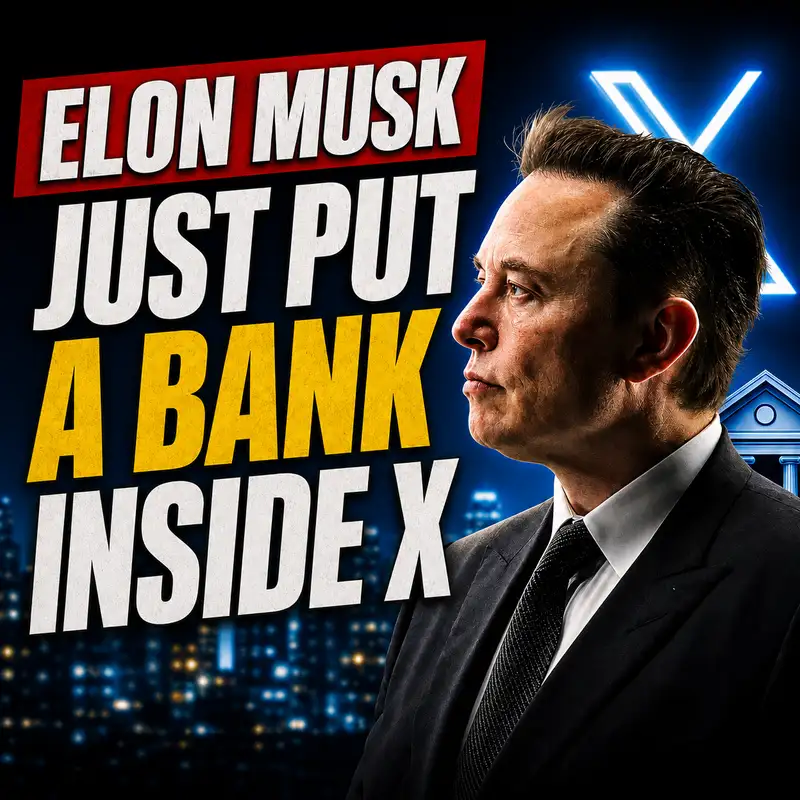
Zubin, X Money is live. Six percent on
your cash, three percent on your spending.
Elon Musk has just put
a bank account inside X.
One catch though, Aman. You
pay X before X pays you.
Premium is about eight dollars a month.
The yield needs real money sitting there.
Park roughly sixteen hundred dollars,
and the interest roughly covers the fees.
Below that, you're
subsidising the subscription.
So Aman, what is it?
A bank account,
or one of the most aggressive retention
strategies in fintech history?
Kind of both. And here's the thing.
The six percent is not the most important
part of the story. Stay with us for that.
It's the next ten minutes or so.
I want to push you on that six. Banks pay
you less than they earn on your deposit.
That is the whole model.
X is paying you more, and the Fed's
benchmark is nowhere near six.
So who's eating the difference?
Follow the sixteen hundred dollar account.
Six percent is about
ninety six dollars a year.
The premium, ninety six dollars a year.
Illustrative numbers, not X's
marketing, but you can see the design.
The yield exists to
neutralise the subscription.
There's also that three percent
cash back on your debit card.
Interchange is thin, and for large
banks it's capped by regulation.
Three percent back cannot be funded
from interchange alone, as you know.
So what you're basically saying is these
accounts are losing money on purpose.
The account is marketing.
Someone at X, or its partners, is
paying above market to acquire you.
Apple did it with savings.
Every neobank did it.
And the teaser rates
share one characteristic.
They end.
They end. Which means if you are here for
six percent, you are not the customer.
You are the campaign.
So what actually launched this week
of the twenty sixth of July? X Money.
United States only, invite only,
paying premium subscribers only.
So it's a deposit account,
an X branded Visa debit card that
drops straight into your Apple Pay,
instant transfers to any other X
Money users, free ATM deposits,
no foreign transaction fees, direct
deposits from your salary, bill payments,
even posted cheques.
What's interesting though is that what you
do not get matters more. So, no crypto.
After years of Dogecoin theatre,
not a single coin at launch.
And X is not a bank.
Your money actually sits with
Cross River Bank in New Jersey,
an FDIC insured institution that
rents its licence to fintechs,
with Visa running the
cards and transfer rails.
And Aman, if this feels familiar, it's
because Jack Dorsey, from Block, or Square,
depending on how you recognise him,
runs this exact blueprint for Cash App.
Rents a partner bank for the FDIC
umbrella, Sutton Bank in their case.
Drops a card straight into Apple Pay.
Uses peer to peer handles
to kill acquisition costs.
And then throws out the zero fee
teasers to win direct deposits.
I just figured out what Jack Dorsey
and Elon Musk share in common.
They tinker around with the
names of their companies.
But right down to the plumbing, here
is where Elon Musk flips the script.
Dorsey built Cash App bottom up for
everyone. Free, viral, heavy on crypto.
Musk is building top down behind an
eight dollar paywall, zero crypto,
and locking your bank account
inside your social feed.
So Cash App gives you the wallet. X
Money is holding your handle hostage.
And holding it in forty one states.
X Payments holds money transfer
licences in forty one states.
Not New York, not Massachusetts, yet.
Hold that name, Cross
River. It comes back.
And hold the login, because the scariest
question in this product is not the rate.
It is who controls the door to your
money when the app is also the bank.
So then why lose money on deposits at all?
Retention, and the everything app.
Musk has said for years he
wants X to work like WeChat.
Messages, commerce and
money all in one place.
Financial products are the strongest
retention feature ever invented.
Nobody casually deletes the
app their salary lands in.
So the thesis is this. X is not
entering banking to become a bank.
It's using banking to make
X impossible to leave.
That is our strategic read, to be
clear, Zubin, not a company statement.
But watch the incentives.
Every feature announced so far strengthens
the subscription, not the deposit.
Six percent buys the habit.
The habit buys the graph.
We're about halfway through.
Everything so far is the offer.
What comes next is the reason.
Three arguments that work,
three ways it breaks,
and the one question about your
login that nobody at X has answered.
Exactly. Let's start with why it
works. Reason one is distribution.
Neobanks spend hundreds of dollars in
marketing to win a single funded account.
X starts with hundreds of
millions of installed users,
and every premium subscriber
already has a payment card on file.
Acquisition cost near zero.
I would make a counterpoint.
Installed is not addressable.
On day one, it all sits behind a paywall.
Your market is not everyone on X.
It is whoever actually pays for premium,
and X doesn't publish that number.
Fair, Zubin. And it lands in the
bear case. But the gates open.
Make receiving money free and
sending it a premium feature,
and the network starts working for you.
Reason number two, and this is why
six percent is not the headline.
To open X Money, you pass a
full bank grade identity check.
Real name, real documents,
real funding sources.
Inside a network famous
for anonymity and bots,
X is quietly assembling
a verified human graph,
with spending behaviour glued
to your social behaviour.
Which is the closed loop every
advertiser has wanted for thirty years.
See the ad, buy the thing,
same verified identity.
And the by-product may be worth
more than the bank itself.
Let me take this one.
Reason three, and this is the one that
surprised us as we were researching this.
They learned from the corpses.
Meta's Libra tried to invent a
currency, and Washington executed it.
Google's Plex built a bank account.
We were somewhat involved
in that, with Google Pay.
We know that well. We've
got the battle scars.
Exactly. And honestly, Google lost
its nerve before it even launched.
Agreed. And X did the opposite of both.
Rented a licensed bank, used Visa's
rails, spent years filing state licences,
and then shipped with zero crypto.
So the most provocative man in tech has
released the most conservative product in
fintech, which tells you that
someone else is holding the pen here.
Reporting points to a payments
operator, Dhruv Bhatura, I'm not sure,
running X Money day to day.
Gets me chana bhatura hungry.
I'm always hungry for payments.
You are always hungry for payments,
Zubin. This is not a meme launch.
This is a licensed launch, in my opinion.
And if you want these non-obvious
reads before the wire hits, subscribe.
We called PayPal months early. The archive
is the product. All right, other side.
The human version first.
Would you tell your mother to move her
savings into an app run by the most
argumentative man on the
internet, maybe in our lifetime?
That is the sentiment. So let
us anchor it in structure.
Risk number one is the plumbing.
And here is the Cross River payoff.
Between you and the bank
sits a fintech ledger.
And Aman, let's talk a
little about history.
When the middleware firm Synapse
collapsed in twenty twenty four,
thousands of Americans found
their money frozen for months,
because FDIC insurance
protects you when a bank fails,
not when a fintech's record keeping fails.
And Cross River itself has two FDIC
enforcement actions, 2018 and 2023,
both cited in Senator Warren's
letter to Musk this April.
That is her letter, not our opinion.
Exactly. And so, risk two.
You touched on it. Forty one.
Massachusetts and New
York sit outside of these.
These are the two hardest
financial regulators in America,
and they are still reviewing.
If either of those says no,
the headline reprices trust
in all those forty one yeses.
I agree. Risk three is one
I'm calling the frozen wallet.
This one is scenario, not a filed report,
so let us split fact from open question.
Fact. X suspends accounts every
day, sometimes over speech.
Fact. Your X Money account lives inside
the X app. The login is the platform.
So, open question,
because we have not seen the full
account agreement answer this clearly.
If your social account is suspended, what
happens to your access to your money?
And Aman, going back to your
mom, let's make this a person.
She's banned over a
post, fairly or unfairly.
I'm sure your mom doesn't
make any controversial posts.
Her balance is legally
safe at Cross River,
and practically unreachable behind a locked
login, on a Tuesday that rent is due.
And her complaints go
to X customer support.
And while my mom thinks tweeting is
something that happens in her garden,
the first time that happens
to a sympathetic customer,
X Money stops being a fintech
story and becomes a political one.
Both sides will hate it,
for opposite reasons.
No bank in history has tied its
trustworthiness this tightly
to one man's timeline.
And Aman, as we were prepping for
this, it's worth taking maybe thirty,
forty seconds of history, because
now it actually means something.
In nineteen ninety nine, Musk poured
his entire fortune into X.com.
One login for your entire financial life.
It merges with Peter Thiel's PayPal.
And then September 2000 comes
along, and we talked about this.
Musk is on a plane to his honeymoon when
the board removes him as chief executive.
Partly over technology, but partly because
he insisted the whole thing be called X.
Then fast forward, eBay buys
PayPal for a billion and a half.
Musk walks away with a cool one hundred
and seventy five million dollars.
He buys the X.com domain back in 2017
for, his word, sentimental value.
Then spends forty four billion
on Twitter, and names it X.
This week, the sentiment
becomes the product.
Fired in 2000 for insisting a
financial company should be called X.
In 2026 there is a bank account,
lo and behold, called X.
And nobody left to fire him.
So, verdict. Bank, retention
feature, or payments strategy?
All three, Zubin, in order of appearance,
and in reverse order of importance.
As a bank, it is a rented
one with a teaser rate.
As a payments network, it is real,
but capped by its own paywall.
As a retention and identity engine,
it may be the shrewdest product X has
ever shipped. The six percent will fade.
The verified identity graph will not.
All right, your turn.
Would you park sixteen hundred dollars
in X Money to offset the subscription?
Comment yes, no, or only if.
And name your biggest concern.
The yield, the partner bank,
or X controlling the login.
The split in those answers
is the whole story.
And if you want the next non-obvious
call before it hits the wire, subscribe.
Hit that button. The full
archive is linked below.
Stay curious, stay purposeful.
Stay drip.
This is A to Z. Non-Obvious Insights.
Z, you mean.