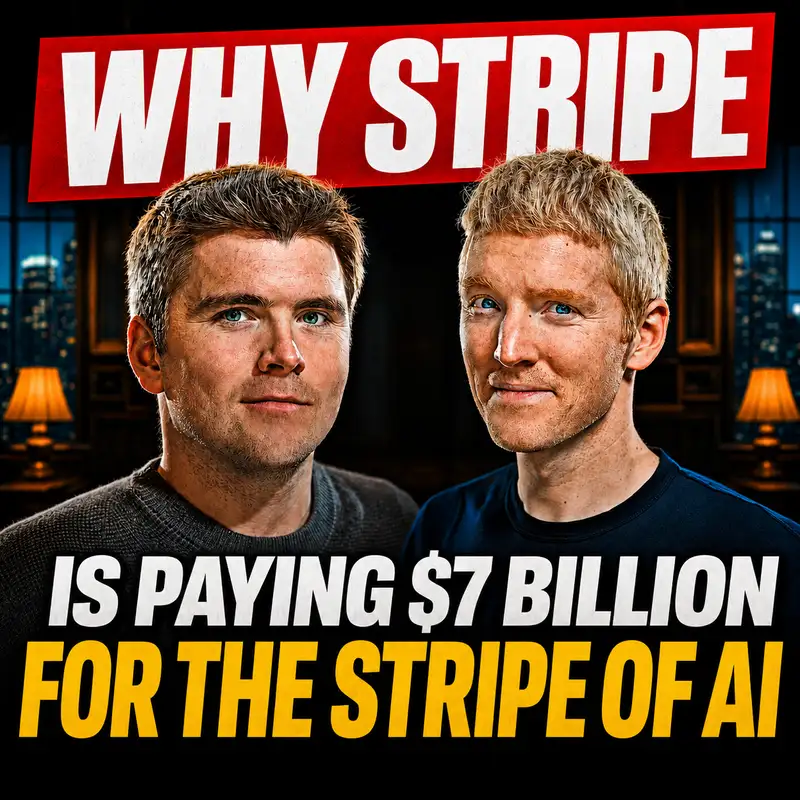
Aman: Zubin, the Collison brothers are famous for two things: building Stripe
and reading. Patrick Collison's bookshelf has its own fan base. Stripe is the
only payments company on earth that owns its own publishing house, Stripe Press.
Actual books, I've got one somewhere here. Beautiful ones. So here's the
question nobody's asking. What happens when the industry's most voracious
readers stop collecting books and start collecting companies? In the last two
years, the shelf has filled up fast. A billion dollars here, seven billion
there, and this summer, a bid for the biggest trophy in fintech. But there's one
number in this story, $50 billion, that tells you exactly how the novel ends.
We'll read that page last.
Zubin: One quick thing before we get into it. Aman, we just passed ten thousand
subscribers on YouTube.
Aman: And we don't take that lightly. If you're not one of them, the honest
pitch is simple: subscribing means you never miss an episode the day it drops.
We're also on Spotify, Apple and fourteen other platforms if YouTube is not your
thing.
Zubin: Right. With that, let's get into it.
Aman: So, Chapter One, Zubin.
Zubin: Two brothers from Limerick sell their first company, Auctomatic, for a
reported $5 million in 2008. Patrick is nineteen. They start Stripe two years
later with seven lines of code and a mission statement that sounds like fiction:
grow the GDP of the internet.
Aman: And for the first decade, Stripe was famously a product company. Write,
don't buy. The acquisitions were footnotes. A point of sale here, a fraud tool
there.
Zubin: Yeah, short stories. Nothing you'd shelve.
Aman: And then somewhere around 2020, the reading habit turns into a collecting
habit. And every collector will tell you the same thing: it starts small, and
then it absolutely does not stay small.
Zubin: So let's do a quick-fire through the shelf. In 2020, Paystack, Nigeria,
reported at about $200 million. Stripe buys its way into African rails. Then
2021, TaxJar, Recko, the boring but brilliant tax and reconciliation layer.
2024, Lemon Squeezy, merchant of record. Then the tone changes: Bridge,
stablecoin infrastructure, just over a billion dollars. At the time, one of the
biggest crypto deals ever done.
Aman: And that's the moment the collection gets a theme, because look at the
sequence. Emerging-market rails, the revenue and tax stack, money movement
itself via stablecoins. Each purchase fills a gap in the same story: if the
internet is going to have a GDP, Stripe wants to own the plumbing under all of
it.
Zubin: Yeah, Privy follows in 2025, crypto wallets. At that point, the pattern
is clear. They're not buying revenue, they're buying chapters.
Aman: And here's the tell, Zubin. Every one of these deals was paid for in
private. No shareholder vote, no proxy circus, no analysts asking about dilution
on an earnings call. When you never go public, the chequebook stays in the
family.
Zubin: Hold that thought, because the next purchase made the whole industry sit
up.
Aman: Yeah. This weekend, Bloomberg reported Stripe had finalised an agreement
to buy OpenRouter for more than seven billion dollars. In May, that company was
valued, Zubin, at one point three billion. Stripe reportedly paid more than five
times that, months later.
Zubin: Alright, Aman, before we jump into this, I think we need a Prof Z moment.
Thirty seconds.
Aman: Bring it. Bring it.
Zubin: What is OpenRouter? Think of it as a switchboard for artificial
intelligence, or AI. You know, one doorway, 400-plus models behind it. Your app
sends a task, OpenRouter routes it to whichever model is the cheapest and best
for the job. Eight million users, founded in 2023. And here's the line that
should make you smile: its own founders described it as the Stripe of AI.
Aman: So Stripe bought the Stripe of AI.
Zubin: Right, I guess the author wrote himself into the book.
Aman: Yeah, exactly. But strip away the irony and the logic is cold. The next
decade of commerce is about agents transacting with agents. Software buying
compute, buying services, buying from other software. Whoever sits at the toll
booth between the companies and the AI models meters the traffic and eventually
moves the money. Stripe just paid seven billion dollars for a toll booth.
Zubin: A payments company buying an AI switchboard sounds like a plot twist.
Aman: Which brings us to the big one. Regular viewers know we did a full episode
on this, The Butcher's Chart, back in July. We strongly recommend watching that.
The reported facts since: Stripe and Advent International offered $60.50 a share
for PayPal. $53 billion. The board said not enough. And as of this week, the
reporting from the Journal is that they're negotiating a higher price, which, by
the way, we called, and a deal possibly weeks away.
Zubin: Sit with the poetry of that. Stripe, founded in 2010 to fix everything
PayPal got wrong for developers, sixteen years later is bidding to buy its own
origin story. Aman, that's not an acquisition. That's the protagonist purchasing
the book he was written in response to.
Aman: You know, Zubin, I watched The Odyssey and this is as riveting. Maybe
they'll get Christopher Nolan to do the biography of the Collison brothers. But
the scale, if it closes: roughly $3.7 trillion in annual processing under one
roof. Venmo, the checkout button, Braintree. I mean, 439 million PayPal accounts
bolted onto the merchant rails Stripe already runs. For context, Stripe alone
processed north of $1.4 trillion in 2024. Something over one percent of global
GDP touched their infrastructure. Add PayPal to that, and you're not a fintech
any more. You're a utility for the world.
Zubin: Right, and a utility that never filed a public prospectus in its life.
Aman: Which is exactly where this novel has been heading all along: the final
chapter.
Zubin: So let's ask the real question, right? Why is the most valuable private
company in fintech, valued at somewhere around, I think, $159 billion in
February, closer to maybe $200 billion on the secondary market, still private?
Aman: Because, and we've called this, private right now in payments is the
perfect place to write. No quarterly reviews, no activist critics. You buy a
stablecoin company, a wallet company, an AI switchboard, and the market only
reads the excerpts you choose to publish. Stripe has spent fifteen years as
literature's favourite device: the unreliable narrator. We know the story only
as well as they have told it.
Zubin: But every manuscript eventually needs to go to print.
Aman: And here's the page we promised you at the start. That $50 billion number.
According to Reuters, the PayPal bid is backed by roughly $50 billion in
committed financing from banks, alongside a $17 billion equity cheque from
Stripe, Advent, even Block. Now think like a lender for a moment. Nobody commits
$50 billion without asking one question: how do we get repaid? And think...
Zubin: Mm-hmm.
Aman: ...like Advent. Private equity doesn't collect books, it sells them. Every
fund has a clock.
Zubin: So that's our read, and it's a read, not a fact, right? The IPO isn't the
epilogue to this shopping spree. It's the financing plan. Buy the past, PayPal.
Buy the future, OpenRouter. Bind them into one volume and take the finished book
to market as potentially the largest technology listing in history. Aramco
raised $29 billion. A Stripe float at those reported valuations could rewrite
that record. The brothers who read everything were never just collecting.
Aman: They were writing. And when the most careful authors in fintech finally
publish, you won't be reading the prospectus. You'll be reading the ending they
spent sixteen years editing in private.
Zubin: That's right. In February, we gave PayPal three endings. In July, we told
you that the $53 billion bid only works in pieces. Both episodes are on the
screen now, and both have aged rather well, I must say, Aman. Now, if tracking
these stories properly matters to you, subscribing is how you get the next
chapter when it drops, because this deal will move within weeks.
Aman: Until then, keep your bookmarks in and your notifications on. This has
been A2Z Fintech.
Zubin: I guess, error 402: payment required.
Aman: Always.