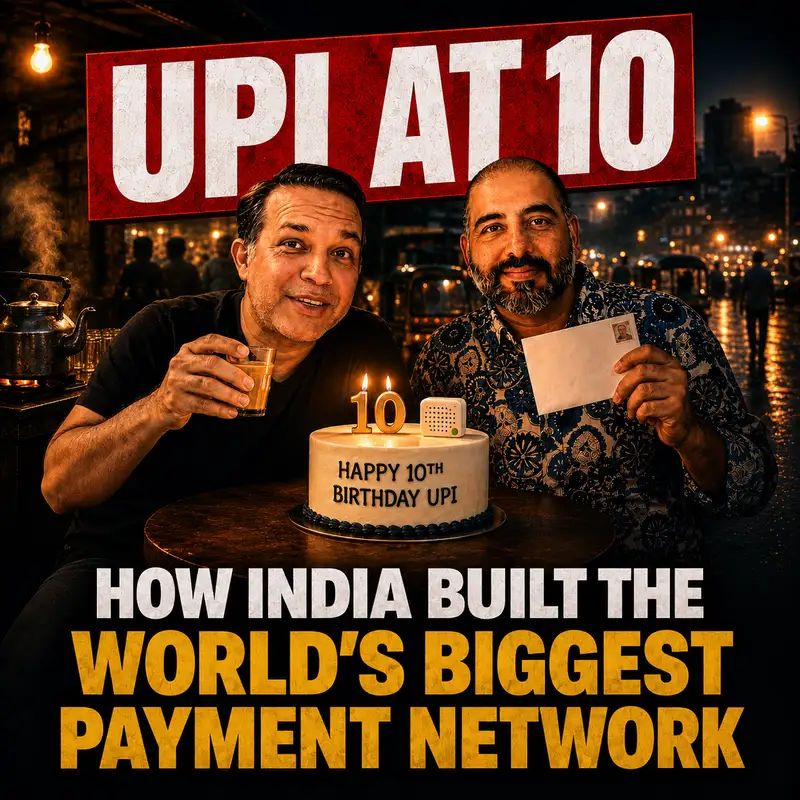
Aman: Zubin, that voice.
You've heard it if you've stood
at a tea stall, a vegetable cart,
a chemist counter anywhere in India.
A box the size of a bar of soap.
Twenty rupees, roughly
twenty-five US cents.
Zubin: And here's what the
box is not telling you.
The network behind that box speaks
roughly 76 crore times a day.
And for all my friends outside
India, a crore is 10 million,
so that's 760 million
times every single day.
And ten years ago this week,
it spoke for the first time.
Aman: That's right.
25th August 2016, a protocol called the
Unified Payments Interface goes live
in Indian app stores. First pilot
month, 373 transactions in total.
Today it clears that entire first
month in about a twenty-fourth of a
second, faster than you can blink.
By the end of this episode we'll show
you why the most important payments
company of this decade
is not a company at all.
Zubin: This is a story of how a country
of cash became the largest real-time
payments market on the planet, told by
two men who grew up in that cash and
helped build one small corner of what
replaced it, and are now watching it
from abroad with a very particular
mix of pride and homesickness.
Aman: So, welcome back.
I'm Aman Narain, your fintech
futurist, calling in from Singapore,
where sending money to India is still
somehow harder than ordering dinner.
Zubin: And I'm Zubin Vandrevala,
your payments provocateur in San
Francisco, or should I say in the 1980s,
where last week I paid a contractor
with, wait for it, a paper cheque.
A cheque, in 2026.
My cousins in Mumbai settle a wedding
vendor on a phone while I'm still
looking for a stamp.
Aman: True, Zubin. That's the
NRI condition in one sentence:
we emigrated, and then India lapped us.
Zubin: That's right. But before
we jump in, a quick disclosure:
expert, biased, and delivered with love.
This podcast is for entertainment
and information purposes only,
not financial advice.
And a public service notice before
anybody's uncle gets cleared out:
if somebody asks for your UPI PIN to
receive money, hang up. That's a scam.
The PIN is only for sending. Always.
Aman: And hold on to that
thought on the scam.
It comes back when we talk about
what the free rail actually costs.
Zubin: But first, the idea that made
the scam and the tea stall possible.
Aman: So most people think UPI
started with an app. It didn't.
It started with a stack, the
India Stack, three layers:
identity, payments, data.
Layer one was Aadhaar,
a 12-digit biometric ID covering
over 1.3 billion residents.
The unsexy number that made
everything else possible.
KYC took the cost of onboarding a
bank customer from about twenty-three
dollars to ten cents.
Zubin: Wild. Layer two, payments.
December 2008, the RBI and
the Indian Banks' Association incorporated
NPCI as a non-profit utility.
Not a fintech unicorn: it built a switch.
November 2010, Immediate Payment
Service, or as we fondly call it, IMPS.
Real-time, 24/7, bank to bank.
Powerful, and also painful.
Account numbers, IFSC codes,
and the whole tax-form KYC
energy of moving money.
UPI's genius was not inventing
real time. It was abstracting it.
One virtual payment address,
your name at your bank's name,
like a Google handle. The complexity
lives under the floorboards.
The user sees a name and a QR code.
Aman: And the architects sat at iSPIRT,
a volunteer think tank
formed in February 2013.
Open APIs, interoperable public rails.
The pilot goes live in Mumbai
on the 11th of April 2016:
Raghuram Rajan, the then RBI Governor;
Nandan Nilekani, the tech
entrepreneur turned evangelist; A. P.
Hota; and Dilip Asbe. 21 banks.
Public launch, 25th of August 2016.
Rajan's line, Zubin, years later,
on the founding principle:
it is a public platform, so
anybody can participate.
Zubin: Now picture this.
The state builds the roads, no
toll booth at the entrance,
and private cars race on top.
That image is the whole episode.
Remember it, because
in segment three one of those cars
had 62% of the road and still lost.
Who lost, and why does a multinational
with the better product get beaten by
a field army under plastic
QR stands? That's coming.
First, the people who
refused to drop the baton.
Aman: So, institutional builders first.
Nandan Nilekani, as we mentioned,
the architect and evangelist. A. P.
Hota, who was NPCI's founding CEO,
the man who had to persuade bank boards
that a non-profit switch was not a
threat to their deposits.
Zubin: And Aman, let's talk about the
engineers. Sharad Sharma at iSPIRT,
rallying volunteers who
never see a Series B cheque.
Pramod Varma, chief architect of Aadhaar,
who brought one golden rule to
UPI: the centre must be dumb.
A stateless traffic cop.
Route the packet, clear the
transaction, don't get clever.
That single rule, along with standardising
the VPA so your handle works
across every bank, is why the network
scales without collapsing under its
own weight. Varma's dumb-centre
rule, I would argue,
is why UPI scales and why closed-loop
wallets eventually had to kneel.
Three fights, non-obvious, and usually
left out of the anniversary episode.
Aman: So fight one, as you
say, Zubin, 2013 to 2014.
The telecom operators and a chunk
of bankers wanted, get this,
USSD on feature phones.
Control, like Safaricom in Africa
with M-Pesa back in the day.
The architects, to their credit,
bet on IP first, smartphone first,
and they won. That single bet, I believe,
is why a QR on a vegetable cart
talks to a San Francisco server and
a Satara pensioner's feature
phone, all on the same rail.
Zubin: Yeah, and fight two. Banks
wanted UPI locked inside their apps.
Rajan and the NPCI
overruled that unanimously.
Third-party apps were allowed.
Without that fight there would be
no PhonePe, there would be no Tez,
no war for the front end. Just 21
bank apps and a polite failure.
Now, fight three, and this is a big one.
SMS OTPs were unreliable at India scale.
They replaced them with device binding,
and then the phone's hardware
trust over the telecom's.
Aman: Yeah. Look, here's the line I want
tattooed on every "Who built UPI" thread.
The best character in this
story is not a person at all.
It's the operating model.
Regulator, non-profit switch,
capable volunteer architects,
private apps fighting to the death
on top. It's pretty amazing.
Zubin: It is, it is. And it's
that continuity question, right?
Because democracies usually kill the
infrastructure when a government changes.
Aman: Yeah, and this is a really good
point. No political agenda here,
but this was conceived under the
Congress and the UPA government,
and it scaled with the BJP and the NDA.
The baton never dropped,
as you alluded to earlier.
The UPA in 2007: the Payments and
Settlement Systems Act, NPCI,
UIDAI and Nilekani in 2009, IMPS in 2010.
All of that was the first government,
along with early Aadhaar-linked
benefits pilots.
Then comes the NDA and Jan Dhan,
hundreds of millions of accounts,
Aadhaar in 2016, UPI's public launch,
BHIM, the app that never was,
and then zero MDR. We'll
come back to that.
And yes, the BJP had opposed
Aadhaar in opposition.
To their credit, when they saw
what they call JAM, Jan Dhan,
Aadhaar and mobile, they hugged the
stack so hard it became a doctrine.
And this is not hypocrisy as a gotcha.
This is what thirty-year infrastructure
looks like in a democracy.
Something the country where you're
sitting could learn a thing or two about.
The rivals keep the pipe,
because the pipe works.
Zubin: We're not going
to make this political.
Aman: We're not.
Zubin: The most I will say is I've
watched infrastructure bills die in
conference committees in other countries,
and I get homesick for the fight
that India already finished. Next
up, the war from the front line,
including the part where a global giant
brought a knife to a physical gunfight.
Aman: So if you want the
real mechanics of fintech,
not the PR press release, hit subscribe.
And drop your thesis in the
comments on open rails:
does the better app win,
or the better ground army?
Zubin: So let's break this up into eras.
I would argue that 2013 to
2016 was the wallet era:
Paytm, MobiKwik, FreeCharge.
Closed loop, pre-funded, a fee
to get your own money out.
The internet's version of
a company canteen card.
Aman: Then comes November
2016. Demonetisation.
Five hundred and thousand rupee
notes withdrawn overnight.
That was pretty incredible.
Zubin: Yeah, I remember that
vividly, waking up to that.
Demonetisation lit a bonfire under Paytm:
billions in wallet loads,
a media coronation.
But here's what nobody clicking
the story is being told.
That same shock opened the door for
a protocol that needed no wallet
funding, no withdrawal fees, no interest
left earning in somebody else's
bank account. Demonetisation lit the
fire. UPI is what the fire built.
Aman: Yeah, there's a lot of debate
about whether demonetisation delivered
on its mandate, but one thing that is
clear is that it was the fire starter,
as you mentioned, for the transformation
of payments in India, which I don't
think you could ever underestimate.
And full disclosure,
because this channel doesn't do
the tourist kind of history:
I was consulting with
Google before I joined.
I was there at the start of what we
called the Tez journey that became
Google Pay, and you, of course,
were inside Google Pay too.
Zubin: Yeah. And Cash Mode,
ultrasonic audio pairing,
two phones chirping at each other
across a chai stall like a science fair
project that shipped to
a hundred million users.
I still hear that sound in my sleep.
Aman: It was an incredible period.
I feel so nostalgic about it.
We were building for chaiwalas on
the streets of Bombay while you were
learning about mezcal in Mountain View.
With you and Abhi Bisarya.
My memory is the bet itself.
From where I sat, it looked uninsurable:
a multinational choosing to build its
Indian payments business on rails it
didn't own. No preferences, shared
with every competitor on earth.
No closed loop, no float, no lock-in.
The product had to win on experience
alone. So we built it all.
We built scratch cards, the little
dopamine hit after every payment,
and the chirping phones you
mentioned. It worked absurdly fast.
By full-year 2018, Tez held
62% of the network's volume.
Zubin: 62%, Aman.
That was the launch-era spike, a sustained
peak of roughly half the market.
And we still lost that ground.
Aman: Honestly, other than search,
I don't know if Google has 62% of
anything. But why did that happen?
Zubin: Because PhonePe saw what
product teams in Mountain View are
structurally barred from seeing. In
India, the last metre is physical.
Aman: Hundred percent.
Zubin: Founded in December
2015 by the Flipkart trio:
Sameer Nigam, Rahul Chari, I
think, and Burzin Engineer.
Aman: Chari, yeah. You've got
to get the next one right.
Zubin: Later backed by Walmart. While
Google optimised an app in an office,
PhonePe carpeted the physical economy.
QR stands at vegetable carts,
soundboxes announcing payments
in regional languages,
the exact voice from the cold
open. Chai stall by chai stall.
By FY20 they had passed us.
Today that score sits at roughly
PhonePe 45%, Google Pay about 35%.
A global team lost the
ground war to a local one.
And by the way, this is not the
first time India has seen it.
For those interested, go back and check
out the Nirma and Unilever story.
But going back to the Google
Pay and PhonePe market share:
point taken, true, and I would
argue that PhonePe earned it.
Aman: But Zubin, before
anyone writes the obituary,
look at the referee's whiteboard.
The NPCI has subsequently
mandated, I think it was,
a 30% volume cap per app,
and enforcement was deferred
to the end of this year.
Zubin: From 2020.
Aman: And with the two
leaders foreign-owned,
the sovereignty subtext is unmissable.
Google Pay at 35 points is
five points from compliant.
Its slide from half the market
was never only a defeat.
It was a descent towards a ceiling
the referee had already drawn.
Now, I'm not justifying
that as a strategic give,
but I think UPI is the first market
I know where losing share and
becoming compliant are the same journey.
So the scoreboard has a salary cap, and
that changes who should be nervous.
Google Pay's silver lining:
no forced shrinkage ahead,
a stronghold in the urban,
smartphone-first India it actually
targets, and a brand that became a verb.
"GPay karo." A few hundred million
people now say that instead of "pay".
And in the AI race Google is fighting,
a daily-use verb in a market the size
of India is a position no share chart
actually captures.
Zubin: Let's talk about PhonePe's
crown, which comes with two clouds.
If that cap is ever enforced,
45 means shredding roughly
a third of its volume:
the largest regulatory overhang in
consumer fintech, I would argue.
And on a zero-fee rail, market share
is essentially the trophy that eats.
The ground army costs real
money; the retail pays nothing.
Every point of share is a point of
cost to monetise somewhere else.
Hold that thought.
Aman: Google, by the way,
built the better app.
PhonePe built the better army. On
open rails, the army wins the crown,
but the referee decides how heavy
that crown, as you say, gets to be.
Zubin: Let's not forget Paytm, who
joined the rail late, and then in,
I want to say, January 2024, the RBI
shuts down its bank's core operations,
and its share slides.
WhatsApp has distribution destiny
in every market, including India,
on the non-payments side, but
it still couldn't dominate UPI,
because the regulators
gated its onboarding.
Distribution is destiny, and it's
what's going to win in the market,
except when the referee decides
when you can enter the pitch.
Aman: I love that.
Distribution is destiny.
Listen, pin this in the comments if
you're watching on YouTube or a social
channel, if you disagree, and I'll pin
some of the best counter-theses on a
public rail. Is the winning moat product,
distribution, or regulatory timing,
as Zubin mentioned? Name your
answer and drop it in there.
Zubin: Kick off the next one.
You know who wins the front end.
Aman: You know who won the front end,
and why the crown is
heavier than it looks.
You don't know what the network
became while they were fighting.
The character flip is the
part the market charts miss.
Zubin: Financial year 17,
about two crore transactions.
Financial year 26, roughly
twenty-four thousand crore.
Aman: Insane.
Zubin: And for my non-Indian
listeners, 241 billion.
Aman: With a B.
Zubin: B with a B. Which is a
twelve-thousand-fold increase.
Say that slowly, so it actually hurts.
Aman: And the value zooms from 700
crore rupees to 314 lakh crore,
or in dollars, 3.4 trillion.
Not market cap. Flow.
Zubin: Let's do some
milestone-scaping for the listeners,
because velocity is the story.
October 2019, a billion a month.
August 2023, that's four
years: 10 billion, tenfold.
Two years after that, August
2025, 20 billion, double again.
July 2026, 23.66 billion a month.
And let's talk about the banks that
are connected: 21 in 2016, 741 in 2026.
Aman: And UPI now carries 85% of
India's retail digital payments volume.
And critically, 49% of
global real-time payments.
It runs in the order of 20
times India's card POS market.
Cards were supposed to be the future,
and the QR codes came and
ate them before lunch.
Zubin: That's right. And
people always ask about cash.
Cash didn't die, it just changed jobs.
Currency in circulation still grew,
because people love a
physical security blanket,
but currency to GDP cratered. UPI
became the daily medium of exchange.
Cash got relegated to a store-of-value
hobby under the mattress.
Aman: Yeah. And here's the flip
the anniversary explainers bury.
Early UPI was person to person.
Today, roughly 63% of
the volume is merchants,
and 86% of those merchant
payments are under 500 rupees.
P2P still dominates value,
and the network's soul is the
20-rupee ticket we opened with.
The large transfers are the body.
Zubin: Let's do a bit
of rapid-fire toolbox,
because the protocol kept growing teeth.
For recurring bills, it was AutoPay.
For microtransactions and offline
taps, UPI Lite and LiteX.
For the non-smartphone world,
123Pay. For credit expansion,
RuPay cards and pre-approved bank
credit lines riding directly on the QR.
And Hello UPI for conversational
commerce in different languages.
And the rail stops looking like a pipe.
It starts looking like
an operating system.
Aman: And those features
are not innovation theatre.
They are how a network built by engineers
learns to speak to a pensioner in
Ludhiana who never downloaded
an app in her life.
The number: seven hundred
million QR codes,
quietly becoming a credit acceptance
network in a country that never
installed even 9 million card terminals.
Now, 2020, NIPL, or NPCI International.
Two mandates, Zubin: Indian UPI abroad,
and licensing the stack itself.
Acceptance corridors now include
Singapore's PayNow linkage,
which I live with, the UAE, France,
Nepal, Bhutan, Sri Lanka, Mauritius,
Qatar, Oman, Cambodia, Greece, where
I was recently, and the Maldives,
where I would love to be.
And the list keeps going.
Tourists scan, and the home rails settle.
Zubin: Aman, that was a cute
flight-to-tourism story,
but I think the bigger story is
that the plane itself is for sale,
or at least some might say.
The deep story is the
payment switch leaving home.
Full-stack exports to Peru,
Namibia, Trinidad and Tobago.
And we've talked in the past
about the BIS Project Nexus,
which is India with Indonesia,
Malaysia, the Philippines,
Singapore and Thailand, standardising
how instant payment switches talk,
central bank to central bank.
Aman: Let's talk Brazil.
Pix launched in November
2020, four years behind UPI,
run directly by the central bank.
Participation mandatory above
half a million accounts.
Per-capita adoption at full speed
in 24 months, I think it was.
And critically, merchants pay a small
regulated fee, 22 to 23 basis points,
so the system funds its own servers.
No annual subsidy argument.
Did Brazil study India's homework,
Zubin, and write a cleaner answer?
Zubin: Look, speaking from operating
experience, not patriotism,
Brazil got two massive things right.
First was making participation mandatory.
It almost deleted the years NPCI spent
begging reluctant bank boards to
join. The second is
built-in merchant fees,
because Pix doesn't have to fight for
government subsidies every spring.
Those are genuine design wins.
But look at what India's messier,
unbundled bet bought us.
Uncoupling the front-end app from the
underlying settlement layer sparked
this crazy street-fight app market
Brazil simply doesn't have.
Pix is trapped inside your
traditional bank app.
Non-banks drove India's explosion.
Aman, you've lived this.
The private competition built things
no central bank committee would ever
dream of: 35 million soundboxes, offline
feature-phone rails, voice payments
in twelve languages. So, to summarise,
Brazil built the tidy system.
India built the bigger,
wilder, more inventive engine.
And the next decade will show
whose economy actually survives.
Aman: Yeah, and that's the
mic-drop setup, not the drop.
India's most consequential export in a
generation is not software services.
It's public infrastructure.
Zubin: If the export is the glory lap,
the common man is the balance sheet.
And Aman, the fine print is where
anniversary episodes usually go soft,
and I don't think we're
ever going to do that.
Aman: No. So, three
people, no TED-talk fog.
One: the tea seller in Chandni Chowk
used to lose about five to ten percent
to broken notes, short change, theft.
That soundbox at the beginning of
this episode didn't just collect 20
rupees. It ended the argument.
Zubin: And Aman, we were
chatting about this in prep.
We grew up in that toffee
economy. Not enough coins?
"Here, Aman, here's your toffee." That
was monetary policy at the store.
Aman: I think I'm diabetic
thanks to the toffee economy.
Zubin: And that soundbox
ended the toffee economy.
And the digital trail turned payments
history into credit history:
PM SVANidhi, and the quiet loan
stacks sitting on top of QR dust.
Two: the quick-commerce rider,
paid per order, API to UPI,
no weekly envelopes. And three:
the pensioner in Ludhiana.
Fingerprint or voice on a feature phone.
Pension in, kirana out, never
touched a smartphone UI.
Aman: And the World Bank's framing
is still the cleanest sentence in
inclusion literature.
Financial inclusion went from roughly
twenty-five percent to eighty percent
in six years, a climb that at the old
pace would have taken in the order of
forty-seven years.
Zubin: Let's not forget China's super-apps
digitised inside walled gardens.
India digitised the twenty-rupee
edge on a public network.
Obviously different civilisational bets,
and potentially different failure modes.
Aman: So, 90 seconds of honesty,
because anniversaries breed amnesia.
You and I get the phone calls
from home when it goes wrong,
and the one phone call
we get is about fraud.
The rail is cryptographically sound.
The humans are being socially engineered
at industrial scale, with AI,
or even before that.
If you've seen the Netflix documentary
Jamtara, I recommend watching it.
Fake collect requests, the PIN
trick from the disclaimer,
screen-sharing "support", sticker
QRs pasted over real ones.
Zubin: And Aman, the second
one was concentration.
We've talked about this
earlier in the episode.
Two apps still carry in the
order of 80% of all the volume.
That 30% cap, which we talked
about as 2026 but really was 2020,
kept getting deferred.
And national downtime, I think it
was March 2025, for about an hour:
700 million people noticed
when the centre breaks.
Aman: I don't know if you know this,
but when we launched with Google Pay,
we actually brought down
the national payment rails.
Zubin: Oops.
Aman: And actually, it
was a beautiful moment,
because it was a scary moment. We
thought we were going to get shut down.
But a bunch of Google engineers were
shipped off to the government offices.
Can you imagine, from California
to Kolkata's mean streets?
And they helped fix
some of those problems,
sitting side by side with the government.
These kids with massive equity cheques,
and guys with zero upside other than
to change the nation. It was amazing.
Look, number three was economics,
and this is the live wire,
the one the news cycle is on fire
about right now. Zero MDR since 2020.
Merchants pay nothing
at the point of sale.
Somebody still funds 251 billion
transactions' worth of servers,
security and settlement.
Industry numbers float in the range of
1,500 to 3,500 crore rupees for the
annual subsidy, and they say it
doesn't cover the true costs.
Parliament has been arguing in India over
the legal room to put
MDR back on the table.
Consumers hear "Will I pay for UPI?"
Merchants hear "Will the free ride ever
end?" The honest answer is
messier than the headlines.
Zubin: Well, defend your baby, Aman.
Aman: So all three are real.
I'll answer as someone who ran
the front end of these rails,
not as a brochure. Fraud,
as we talked about:
the 1930 cybercrime portal can freeze
mule accounts when the wiring works.
On an irreversible real-time rail,
education is the only durable defence.
The disclaimer was not comedy.
Second is concentration.
I sat inside one half of that duopoly.
That cap looks cleaner on
paper than in production.
Enforcing it means deliberately failing
a grandmother's payment because
her app hit the quota.
That's why NPCI keeps blinking
when Navi, CRED, super.money,
BHIM and the bank apps try to
grow a third lane organically.
They're around the low teens
together. Not a revolution yet.
Zubin: And to that I
would add the zero MDR.
Free at the point of use was
essentially the rocket fuel.
The state's argument,
formalise the economy,
shrink the cost of printing and
moving money, is not nothing.
But the pressure valve is already visible.
Credit on UPI carries
commercial interchange.
The free rail carries the volume;
the credit layer will
carry the business model.
Aman: And if your country
is studying this model,
pin whether you'd copy India's
free rail or Brazil's priced rail,
whole or in parts. We
always read our comments.
Zubin: Ten years, one toffee economy
retired, two homesick fintech dudes.
Let's bring it home.
Aman: So here's what I
keep coming back to.
The next decade is already sketched.
NPCI and the RBI are pointing at
a billion transactions a day.
Micropayments sliding onto on-device
ledgers, transit gates, voice.
The second act, I believe, is credit:
700 million QR codes built for payments,
quietly becoming the largest credit
acceptance network ever assembled,
in a country that never managed to
install even 9 million card terminals.
The data layer turning a tea seller's
payment history into his loan
application. And the standard going
abroad, corridor by corridor,
central bank by central bank.
But strip away all of that,
and we return to the box on
the tea seller's counter.
Zubin: You and I grew up
counting change in that economy.
We were paid a childhood interest,
and some adult diabetes, in toffee.
We left, and we helped build one
small corner of what replaced it from
inside a foreign company.
Now every Indian home feels
like visiting the future,
while my adopted country
still posts cheques.
Aman, for most of financial history the
poorest customers were the ones that
were the most expensive to serve, and
we've seen it happen over and over
again: the system politely ignores her.
India's answer was not a better
bank, or even a cleverer app.
It was to make the infrastructure
public, the marginal transaction free,
and the competition private.
And then let a 20-rupee payment matter
as much on the network as a 20-lakh
one. A decade on, the results
speak 760 million times a day,
in a dozen languages, from
35 million little boxes,
and it says the same word to a
billionaire and a chaiwala alike.
"Received." The most important payments
company of our decade is not even a
company at all. It is a protocol.
Aman: And it belongs to everyone. And
it has only just learned to talk.
Zubin: All right. So,
happy 10th birthday, UPI.
If your country's payment system
still feels like it's stuck in 2015,
whether you're in San Francisco or
Sydney, share this episode with them,
and forward it to that one friend
who still writes paper cheques.
Yes, you can forward it to me.
That friend is me, and yes,
I am actually on my way to
the post office right now.
Aman: Might want to use your
phone next time, Zubin.
Zubin: All right, Robben Island boy.
Aman: Stay curious.
Zubin: Stay purposeful, and today
of all days, stay interoperable.