Walmart ran a multimillion dollar
experiment, so the rest of
us don't have to.
They put their own shopping assistant
inside ChatGPT. The result?
Checkout in the chat converted at three
times worse than
the checkout on Walmart's own site.
Six months in, OpenAI quietly killed
Instant Checkout.
Out of the millions of brands, only
twelve were still alive. Twelve.
Then last week, Anthropic dropped a
bomb.
They shipped the exact opposite
architecture for agentic commerce.
No in-chat checkout, no proprietary
marketplace, no cut of the sale.
And Visa and Mastercard, they were there
at the launch
on day one.
But here's the detail that made me sit
up.
While everybody was busy writing the
obituary of AI in
shopping, Google quietly turned it on
inside Gemini,
paid via Google Pay.
Gap and Ulta are already live.
The exact thing that killed OpenAI is
working for somebody else.
At the end of this episode, I'm going to
answer three questions.
What did Anthropic learn?
How does OpenAI strike back?
And why is a company marching towards a
two trillion
dollar IPO giving its commerce stack
away for free?
Welcome back to A to Z Fintech,
where we break down finance, tech and
payments one letter
at a time.
I'm in Hong Kong.
Zubin is in, or on his way to, London.
One of us is in the old capital,
one of us, I guess, is in the old
harbour.
We looked at this story and decided it
was too
important to sit on while we're
gallivanting all around the world.
So we did the one thing that the Empire
does genuinely well.
And we decided to divide and conquer.
He takes London, I'll take the
waterfront.
Which is fitting, because strip out the
flags and the
Empire's real business model was the
lease.
Ninety-nine years, no renegotiation,
rent due regardless of how the
tenant's quarter went.
Hold that thought.
It matters in about four minutes.
Let's get the mechanics out of the way
fast.
On September 2nd, Anthropic open sourced
their commerce agents.
Two reference AI agents.
One faces the shopper, one faces the
merchant staff.
Here is what it doesn't do.
It places no orders, it touches no
credit cards,
it hands the shopping cart right back to
the merchant's own checkout.
Shopify, Square, Visa, Mastercard, all
integrated from day one.
They gave the architecture away and took
absolutely nothing on the sale.
Now look at who is doing the giving.
Anthropic is staring down an October
IPO.
The whispers say two trillion dollars,
making it the largest in history.
That valuation doesn't rest on this
year's revenue.
It rests on a projected two hundred
billion in 2028.
And you don't hit that number just by
selling enterprise coding seats.
You have to conquer a room with no
incumbents in it.
Commerce is the biggest room in the
building.
This isn't a developer tool release.
It is a massive land grab.
So how do you claim land that OpenAI
already fenced
off and then lost?
You change what you charge for.
If you take away one idea today,
make it this one.
ChatGPT's Instant Checkout took four
percent of completed orders on
top of standard card fees the merchant
already paid.
Call it seven percent at the top line
just to
process a sale.
For a direct to consumer brand, that is
a channel
cost that wipes away your operating
margin.
A percentage of revenue is rent.
It scales with your success.
You can't engineer it down.
It's simply the price of being allowed
to exist on their platform.
Compute is different.
Tokens are an input, like electricity.
You can model it to your gross margin.
You can cache prompts, shrink contexts,
swap models.
Procurement can negotiate inputs.
But rent, rent gets paid until you die.
The fight was never about whether AI
could shop.
The fight was about whether the AI acts
as a
supplier or a landlord.
OpenAI showed up as a landlord and the
tenants left.
Anthropic priced itself as a supplier,
and the supplier, well,
they get invited in.
It's easy to claim you learned from a
rival's failure.
Here is where Anthropic actually welded
those lessons into the plumbing.
One, the price.
Rent out, compute in.
Two is the till.
OpenAI tried to keep the shoppers
hostage in the chat.
Anthropic hands the cart back and never
touches the card credentials.
Walmart's failure didn't mean agents
can't shop,
it meant that the cash register was in
the wrong place.
Three, the guardrails.
If an AI hallucinates a product ID,
it's rejected by the server, not by the
model.
If you're letting a language model
anywhere near live retail
inventory, hard coding plumbing beats
any AI safety benchmark on the planet.
Will OpenAI come back? Yes.
They retreated to discovery.
They didn't exit commerce.
But twelve merchants shut the door on
the landlord model.
And when OpenAI returns, they will have
to play by
the pricing rules that Anthropic just
set.
That's how you win a standards war.
Which brings me to the thing I got
wrong.
And I'll correct it out loud.
Everyone says Google is asleep at the
wheel on agentic commerce.
Google is not asleep.
Google built Universal Commerce
Protocol, UCP, alongside Shopify, Visa,
and Mastercard. Fast Company is
reporting that Gemini has live pricing,
live inventory, and in-chat checkout all
via Google Pay.
Sit with that for a second.
The exact model that collapsed for
OpenAI is running right
now for Google. Why?
Because OpenAI asked merchants to fund
the experiment with a
four percent tax.
Google owns the rails.
It owns the merchant feed.
And it can run that checkout at zero
percent for
as long as it wants, because Google
makes its money
one layer up in advertising.
That is deeply uncomfortable if you're
Anthropic.
You priced yourself just now as a
reasonable supplier.
Google can price itself at zero.
And yet Google just overhauled its AI
leadership,
bringing in Koray K to operate with
absolute intention and velocity.
They are winning the commerce argument
on paper but changing management anyway.
Why? Because owning the plumbing is only
magnificent if you're indifferent
to the front end.
Google's trap is that it sells ads
against that front end.
Okay, I've been generous for six
minutes.
Let me argue against myself, since Zubin
isn't here to do that.
Anthropic claims early retailers saw
cart sizes were thirty-five percent larger.
But there's no test design, no sample
size.
That is a ceiling drawn by the vendor,
and you don't build financial forecasts
off a vendor's best case scenario.
Furthermore, 73% of independent
merchants don't even have machine readable
product catalogues. But here's the
counter to that counter.
In March, Shopify switched agentic
storefronts on by default.
Millions of stores are now instantly
discoverable across ChatGPT and Gemini.
Nobody asked the merchants to integrate.
The readiness problem is solving itself
through the platform defaults.
And if you thought that this episode was
just an
AI tech demo, you're in the wrong room.
Here comes the fintech punch.
Everyone is obsessing about shopping
agents.
They are looking at the wrong agent.
Look at the merchant agent.
It reads sales, labour, and inventory
continuously.
To a lender, that isn't just an
inventory tool,
that is an underwriting file assembling
itself in real time,
with purchase intent already attached.
We've seen this before.
Square originated nearly six billion
dollars in credit last year
off card data.
Shopify Capital does the same.
They approve loans in days, not weeks,
repaid as a slice of daily sales.
But those platforms only see what
already sold.
Friday's promotion shows up in
Saturday's data.
An AI agent knows on Tuesday that you're
going to
run out of stock before Friday.
It drafts the restock order, it prices
the invoice,
it is exactly one API call away from
offering the
merchant the working capital to cover
it,
inside the exact same screen where they
approve the inventory.
Anthropic gave the blueprint away.
And who integrated on day one?
Shopify, Stripe, and Square.
Every single one of them runs a massive
lending book. Coincidence?
Not a chance.
This is the ultimate distribution
channel for embedded finance.
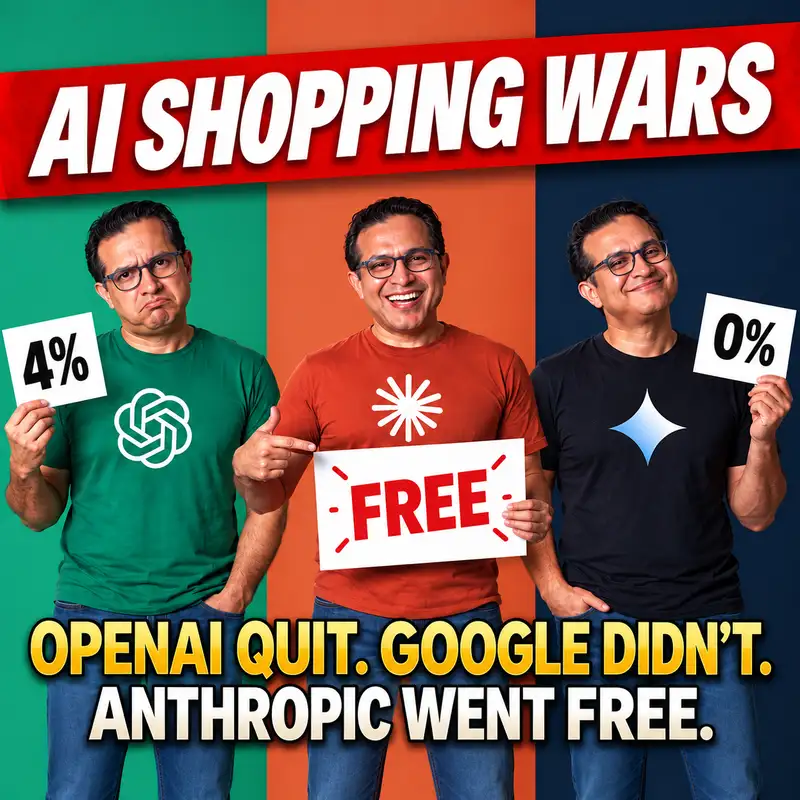
Three companies, three postures.
OpenAI charged rent and got left with a
dozen merchants.
Google runs the checkout at zero, but is
trapped by
its own ad model.
Anthropic gave the architecture away,
charges for the electricity,
and is quietly turning itself into an
underlying engine of
the small business economy.
Discovery will always drift back to
whoever aggregates it.
Eventually there will be a new toll,
but it has to be priced as a supplier.
So if Anthropic lists in October at two
trillion dollars,
what are you actually buying?
A research lab, or the greatest
underwriter the market has ever seen?
Two very different investments.
Only one is priced in.
You pinned it at the top, let's see
where you landed.
Supplier or landlord?
That's me, solo here from Hong Kong,
Zubin in London with the protocol rails.
He'll be back next time and frankly,
he's gonna be insufferable about being
right.
Save your worst takes for him.
Stay curious, stay purposeful, and stay
drip.