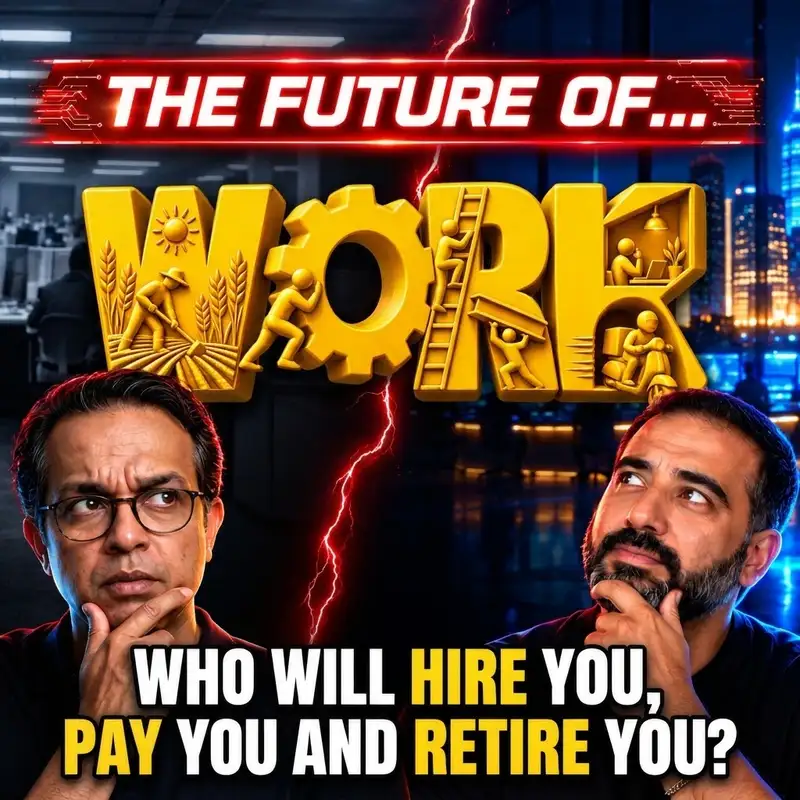
Aman: Picture this. It's 1985.
You walk into a job interview carrying
the briefcase your dad insisted would last
a lifetime. You shake hands.
The manager, whose hair absolutely
defies both physics and good judgement,
asks you five questions, smiles
and then says: "Great energy.
You can start Monday."
Simple. Human. Predictable.
Zubin: Now jump into 2025. You apply
online, upload your CV, hit submit.
Seventeen seconds later,
you get a response:
"Our AI screening system has determined
that your behavioural signature does not
align with the success profile for this
role." You ask: behavioural signature?
Dude, I just wanted to answer
phones and maybe get some dental.
Aman: The tragic part is you
didn't even lose to a person.
You lost to a vibe-checking
spreadsheet with commitment issues.
Zubin: Same species, same ambitions,
completely different operating system.
Aman: By 2030, there will be two
billion independent workers globally.
That's a multi-trillion-dollar
market opportunity.
Two billion people, and most of the
financial system still can't see them.
This is The Future Of, our three-part
mini-series on how you bank,
how you shop and, today, how you work.
Zubin and I first had this
conversation late last year.
It hasn't aged. It's sharpened.
Aman: Stay with us, because you're about
to meet Divya: 400,000 subscribers,
180,000 a year, and invisible to her bank.
Aman: Welcome back to A to Z Fintech,
where we decode finance, tech,
people and power, so you don't have to
pretend you skimmed that 110-page McKinsey
deck on your commute. I'm Aman.
Zubin: And I'm Zubin,
your friendly fintech provocateur,
still recovering from my daughter asking
me if cassette tapes were like square
iPods for old people. You know,
back then the vibes were simpler.
Now we're living in what economists
politely call the vibecession,
where the numbers say everything is fine,
but the vibes say
the universe is glitching.
Aman: Carlota Perez would
call this a turning point:
the chaotic middle between two eras.
The industrial age rules are decaying.
The intelligence age rules
haven't been written.
So everything feels slightly broken.
Zubin: Yeah, and so Aman, today
we're unpacking, for our listeners,
the evolution from farms to factories
to feeds, and how finance,
or what we call the Money OS, needs to
Aman: Evolve. And yes, in case you haven't
figured this out, it's an 80s theme today,
because Wham!, as you will see shortly,
isn't about your last Christmas.
Zubin: All right, before
compliance Rickrolls us:
this podcast is for information
and entertainment purposes only.
They are our views, not those of any
organisations we both work for.
Also not financial advice. This is not
quit-your-job-and-become-a-creator advice.
Think of us as that loud table
in a café: fun to listen to,
but no replacement
of your CFA or therapist.
Aman: Let's zoom out, Zubin. For most
of human history, work meant farming.
You didn't pick a job, you inherited one.
Your bosses were weather and the local
guy with the biggest sword.
Zubin: If you made it through
winter, your bonus was not dying.
Aman: Then came the Industrial Revolution,
with factories, steam, electricity.
Suddenly we invent the job,
the wage, the pension, the weekend,
the career ladder and the middle class,
and, crucially, the safety net.
Zubin: But Aman, that wasn't inevitable.
It was actually fought for.
Unions battled for weekends. Governments
created unemployment insurance.
You know, here's what historians won't
tell you: the 80s weren't the golden age.
They were actually the beginning
of the unravelling.
Aman: Union membership in the US dropped
from 35% in the 1950s to 16% by 1983.
Reagan and Thatcher were dismantling
the stability we now romanticise.
Pension coverage had peaked in the 70s.
The 80s felt stable for a specific cohort:
white-collar, predominantly male.
But the industrial age social
contract was already fraying, Zubin.
Zubin: So when we talk
about the 80s being stable,
what we really mean
is that it was the last moment
that the illusion of stability
was broadly shared.
Aman: And then digital arrived:
the internet, smartphones,
platforms and now AI. Work stopped
being a place. Work became a portfolio.
Zubin: Your office is wherever your laptop
opens, and later your phone goes.
Your career isn't a ladder,
it's a playlist.
Aman: And all the institutions built
in the industrial age, banks, pensions,
labour laws, mortgage underwriting,
are still speaking 1950s English.
Workers are speaking 2025 modular emoji.
Zubin: Yeah, and that mismatch
is why everything feels so odd.
Aman: So what's driving
this glitchy feeling?
We believe it's a mixtape of four
forces hitting simultaneously.
And because we are committed
to our 80s theme,
they spell one of the decade's
most iconic duos.
Zubin: So you are serious
about Wham!, aren't you?
Aman: This WHAM explains
the structural shift reshaping work.
Zubin: Wake me up before
you go-go, to your independent
worker job. Love it. Love it.
Aman: W is for walls:
fragmentation and nationalism.
Globalisation may have just peaked.
Now we're seeing trade walls, data
localisation, supply-chain nationalism,
Brexit, US-China decoupling, GDPR,
all creating compliance moats.
Zubin: So how does this affect
that independent worker? Well, directly.
Cross-border remittances get harder.
Platform access fragments by region.
A creator in Nigeria cannot
monetise like one in California.
All of this while, paradoxically,
the internet and rails are technically
bringing stuff together.
Aman: Walls isn't just macro noise.
It's reshaping who can participate in
the platform economy, and on what terms.
Next up is H, for human agency,
or workers essentially reclaiming control.
Workers want autonomy: control over
time, place, identity and meaning.
The hierarchy is melting.
Zubin: Let's be honest, Gen Z
didn't invent the side hustle.
They just turned it into
an operating system.
But "be your own boss" often means absorb
all the risk while the platform takes 30%.
Aman: And human agency is rising,
but so is uncertainty.
The flexibility that lets you work
from Bali also means no sick
days, no pension, no HR.
Zubin: Right. Freedom is great
until you need that dental surgery.
Aman: Touché. A is for automation, or, if
you like, the AI reshuffling of this deck.
AI isn't just removing jobs wholesale.
It's unbundling jobs into
tasks: some automated,
some augmented and some more human.
Zubin: Yeah, and we read this MIT research
report that shows that automation creates
this polarisation. High-skill
jobs grow and low-skill jobs grow,
but it's that middle-skill job that just
vanishes. It's the barbell economy.
Aman: And the people caught
in the middle bear the transition costs.
Who pays for retraining?
How long is displacement?
What happens to the 45-year-old
accountant whose job just got automated?
Zubin: Yeah, AI is that new
synthesiser: reshaping the sound,
not removing the music. But someone
still has to learn that new instrument.
Aman: It's easy to focus on that
displacement and see it as structural
failure. But this massive early
inequality is a feature of transition,
not the destination.
When the Industrial Revolution began,
wealth concentration exploded.
It took unions and government intervention
to build out that middle class.
Today's creator economy has an
eye-watering Gini coefficient of 0.89.
South Africa is at 0.63
Aman: And the US 0.49, showing how
wealth concentrates at the top.
But just like the industrial age,
the current chaos is that painful,
necessary stage before new social
contracts and infrastructure are built
to stabilise the system.
Zubin: Yeah, so Aman, what you're telling
us is that the current anxiety is not
an irreversible decline.
It's just an emergence.
Aman: That's correct.
Now let's keep moving.
M of WHAM is for modularity:
the playlistification of everything.
Careers used to be albums: one
employer, predictable tracklist.
Now they're playlists.
Multi-income, multi-platform.
You might be an Uber driver,
a freelance designer,
a YouTube creator and an Etsy
seller, all in the same week.
Zubin: But Aman, that modularity
comes with volatility.
Imagine last month $8,000,
this month maybe $1,000.
Your income looks like
a seismograph during an earthquake.
Aman: And the systems built for album-era
workers, payslip-based mortgages,
employer-sponsored insurance,
40-year pension plans,
can't handle the playlist-era income.
Zubin: Yeah, and to sum it up, Aman,
the WHAM forces aren't neutral.
They're creating these winners and losers.
They concentrate power.
Without intervention,
they will amplify inequality.
Aman: So now let's talk about what
these forces are creating:
the one-person enterprise, the independent
worker and the small business,
and how that's booming.
Zubin: Wait, wait, wait.
Didn't the 80s kill small business?
Walmart, corporate consolidation?
Aman: Exactly.
The 80s were the great hollowing out.
But then something changed in the US.
Back in 2020, we saw 4.5 million new
job applications [business applications:
about 4.4 million]. In 2021 that went
up to 5.5 million [about 5.4 million],
and 2022 sort of maintained
that pace [about 5.1 million].
Record numbers, the highest
in American history.
Zubin: So, 2020. What was driving this?
Aman: COVID, to some extent,
was an accelerant,
but more fundamentally
it was three things.
First was platforms lowering barriers. You
don't need a storefront or a warehouse.
Shopify is your store; GCP,
AWS is your infrastructure.
Second is that remote work normalised
solo operating, or independent work.
And then three: the Great Resignation
was really the Great Re-evaluation.
Aman: Millions said no to Zoom
meetings about Q3 roadmaps.
Zubin: Yeah, and that's just
in the US, right?
What about other massive
democracies in the world?
I don't know, India maybe, as an example.
Aman: Yeah, so India, good point.
Over 63 million MSMEs, that's micro,
small and medium enterprises.
They contribute 30% of the GDP
and employ over 110 million,
but only 14% of them
have access to formal credit.
A massive underserved market, growing fast
with UPI and Aadhaar and the whole digital
public infrastructure enabling
micro-entrepreneurs everywhere.
Zubin: That's wild. And it really
opens up the one-person enterprise.
But what is that, exactly?
Someone running what looks operationally
like a full company, but it's just them.
A YouTuber with 500,000 subscribers
is essentially a media company.
A freelance developer with 10
repeat clients is a consultancy.
They have expenses, they have revenue,
they have cash flows,
they have growth projections,
Zubin: But no employees.
So the tools that required 50 people
can now be wielded by one person
with the right stack. There are already
YouTubers earning staggering numbers,
like 10 to 20 million annually.
Newsletter writers with subscribers
earning in the millions.
These people aren't self-employed
traditionally. They're enterprises.
One-person corporations.
Aman: And inspiration
for podcasters like you and me.
Now let's talk about what's enabling
these one-person enterprises, Zubin.
The secret is you're not alone.
You have a team, but it's predominantly
digital tools for now, with agents,
we've covered that before,
as we develop agentic AI.
Zubin: Yeah, and let's break this down.
Platforms have become that new C-suite
for solo workers, or independent workers.
And if we break that down even
further: your CRO, or sales.
Think Uber, Fiverr, Upwork, YouTube.
They essentially find customers for you.
They handle the discovery,
the matching of supply and demand,
and you don't need to cold call.
These platforms are your sales force.
That's sales. What about marketing?
Who's your CMO? Think about
Zubin: Instagram, TikTok, even
your LinkedIn handles, as we do it.
They handle the distribution,
amplification and targeting.
Marketing is now a platform function.
Your operations, or your COO: think
Shopify, which handles storefront,
inventory, fulfilment, or Amazon's
FBA, which manages your warehouses.
Stripe handles your payments.
Operations that have typically required
20 people now happen via API calls.
Let's not forget tech.
Zubin: Your CTO: this is your AWS, your
Google Cloud, providing compute, storage,
databases. A solo developer
doesn't need to buy servers.
They just spin up cloud instances. And
then HR, right? Your CHRO. Oh, wait, wait.
You don't have one,
because you don't have any people.
Aman: Right. The ultimate lean org chart.
But this is actually a problem, Zubin.
No HR means no one managing
burnout, development, benefits.
And this is where we,
as a fintech podcast, must focus.
Platforms are rapidly becoming
your CFO: the Money OS.
This is the most under-discussed
transformation happening right now.
Uber isn't just a ride-hailing app. It's
payroll, paying you multiple times a day.
Aman: It's your treasury,
managing when you get paid.
It's your cash-flow management
system, with instant payment.
And it's your tax adviser,
processing 1099s for you.
It also helps you with dynamic pricing:
think surge pricing
equals bonus compensation.
Shopify, we talked about,
isn't just your storefront.
It's a payments infrastructure,
working capital with Shopify Capital,
FX management, business intelligence and
revenue forecasting. Let's take YouTube.
Aman: That isn't just a video platform.
It's a monetisation engine,
with revenue diversification,
analytics and payout management.
Zubin: Right, and platforms are becoming
full-stack financial operating systems
for millions of independent workers.
They're not competing with banks.
They're essentially becoming the bank.
Aman: Or, more precisely,
they're becoming the CFO layer, Zubin.
The banks are becoming the regulated
infrastructure underneath them.
Zubin: True, true. But platforms
optimise for their interests,
not the workers' interests.
Uber wants you to drive more.
YouTube wants you to post more.
They're not necessarily optimising for
your financial health or your long-term
security. And frankly, if there
is a better option, like driverless,
they will swap you out
without thinking twice.
Aman: Which is why the world needs,
and this is big and really important,
an independent Money OS:
financial infrastructure
that works for workers, not for platforms.
Zubin: So what do platform workers, these
one-person enterprises, actually need?
You know, Aman, you and I have talked
about these five financial primitives,
the building blocks of the new Money OS.
If the industrial age was the past
and the intelligence age is the present,
then the current financial system is like
the DeLorean, only running on plutonium.
It was great in 1985, but we need that Mr.
Fusion upgrade, something
that runs on modern
Zubin: Volatility. We need
infrastructure that is simply the best.
Aman: Tina references,
keeping the 80s alive, Z.
So the five primitives we discussed
are the ability to see your money,
move your money, borrow money,
and then grow and protect your money.
Zubin: Quick note if you're
joining the series here.
These five verbs are the spine
of all three Future Of episodes.
For a bank, they're the whole job.
For a shopper, they're what happens
in the half-second after you tap to pay.
And for an independent worker,
they're the difference between
a career and a cliff edge.
Aman: Five verbs, three futures. Let's go.
Let me take a shot at explaining
the first: seeing your money.
This is about real-time,
multi-stream visibility.
This is more than viewing
your balance or transaction.
Traditional banking gives
you a monthly PDF or statement,
but platform workers earn continuously,
from Uber, Etsy, YouTube, Patreon,
you name it. They need unified,
real-time visibility across
all income streams, portable
Aman: Across platforms.
Zubin: That's right, Aman.
And right now, if you're earning
from, let's say, five platforms,
you're probably manually
tracking five dashboards,
maybe three payment processors,
and praying your spreadsheet,
assuming you have one, doesn't get
Aman: Corrupted. You know,
and zero ability to forecast.
Will I earn 3,000 or 7,000 next month?
You genuinely don't know.
You can't plan rent, groceries
or even your health insurance.
What workers need is a unified
financial OS that allows you to see all
of your money in one place, in real time,
with predictive insights. Right.
Zubin: Let's move on. Primitive two
is close to my heart: moving your money.
Instant, low-cost, programmable.
Uber pays their drivers multiple
times daily in some markets.
Independent workers can't wait two weeks
for ACH batch settlement from the 1970s.
Meanwhile, banks still treat payments
like moving gold bars on donkey carts.
And when it comes
to international payments,
that Filipino freelancer working for a US
client probably loses somewhere in that 7
to 10% on just fees and FX spreads.
Zubin: We've shown this in the past;
we've talked about this
in our real-time episode.
Brazil's Pix processes payments
in ten seconds, 24/7 and free.
India's UPI handles billions monthly with
near-zero friction. Real-time rails exist.
Banks just need to use them
better, and more interoperably.
And we haven't even touched
on programmable money.
Now imagine there
was a handyman buying materials,
and imagine they
had this smart contract that
Zubin: Essentially pulled funds directly
from the client's escrow account.
So he pays absolutely zero out of pocket.
The moment the job ends, his income
instantly splits between tax, insurance,
and any profits get
deposited into their bank.
He drives home with his accounting
finished before even the engine starts.
In short, moving money needs
to be instant, low-cost, programmable;
that matches how you actually earn.
Aman: Okay, primitive three: borrowing
money, or underwriting for volatility.
This is where the system, I think,
Zubin, really most dramatically fails.
Traditional lending asks for payslips.
Platform workers have volatility.
I'll give you an example. Meet Divya.
A YouTuber, 400,000 subscribers, earned
about $180,000 last year across AdSense,
sponsorships, Patreon.
Three years of consistent growth.
Aman: And she wants to buy an apartment.
The bank says: "Do you have a W-2?"
Divya says: "I have an analytics dashboard
that shows you three years of audience
growth and revenue." Bank says:
"We don't underwrite dashboards."
The unbankable millionaire moment.
The algo says you're a star.
The bank says you're invisible.
Banks must move from income
history to cash-flow underwriting.
Aman: Use platform data,
subscriber behaviour,
client retention and project pipelines.
Price for volatility; don't
pretend it doesn't exist.
A creator's payslip
is their analytics dashboard.
A gig or independent worker's
creditworthiness is their earnings
patterns across platforms over time.
The new economy needs new credit
underwriting rules that understand
portfolios, volatility
and multi-platform income.
Zubin: So we saw the see,
we saw the move, we saw the borrow,
which brings us to primitive four,
which is grow your money.
Micro-investing, portable pensions.
Retirement in the industrial age was:
work 40 years, get a pension and retire.
In today's intelligence age: 17
different income sources across 40 years.
How do you even build a retirement?
And the answer cannot
be "manually transfer money from
Zubin: Seven different platforms to your
pension". This needs to be automated.
Micro-savings across every income stream.
Little drips from every gig,
auto-invested, compounding across decades.
Uber could auto-save 5% of every ride.
YouTube could auto-invest 10% of AdSense.
Fiverr could potentially
round up your earnings.
Aman: And Zubin, critically, portability.
Your pension can't be locked into Uber.
It must travel across platforms, careers
and borders. This is happening, slowly.
I've been a board adviser
to a micro-pensions platform called PinBox
for over four years, and we're really
starting to see the green shoots around
this. Singapore is testing,
for example, gig economy contributions.
France has mandated
platform contributions, and
Aman: The UK is exploring
auto-enrolment for platform workers.
The future pension contribution
isn't monthly. It's continuous.
Zubin: Right. And that brings
us to primitive number five,
which is protecting your money.
Insurance for algorithmic risk.
Now, if your boss is an algo,
you need algorithmic insurance.
Income protection looks completely
different. And let's play that out.
You need income smoothing, which is
essentially a buffer for volatile months.
You need, potentially,
platform-failure insurance.
What happens if YouTube suddenly
demonetises your channel?
Zubin: Now what? You need health coverage
that is not tied to one employer.
You need algorithmic error protection.
What happens if the system
miscalculates your pay?
And then, finally,
it's disability coverage
that understands multiple income sources.
Aman: Absolutely, Z. Imagine your income
drops 40% for two consecutive months.
Automatic income-smoothing insurance
covers 50% of that gap for six months
while you rebuild. Or you're a YouTuber,
and YouTube changes its algo
and your views drop by 60%.
Platform-failure insurance compensates
you for three months while you diversify.
Zubin: And you know, Aman,
while we were prepping for this,
one of the things we talked about was
that parametric insurance already works
for weather in agriculture.
Think of smart contracts that can
trigger payouts based on verifiable data.
And so, to sum it up,
that's the fifth primitive:
protection that matches algorithmically
managed, multi-platform work.
Aman: So, shifting gears,
here's the core issue, Zubin.
The Money OS was built for individuals
and large employers, the historic one.
Everything flows from employment: your
bank account, health insurance, pension,
credit scores, even
your mortgage eligibility.
Zubin: Yeah, maddening, right?
In a world where independent workers
have multiple income sources,
no single employer and careers that
potentially even look like stock charts,
that system is structurally obsolete.
Aman: The Money OS must pivot
from employer-centric to individual,
or even entity-centric. From static
to dynamic. From monthly to continuous.
From payslips to patterns.
Zubin: You know what, Aman,
we've talked a lot about banks,
and to us the banks that do evolve will
evolve from being just deposit vaults
to identity engines,
powering entities at scale.
From that rigid underwriting
to behavioural lending.
From employer-linked benefits
to worker-linked benefits.
And, potentially, from monthly
statements to real-time life graphs.
Aman: The banks that win will say:
we see your multi-platform income,
we understand your volatility,
we're smoothing out your cash flow,
growing your wealth, protecting
your downside. And that's not charity.
Zubin: Aman, this is a
massive transformation,
with some clear opportunities and risks.
Keeping with the theme, let's throw
down the Now greatest hits,
but let's keep it to five only.
Aman: So, Zubin, let me tell you about
what keeps me up at night about this.
The first is platform dependency.
One algorithmic change
and income evaporates,
with no recourse or union to fall back on.
Number two is predatory finance.
Payday loans in fintech clothing, offering
"get paid today" that really translates
to 400% APRs.
Number three is inequality amplification.
Aman: A winner-takes-all economy,
powered by the creator Gini coefficient
that we talked about.
Number four is burnout.
No colleagues, no boundaries and no
off switch, since algos never sleep.
And then fifth: the benefits gap.
The system built for employees means
independent workers fall through
the safety net. There isn't one for them,
and they lack health
insurance or paid leave.
Zubin: I'm feeling like
Walking on Sunshine.
And let's talk a little about the massive
upsides that will come out of this.
Global micro-entrepreneurship.
Imagine that teenager in Lagos
who can now monetise globally,
turning geographic arbitrage
into talent arbitrage.
My wife works for Netflix,
and I've seen that happen with content,
which typically required
a studio and production.
Netflix has completely
democratised content. And
Zubin: For me, some of my favourite
shows are Korean shows.
Aman: You and my kids.
Zubin: KPop Demon Hunters.
I think the final one is pretty wild,
which is power redistribution.
Right now platforms are concentrated,
but we are seeing a rise of platform
cooperatives and worker-owned
marketplaces.
When workers own the platforms, fees drop,
transparency increases, long-term
thinking replaces extraction.
These prove that the model works.
Zubin: And even if they remain niche,
their existence creates
competitive pressure.
Aman, this series is supposed to make
bets, not just observations. One each.
Mine: by the end of 2027, a major
platform, an Uber, a Grab or a Shopify,
will auto-save a slice of every payout
into a portable pension by default,
or over and above
anything the law requires.
Aman: Mine is closer to home.
By the end of 2027, I think a top-ten bank
in Asia will be approving home loans where
the main proof of income is platform
earnings data, not a payslip.
Divya gets her apartment. And if
Zubin: Neither happens?
Aman: We'll come back on air and eat
humble pie, with a slight side of K-pop.
Okay, Zubin, you've pretty much convinced
me. But let me bring this together.
We've moved from fields
Aman: To factories to feeds to algorithms.
The WHAM forces, love that: walls,
human agency, automation, modularity.
These aren't breaking work. They are
rewriting it. We're not living in failure.
We're living in transition.
The Industrial Revolution was violent,
chaotic, deeply unequal.
But eventually we built unions,
safety nets, weekends, pensions.
We created a social contract
Aman: That made us broadly shared in our
prosperity, and that made it possible.
We're in that same moment again. The
question isn't whether work has changed.
It has, most definitely. The question is
whether the Money OS will evolve to match.
Because right now we're running
the intelligence age work patterns
on industrial age
financial infrastructure,
and the mismatch is creating
precarity and anxiety.
Aman: But this isn't an irreversible
decline. This is emergence.
The tools exist: real-time payments,
behavioural underwriting,
portable pensions, algorithmic
insurance and, Zubin's favourite,
platform cooperatives, worker-owned
infrastructure. We can see the future.
We're just building it too slowly.
So to builders, banks, policymakers,
platforms and workers: stop designing
Aman: For the neat, payslip-carrying,
40-year career. That worker is a relic.
Start designing for the messy,
multi-income,
portfolio-career independent worker.
That worker is the future, and they're
already here, all two billion of them.
The one-person enterprise isn't a trend.
It's the dominant form of economic
organisation in the intelligence age. Both
Aman: The future billionaire
and the comfortable freelancer deserve
infrastructure that works.
If the 80s taught us anything,
it's that reinvention isn't chaos.
It's the opening notes of the next
great track. Work has already changed.
Money must now catch up.
Zubin: So the industrial
age created the employee.
The intelligence age
is creating the entrepreneur,
whether they want to be one or not.
Aman: The question is whether we build
infrastructure that makes that transition
fair, sustainable and human.
Zubin: You know what, Aman,
this was a wild journey.
I loved creating this, and this sort of
brings us to the end of today's podcast.
Aman: That's The Future of Working, and it
starts the set: banking, shopping and,
this time, working.
Three institutions built around a place,
scrambling to catch up with people.
Zubin: Watch them in any order.
The five verbs connect them.
And of course, subscribe, so the next
future finds you before the algorithm
does. Stay curious, stay
purposeful, stay adaptable,
and may your income streams harmonise.
Aman: And remember: you're not
just an independent worker.
You're a one-person enterprise. Demand
the financial infrastructure you deserve.