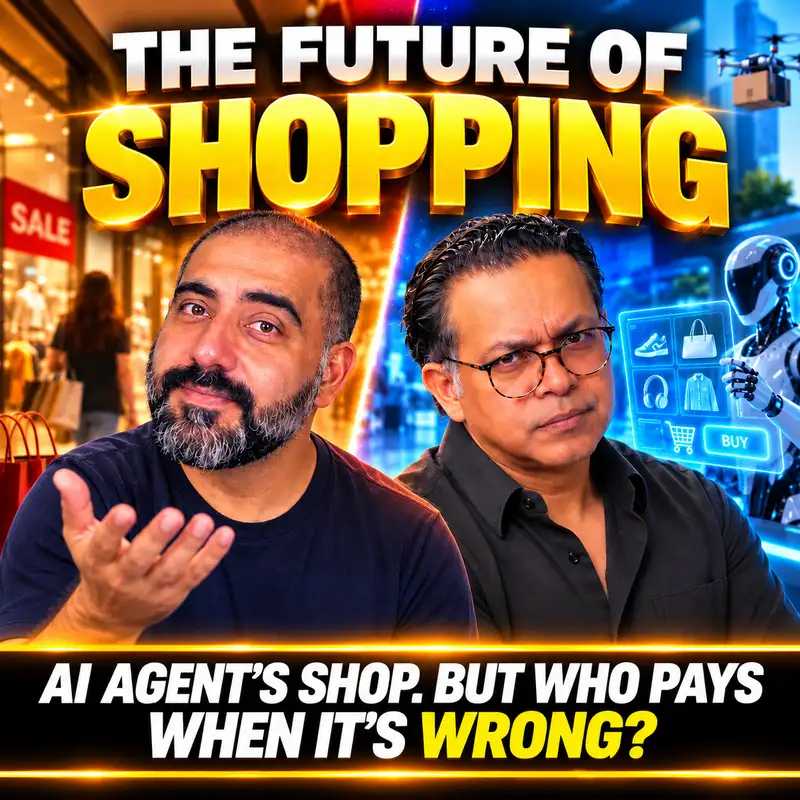
Memphis, Tennessee, 1916. A grocer called
Clarence Saunders opens a shop with a
turnstile at the entrance
and a checkout at the exit.
In between, there's no clerk fetching
your flour from behind a counter.
You walk the aisles,
you take the tins off the
shelf yourself, you carry them to
the till. He calls it Piggly Wiggly.
It's widely credited as the
first self-service grocery.
The labour of choosing has just
moved from the shop to the shopper.
Now, a Tuesday morning in Atlanta in 2030.
This is a possible future, not a fact.
Tamika Reed is 41 and she is a composite.
Overnight, her phone did the weekly shop:
milk, bread, detergent, the usuals.
And it stayed inside the
$100 she had allowed it.
It paid with a credit card number
that existed for one purchase.
And then it expired. And it paid the
same shelf price she'd have probably
seen if she had just walked
down her aisle herself.
In 1916, choosing moved from
the clerk to the shopper.
In 2030, it moves from the shopper to
software, which brings us to this autumn.
On the 21st of September, Amazon blocked
Meta's shopping agent from its website.
Exactly a month later, Walmart opens
its doors to approved shopping agents.
Two of the biggest retailers on earth,
the same question, opposite answers.
So three things to hold on to.
There's one number in this episode
that should make you doubt the hype.
There's a payments trick
from Hangzhou in 2004
that I think tells us how this
ends. And there's a question.
When the customer is the software,
who is the customer?
Welcome back to A to Z Fintech.
I'm Aman in my living room in Singapore.
And I'm Zubin, the Z in A to Z,
you're in my workspace in San Francisco,
where the guitars have
heard this argument before.
This is Part two of The Future Of,
our three-part series: work, shopping,
banking. Part one asked who pays you.
Today we ask who you pay and through whom.
Part three then goes on to
ask who holds the money.
And Aman the spine of all
three of these is five verbs.
See, move, borrow, grow, and protect.
For a shopper, that's
everything that happens in the,
I don't know, half a second
after you tap to pay.
In Part one, Divya had a dashboard
her bank wouldn't underwrite.
This time the bank can't even be
sure the customer is a person.
Before we go any further, Aman,
I'm gonna push on your premise.
Your notes say every shopper
revolution was a trust story.
I think some of them were just cheaper.
Self-service was,
I don't know, cost-cutting,
Amazon was a price war with free delivery.
Cost was the motive, trust was the
licence, in my opinion, Zubin.
Nobody lets strangers wander
their shelves or post money to
someone they've never met
unless something makes it safe.
The capitalist in me thinks otherwise,
but prove it in Act One
and I'll keep score.
Deal. Well, if you're new
to agents, by the way,
there are three earlier episodes
that sit underneath this one.
Bot Wars, our session on Stripe Sessions,
and my solo on Anthropic's
commerce agents.
But before we dive into
this episode, Zubin,
I think you have some legal jargon
to throw throw our viewers' way.
All right, folks, if you've
heard this podcast before,
you know exactly what's coming.
This podcast is for information
and entertainment purposes only.
The views expressed are of Aman and mine.
they're two dudes driffing
on topics that we care
about and does not
constitute financial advice,
legal, tax advice, and definitely does
not reflect the views of our employers.
And by the way, if you
use a shopping agent,
however good its manners, stay smart.
So there have been four acts
today: the past, the present,
the future, and what this
all does for your money.
The past comes down to one idea.
Every revolution in shopping removed a
friction. Distance, information, trust.
And there's a fourth, which is where
this episode in its entirety lives.
Attention. Distance, I think,
went first, as we said.
In 1872, Montgomery Ward's catalogue
brought the city store to the farmhouse
by rail and post with a printed
guarantee to make strangers trust it.
But Aman, so which one
did Piggly Wiggly remove?
I know you love saying that.
Now s not not actually. Yeah.
By the way, Aman. Hang on,
hang on, hang on.
I have a side story with Piggly Wiggly.
Way back, this is I'm
talking 2005 or 2006,
I actually did a side project where
I was at Kellogg doing business
school with a dairy
farmer out of Wisconsin,
really analysing his entire distribution,
which led me to guess who?
Piggly Wiggly. And I'd never
ever heard of this brand before.
And I've actually been to one of them.
So to answer your question on which
one Piggly Wiggly removed and take
you back to your business school days,
I think none, strictly speaking.
It moved the work,
but look at what it created.
Once there's no clerk
recommending the soap,
the box has to do the selling itself.
Self-service forced the brands into
packaging and national advertising,
something your business
school was very famous for.
So they could sell themselves straight
off the shelf. The shelf became a medium.
Attention as a business was seeded,
if you'd like, in 1916
So going back to the point
I was trying to make,
retail media's founding father is a pig.
Very successful pig.
Alright, then information
and a date that every
shopping or commerce
person should care about.
The 26th of June in 1974,
a Marsh supermarket in Troy, Ohio.
A cashier scans a pack of Wrigley's
Juicy Fruit gum with a barcode on it.
And and the store starts to know things.
every item, every lane, every day.
That data lets stores automate,
I don't know, replet replenishments.
It powers the big boxes,
Walmart and Costco
and category killers like Home Depot.
The barcode's real gift
wasn't a faster queue.
It was a retailer who knew more
than anyone else standing in it.
And then Zubin came trust,
which is of course your patch.
Yeah, let's let's talk
through that, right?
1950 Diners Club, 1958 BankAmericard,
which later became Visa,
and we've done an entire episode on it.
A network now separates the moment
you buy from the moment you pay.
The merchant trusts the network to settle,
the issuer trusts the cardholders to pay.
Nobody in the store has to trust anybody.
An and a trust layer dressed
up as plastic, if you'd like,
which brings me to the story
I want you to remember.
China 2003 eBay is in the
market through a local site,
EachNet, with the brand,
the technology, and the money.
Alibaba out of Hangzhou
launches Taobao against it.
Zero listing fees, a chat tool so
buyers can haggle with sellers,
and in 2004 Alipay with one rule.
The buyer's money sits in escrow
and the seller isn't paid
until the buyer confirms the
goods have arrived as described.
a market full of counterfeits,
that's not a feature, that's a product.
It really was Zubin. I was there to
see it and it drove eBay out of China.
eBay had, the technology,
but Alibaba had the trust layer.
And hold that thought. We'll
come back to it at the very end.
Aman, and as we were researching this,
we took this to India as well, right?
And every big emerging market built
its own bridge. Flipkart unlocked
Yeah.
India's e-commerce in in
2010 with cash on delivery
for shoppers wary of
putting a card online.
we we lived this with in in 2014,
where over the Lunar New Year,
WeChat's red envelopes
had people linking bank
Totally.
accounts by the millions. And then
I don't know, take April 2016,
a time when we really lived
much more closer together,
India launched UPI,
a public rail for instant
account-to-account payments
with no merchant fees.
Yeah, and we've both done time at
Google Pay, so the last one is very
personal and relevant as India
debates adding a small merchant fee.
Well, I'm I'm gonna I'm gonna take what
I said back in me being capitalist.
I'll you're right, right? I'll give you
Act One. Cost was the motive every time,
but each one shipped with
a trust device bolted on.
I'll take that.
Before anyone gets excited
about the future, a scorecard.
Four confident predictions
made by some very,
very serious people that totally missed.
Let's let's break these down.
One, in 2017, Credit Suisse
made a statement, a prediction,
a fifth to a quarter of American malls
gone by 2022. And the stores with it.
Colliers today says stores still
take about 85% of US retail sales.
Number two, 2018 OC&C voice shopping from
$2 billion to 40 billion dollars by 2022.
Smart speakers have really
become kitchen timers. 3.
2013 60 Minutes Jeff
Bezos shows off delivery
drones on a two to five year timeline.
And I think this is his quote.
I know this looks like
science fiction, it's not.
Well, reality is drones are still a tiny
fraction of the last-mile
delivery problem.
And the fourth, which we've talked quite
a bit about, in 2022, our favourite.
Zuck came on and said the metaverse.
Gartner, in fact,
went on and said a quarter
of us would spend an hour a day
there in 2026. Well, here we are.
And Let's just say Meta has
moved on to Muse and AI Agent.
Every one of them mistook
capabilities for equilibrium.
What about the bonus round?
Right, let's go back to Zuck
at F8 in 2016 said Messenger
bots would become the way
we talk to businesses.
Well, right interface wrong decade.
The technology worked,
the economics, the behaviour,
the rails, all the rules didn't settle.
So that's the test for the rest of today,
not whether it can be built,
whether it settles.
Act two, the present,
and a number to set the table.
eMarketer via Shopify puts
global online retail at $6.88
trillion dollars this year,
about a fifth of all retail.
and Zubin the footnote is the story.
That's true, that's true.
Take China out of it and that share I
think falls to under thirteen per cent.
Yeah, so twelve point eight to be precise,
but who's counting? So there's
Ha ha ha.
there isn't one future of shopping.
There are three operating
systems, in my opinion.
There's the Chinese one which builds
vertically inside
super-apps and warehouses.
There's the one in India
that's emerging that builds on
public rails with private
dark stores on top of them.
And then there's the West, where you live,
which is fighting it out between
open protocols and walled gardens.
Let's let's take China first a bit.
Lin Wei, another composite, is a
29-year-old product manager in Shanghai.
On the metro home, she asks Qwen,
her assistant inside Taobao,
for a low-calorie stir-fry,
as you regularly do yourself.
It builds the basket,
and 24 minutes later,
it's at her door from a front warehouse
nearby. She never sees a checkout.
Alipay settles it inside the app.
And down the coast in Fuzhou is Chen Bo.
27, also a composite, at the
other end of an order like hers.
An algorithm decides what
sits on the front racks.
He grabs a bagged order
in about 90 seconds,
and he's at the door in about 23 minutes.
And building it costs a fortune.
in 2025, Meituan, Alibaba and JD fought a
subsidy battle worth
around 100 billion yuan.
That's approximately 14
billion dollars, right?
Just to put things in perspective. Alibaba
alone pledged about 50 billion yuan.
JD even pitched social
insurance. for its riders.
Meituan's delivery engine,
core local commerce,
made an operating profit about
52.4 billion yuan in 2024.
By Caixin's account in 2025,
it lost 6.9 billion on revenue
that still grew, a swing of
nearly 60 billion yuan in a year.
So it bought its own
customers back at full price.
Yeah, and kept them, right?
Coverage of its 2025 results,
puts its food delivery share at about 60%.
And then of course, we've talked about
this. The regulators, SAMR called time.
So they stopped buying customers
and started buying warehouses.
In February, Meituan
agreed to buy Dingdong
Maicai's thousand front
warehouses with spoilage
of 1 to 2% And all three went after Pupu,
the Fuzhou chain with more
than 70% penetration.
I swear I didn't put that
in the script for you, but
Ha ha ha.
I hope you enjoyed that. Look, subsidies
rent habits and warehouses own them.
Right, and and agents live inside
the same closed loop, right?
At Lunar New Year, on the back of what
400 million dollar voucher campaign,
Alibaba's Qwen app handled what,
10 million milk tea orders in nine hours.
And I think we covered
this last year as well.
And now testing in a merchant agent,
Qwen Work, which, you know,
TechTimes reports Alibaba
wants every Taobao
and Tmall seller on by the end of 2027
I swear I think I bought nine
million milk teas for my children.
I don't know if your kids
are in a bubble tea,
but it's a huge craze in Singapore.
It's it's an Asian thing.
It's an Asian thing.
Is this? Okay. So one ecosystem runs
the chat, the shop, and the wallet.
No protocol debate. One building. India
next. And let's take Imran and Lakshmi.
Dual-income couple in Hyderabad, another
composite. Coffee runs out mid-meeting.
And it's at the door in
about eleven minutes.
Aman you talked about your
experience in a previous episode.
This is, one of five thousand plus dark
stores run by Blinkit, Swiggy Instamart,
Zepto, and up from barely about three
thousand a year earlier, which is crazy.
So the corner shop now essentially
Zubin lives in a warehouse.
Yeah, and it it isn't a niche, right?
Bain and Flipkart put quick
commerce at two-thirds of
India's online grocery orders
and a tenth of all e-retail.
And the money side matters.
Top-ups go on UPI, but when Lakshmi
buys a 28,000 rupee hair tool,
as she does, she taps a pre-approved
credit line on UPI at the checkout.
Move and borrow are fused
inside a delivery app.
Meanwhile, Getir and Gorillas
tried it in the West.
Gorillas was sold to Getir at
what a steep discount in 2022,
and by 2024, Getir had left the UK,
the US, and most of Europe.
It it occurs to me, Zubin,
that as we dabble with shopping,
the one difference between shopping and
and finance is that the names are much
more creative, let me put it that way.
so so essentially it's
Hyderabad, not Hackney.
Exactly. Four conditions, right?
Density, so a rider can batch
two to three drops a trip,
wages, because courier pay
makes or breaks it, right?
direct procurement, so spoilage stays low,
and then categories beyond groceries,
things like chargers, the example you gave
in the past episode, beauty, medicine.
It's a labour and density
trade, not a technology.
Which is why the robots in Act Three
matter more to London than to Mumbai.
Now let's go to the West and let's go
back to Tamika again in in the present.
In September, she asks
Meta's new agent Muse
to buy a rain cover for
a pushchair on Amazon.
Amazon said nope. Muse gets an error.
Continued access by an unauthorised
agent violates Amazon's T's and C's.
So Muse takes her to Walmart,
one of its launch partners,
and she approves a one-time card.
Then on the twenty first of October,
Walmart opens a proper door in beta,
the Agent Gateway, built on the
open Model Context Protocol.
Approved agents can buy
directly and see her
usuals without seeing her whole
purchase history. That's kind of big.
Yeah. And Aman,
I'm gonna do a slight plug.
This early this morning I actually did
a webinar with MRC on agent payments.
And one of the key concepts
I talked about in my
webinars this notion of
front door versus side door.
What Muse Instinct are all doing
is coming through the front door.
And for merchants, they can't tell the
difference between bad
bots and these agents.
And I think what Walmart and what
the open protocols are that are out
there are attempting to do is
create a true legitimate side door.
And so as the industry
thinks about what's the
proper door to open to
our analogy right here,
Yeah.
it's creating those side doors
and creating real legitimacy
for these transactions is what's
gonna make the difference.
I I wonder to some extent,
like the need is
greater in the West, given the
cost of labour. But the Yeah,
And exactly, I think that's
the point you're making. Yes.
but the orientation is
stronger in the East.
and and I mean this but let
me go go here for a second.
Like people are used to
having helpers in the home,
people are used to having a service
elevator as opposed to a main elevator
physically in a building you've grown
up in. in places that have that.
There's a entire subculture
around that side
door you refer to as
opposed to the main door.
I wonder whether need versus
orientation will play a role,
but you know, back to you.
That's a good point. But coming back
to the point we were just making,
it's it's really a combination of need in
this case where human power and labour
power sort of density
sort of makes up for it.
In the Western world, agents are
required to sort of address that
Yeah.
problem. Right. So and and coming
back to the point we were just
trying to make around
Agent Profiles, right?
Like due within a month work like
adding authorised cardholders?
These are the mandates that the
industry is driving towards,
approves every order or sets a limit.
Whether it's $50, $100, $200,
the agent never sees the card,
and all they really see is that.
Yeah, and Tamika plans to set a hundred.
And Walmart made a promise, I would frame,
We price products, not people.
So the prices that an AI agent sees
are the same prices a customer sees.
So I guess the question
is why does one giant
lock the door and the other open it up?
Well, it's simple. Follow the ads.
Forbes puts Amazon's advertising
business, it's something
that nobody talks about,
at around 68 billion dollars a year.
And today's shopping agents
skip the sponsored tiles.
They read prices, stocks, and reviews,
and they hide the browsing data
and the ad machine runs off.
Yeah, so it's the agent isn't
attacking Amazon's checkout,
it's really just attacking
Amazon's billboard.
Exactly, and people think always about
Google when it comes to advertising,
but Amazon's massive and retail's
real profit pool is attention.
So agents threaten that ad
model more than the till.
The incumbent with the
biggest ad business walls in.
The one chasing shares opens up,
even with ads of its own.
Walmart's open, Amazon blocks. And I've
seen this film from the bank side.
Banks fought the aggregators,
scraping their customer logins,
and they continue now to try
and do that with agents.
But in 2018, Britain's competition
regulator made the
biggest banks open APIs.
Similar
Yeah, yeah.
things happened in India,
similar happened in Singapore,
with consent screens, of course. Amazon
is essentially the bank in this story.
Yeah, and it's let's do
a reality check, right?
ICSC and McKinsey found that
about 68% of American shoppers
used an AI tool while shopping
in the first quarter.
But in Capgemini's global survey, 71%
worry about how Gen AI uses their data.
And then I think what 76% want the ability
to set strict limits on an AI assistant.
Curious, but I guess
they're not yet trusting.
That's true, that's true. And and your
open-against-walled split is too neat.
You know, and on Amazon's
results calls in in February,
Andy Jassy said of the AI companies, and
this is quote, we have to try to find a
customer experience together that's
better. I I d this isn't a wall.
What I read it is a tollgate,
the JPMC of of banking, right?
Which is still under construction.
Yeah, that's fair. Open against
walled isn't binary, I think.
Amazon is likelier to, I guess, sell
access on its own terms than to stay shut.
I guess you could have that one, Zubin.
Alright, the Walls Concession, number one.
Okay, so Act Three,
the future, out to 2035.
Four forces, and they spell CART:
compression of time and distance,
agents, rails, and tolls,
meaning where the rent goes.
Well, you spend a lot of
time on that acronym man.
It's the it's like your interchange one,
right? So it's I'm gonna pull things.
All right, all right, God,
God, go on, go on, go on.
Okay, I have and I'm I'm not sorry,
spent some time on this.
Next to it is a framework of
our own, the Delegation Ladder.
Rung one is the agent researches.
Two, it recommends.
Three, it fills the basket
and you tap to pay.
Four, it pays by itself
within limits you set.
And then five, your agent
negotiates with the shop's agent.
And the Fed draws the line
between three and four.
At Sibos Governor Waller
split agent-assisted commerce
where you still pay from agent-delegated
where the agent can buy.
Almost all of today's volume
sits on rungs one to three.
Yeah. Prof Z, the forecasts,
and the ruler problems.
Well, that's true. That's true.
So forecast for agentic commerce
runs to anywhere from 144
billion to about 5 trillion,
which is crazy, a 35-fold gap.
This isn't a disagreement.
It's just different rulers.
The shortest is eMarketer's
144 billion by 2029,
which really counts only US sales
completed inside an AI platform.
Morgan Stanley counts US purchases.
An agent executes at about somewhere
between 190 to 385 billion by 2030.
Bain counts anything an agent initiated,
influences, or completes,
which is somewhere in that 300 to
500 billion in the US by 2030.
So essentially one measures the till,
one the hand on the basket,
and one the whisper in your ear.
Yeah, and I've already
got to the biggest one.
And then, our our friends at
McKinsey, the longest ruler,
count that up to a trillion
dollars in the US.
And, you know, somewhere about three to
five trillion with the T globally by 2030.
And this is for consumer
goods orchestrated by agents.
And orchestrated is doing the heavy
lifting. It's not about completed.
And what about Gartner's fifteen trillion?
Alright, that's different planets, right?
So I think that's more B2B buying.
I think it's by 2028 Bigger and
boring first because purchase
orders and approved suppliers
come with guardrails built
Okay, payables agent pays
suppliers invoices against
purchase orders with scoped
credit card credentials.
Visa is piloting exactly that
with BILL and Billtrust.
Now the number I promised you, the one
that should make you doubt the hype.
Less than 1%. Bain in May, AI is under
1% of total retail website traffic,
even where it's up to a
quarter of outside referrals.
And I think Checkout.com did this
their own data report in in July,
puts agents at about three
per cent of transactions.
And yet the people who do
arrive from AI, they buy.
They do, and and it's
funny because I referenced
a lot of this data in my
webinar earlier today.
Adobe did this really good
study which says AI-referred
shoppers convert 54% better
than other traffic. And what's
Yeah.
crazy is less than a year
ago, it was 23% worse.
Let that sink in, that sort
of shift that has happened.
And granted, this is a
small and tiny base,
and I would even peel the
onion one layer back.
Even it's the it's not just
a lift and conversion.
Because these shoppers show
up with better intent,
they're staying on the page
longer and they're buying more.
Yeah, and and we talked a little
bit about Stripe's John Collison.
That's right.
I even have my Cheeky Pint podcast mug,
but Payments Dive reports he says
the agentic activity only as of September
basically started going vertical.
Vertical from a small base
and he gives no numbers.
So AI is already a research
engine and barely a buyer.
Discovery moves first,
checkout follows later.
Yeah, it's a crowded field, Aman, right?
Meta says Muse passed ten
million users in six weeks.
I think it was five in the first week,
so nearly doubled in first four weeks.
So it's like really doubling in a really,
really sh quick period of time.
About two hundred dollars an
order Meta's own numbers.
OpenAI has Dots, Google has open protocols
for the cart and payment mandate.
In fact, they launched their universal
protocol earlier this month,
and then Anthropic has
Claude Duet in preview.
I know it came out almost as we launched
our bots programme and and of course
That's right.
we use Claude in our own production
efforts increasingly, so
Right. So, so hold your
dates loosely, right?
Gartner expects more
than 40% of agentic AI
projects to be cancelled
by the end of 2027.
And of 50 retail executives
McKinsey surveyed,
45 had considered an agentic tool,
and fewer than five had a
board-aligned strategy.
All right, my own date for mainstream
delegated checkout for ordinary shoppers,
rung four, was the end of 2028 I'm
moving that now, I think, to 2030
The Trough Concession.
I'll take that, that's two.
Don't get used to it. Okay.
Rails, Zubin, and and the human problem,
which Governor Waller put in one
line at Sibos: who is on the hook if
an agent makes the wrong purchase?
Prof Z, know your agent.
Right, right. And here's
the uncomfortable bit.
For as long as as many of
us have worked in payments,
fraud teams were paid to stop
software from buying things.
Now the bot is the customer.
So know your customer becomes
essentially know your agent.
And what happens when
the agent gets it wrong?
Right. 22 September, six banks,
including Bank of America,
I think it was Capital One, ING, NatWest,
said liability outcomes should reflect
where the risk and errors were introduced.
That's the whole fight in one line.
Liability is the product.
So waller named three
walls. Authentication.
Is this agent real and is this
acting for you? There's liability.
Who pays when it's wrong? And fraud
systems rebuilt for machine speed.
Meanwhile, LexisNexis cited
second-hand says every dollar
of direct fraud costs US
merchants 5.13 cents in total.
So Zubin, what's the fix?
I would argue the Apple Pay trick.
Never hand over the real card.
Mastercard Visa,
the network token services,
Yeah.
the one behind your network cards,
your Visa Mastercards in Apple
Pay now issues agentic tokens tied
to one agent and its own rules.
A ceiling, a merchant type, an expiration.
And since the 13th of
September, it also scores
how likely a payment is
to come from an agent.
Visa's Trusted Agent
Protocol with Cloudflare
tells a verified agent from a scraper.
Amex records proof of intent,
Stripe issues one-time cards,
x402 lets machines pay machines
in fractions of cents.
And I know, Mastercard's also piloting
x402 with Cloudflare Coinbase.
Zubin Da Vinci would call that
making the complicated simple. Tolls
Hope so.
Tolls. Where does the rent go?
Let's talk about tolls.
Where does the rent go when
nobody's looking at the ads?
Yeah, Zuck answered at
Connect in September
as you know is reported no ads in Muse.
You know, Meta expects to make their money
from taking a small fee
on the transaction.
Essentially from renting attention
to I guess taxing intent,
from the billboard to the tollbooth
Yeah, so brands now sell to
machines, the exact specs,
no surprise fees,
accurate stock, low returns.
I think we we were researching this.
Euromonitor says agents favour
clear, structured propositions.
Okay. Seun Adeyemi, 36,
our Portland composite,
runs a trail-running
shoe brand on Shopify.
Couldn't make that up. Or could we?
On the 8th of September,
Shopify shared his
catalogue with Meta's agent by default.
So he rewrote his product data for
software, toe-box width, heel drop.
The returns rule in plain words.
And his proof it's working?
Not a conversion number,
he's still the merchant of record.
The agent brings the order,
but the customer,
the support, the relationship stays his.
Compression quickly. Drones
are a supplement, not a fleet.
China runs what tens of thousands
of driverless delivery vans,
and Amazon passed a million robots in
its up in its operations last year.
And and remember London, pavement robots
already make short food delivery runs,
pay wherever minimum wage
kills a four-dollar fee.
So humanoids at scale,
2028 to 2032 at best.
And stores, Zubin, this is a big
one, don't die, they polarise.
ICSC and McKinsey say each
store has to pick a job:
convenience hub, discovery
destination, or dark node.
97% of Gen Z still shop in stores.
What hollows out is the routine middle,
the weekly shop Tamika's phone now does.
Yeah. And now the critical part.
Let's start with prompt
injection and scope creep.
A website that talks your agent into
express shipping, you never asked for.
In fact, OpenAI reportedly
shelved an internal project.
internal model called Astra
over scope and authorisation.
The other one is surveillance pricing,
which is why Walmart made the pledge.
Here's another one liability gaps.
No protocol yet settles who
pays for an agent's mistake.
And then let's talk about gatekeepers.
Three or four agents replace the
search box and the shelves at once.
And finally, I want to
end with you know what.
Most Europeans care a lot
about and most of all
of us should care about
is data sovereignty.
Muse launched in the US and Canada
alone and essentially left out the EU.
The human edge. Chen Bo's pay, insurance
deductions, and incentives are set
by a dispatch algorithm,
and nobody negotiates with that.
As agents speed up the front end,
the pressure lands on the person
carrying the bag. So three waypoints.
2027, the trough. 2030, business buying
and household replenishment at scale.
2035, software as the
default shopper for staples.
First to go, the boring,
low-regret, repetitive stuff.
Detergent, invoices, chargers.
The last to go will be fashion, luxury,
fresh produce, anything
that is emotionally loaded.
And let's run the scorecard test.
Replenishment loses the attention
friction and only rails stand in its way.
Fashion loses a friction people
enjoy. So behaviour stops it.
OpenAI reportedly stepped back
from in-chat checkout in March,
and we covered this,
and reportedly blamed Rails and
support load, not the model.
Okay, Act Four. And the reason a banker
and a payments man care about shopping.
Checkout used to be the
end of the journey.
Now it's the trigger for the whole
Money OS. Five verbs, one line each.
Yeah, which is we talked about this,
right? Let's start from See.
Agents leave an order
trail and Walmart's Agent
Profiles show each agent's
order against its own limit.
Seun sees every agent's order
land as his own customer.
The risk for a bank is that all
it sees is an opaque token.
Move tokens, one-time cards,
x402 for machines,
UPI in India and in Shanghai Lin
Wei never sees the payment at all.
Number three, borrow.
The agent picks between your cards and
buy-now-pay-later in milliseconds.
Imran and Lakshmi already choose
credit on UPI at checkout.
Grow rewards and yield. An agent
working to your rules will always
reach for the card with the better offer.
So the habit of using whatever card sits
on top of the wallet goes. That's big.
And yeah, and and and five is protect
liability and know your agent.
Everything we said in Rails.
So the contest at the checkout
isn't really about payments,
it's about who owns the
customer relationship.
And Treasury Watch the operating
accounts and sweeps anything above
Friday's payroll into a tokenised
treasury fund without asking anyone.
Treasurers have swept cash for decades.
What's new is the agent
doing it unprompted
on rails that reach retail deposits too.
Some commentators have called
that the agentic bank run,
where idle money leaves 0.1% accounts for
3.3 to 5% or high-yield savings accounts.
That's a scenario from commentary.
It's not a forecast, but it's
also why Part three exists.
Alright, let's let's do this. Bets, one
each. Mine follows the Walls Concession.
By the 31st of December 2027,
Amazon publishes a official programme,
API or MCP endpoint,
that lets named outside agents
search and buy on Amazon.com.
Resolution, Amazon's newsroom
or developer documentation.
I think that's a good one.
Mine follows the liability.
By the 31st of December 2027, more near
term, Visa or Mastercard publishes
a dispute rule or reason code specific
to agent-initiated transactions,
or the CFPB, the Fed or Britain's
FCA issues a rule or formal
guidance on who's liable when an agent
buys the wrong thing. Resolutions.
the network's published rules
or the regulator's own website.
And Aman if we're wrong.
Same deal as Part one, Zubin. We come
back on air and we eat pie. Humble pie.
That's right, that's right.
And and by the way I can feel it.
Here comes the mic drop.
Go back to Memphis,
Clarence Saunders took the
clerk away and handed his
shelves to strangers.
Then go to Atlanta in 2030, where
Tamika hands the shelf to software.
Both times, the technology is the easy
part. The one number, less than 1%.
AI is barely a buyer today. The hype is
right about the direction and wrong,
if you'd like, about the timing.
The trick from Hangzhou,
eBay had the better technology.
Alibaba held the buyer's
money until goods arrived.
It took the stranger's risk
off the buyer and it won.
The agent era will be won by the same way,
by whoever underwrites
the software's mistake.
And who is the customer when
the customer is the software?
In law, it's still Tamika.
In commerce, whoever stands behind
the agent when it gets it wrong.
The firm that says, if my software
buys the wrong thing, that's on me.
Every shopping revolution
looked like a technology
story and turned out to be a
trust story. This one will too.
Which is why Part three is about the bank.
Because while the software shops,
someone still has to hold the money.
So that's Part two of
The Future Of series.
We talked about work,
shopping, and next, banking.
A question for you and and
tell us in the comments,
would you let software do your weekly
shop? And what limit would you set it?
Fifty dollars, a hundred, none at all?
And by the way, we read every answer,
even the ones written by agents,
and for the record, final score,
Act One to Aman, two concessions to me.
He's been waiting all
episode to say that. Okay.
Yeah.
Part three, The Future of Banking,
lands in a couple of weeks,
and if you want the long read, I'll be
issuing an essay on A Man Who Blogs.
All right, subscribe and share
this with that one person
in a team who still thinks agents are
a 2035 problem. And leave a review.
It helps people like you find us.
Stay curious.
Stay purposeful.
And stay within your limit.