Click here to watch a video of this episode.
Stripe shipped 288 features in a single morning at Sessions 2026 in San Francisco. The right pattern match for what the company is becoming is not Visa, Mastercard, or PayPal — it is Google in 2006.
On the final Wednesday of April, almost ten thousand founders, engineers, and CFOs queued around Yerba Buena Gardens, the same plaza where Steve Jobs unveiled the iPhone nineteen years earlier, to hear Patrick and John Collison announce the largest single-morning product launch in fintech history. (334 if you count the entries on the public roadmap, per Stripe's own footnote.) The 288 launches grouped into five buckets, three of which would have been laughed out of a payments conference five years ago.
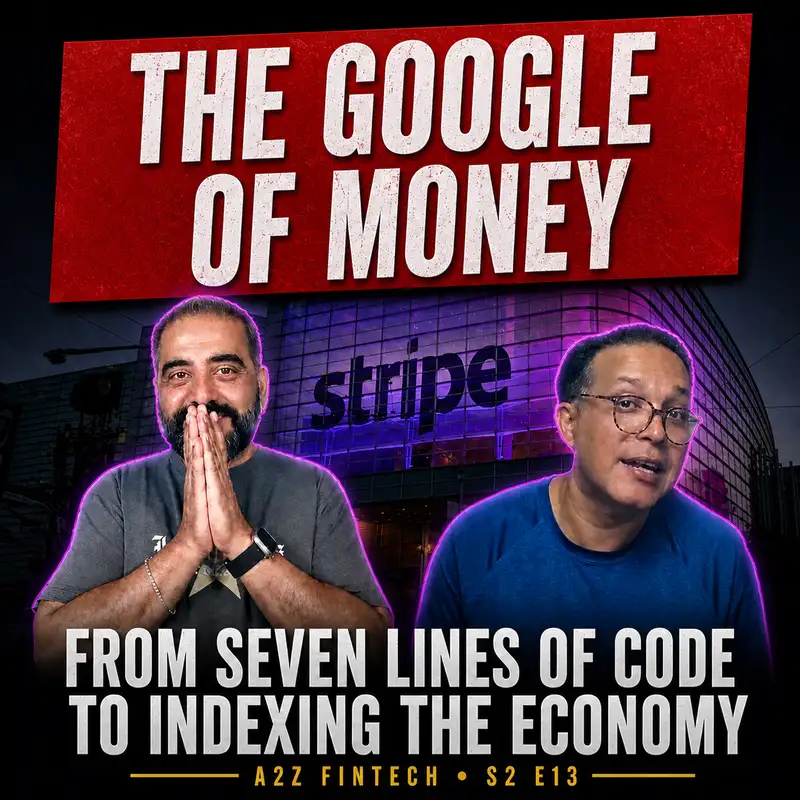
Aman Narain and Zubin Vandrevala break down what Stripe Sessions 2026 actually shipped, why payments was always the wedge rather than the company, and the long-arc historical parallel that explains the architecture. This is part one of an A2Z Fintech anniversary special, marking 30 episodes and one year since the show's first recorded cameo, on Stripe Sessions 2025.
Key takeaways:
1. Stripe shipped 288 product launches at Sessions 2026 in a single morning, grouped into five buckets that share one thesis: payments was the wedge, not the company.
2. Three transformations are running simultaneously: rails (Tempo, Bridge, Privy, Link, the Machine Payments Protocol), mission (GDP of the internet to economic infrastructure for AI), and customer (developer-led to enterprise-led).
3. The right pattern match for Stripe is not Visa, Mastercard, or PayPal. It is Google in 2006: a company that started narrow, ate every adjacency, and built its moat on the index rather than the algorithm.
4. Stripe processed roughly two trillion dollars in payment volume in 2025, equivalent to about 1.5 percent of global GDP, at a 40 basis point take rate that can only be grown by stacking software on top.
5. The unit of growth has changed: Stripe used to grow when more humans bought things online; it now grows when more businesses are created, which is parabolic in the AI era.
Topics covered:
- The five buckets of Sessions 2026: stablecoin shadow banking, agentic commerce, the full-stack business bank, AI-native revenue, trust at agent scale
- Tempo, Bridge, Privy, Link, and the Machine Payments Protocol as the kit you build to be a network, not a payment processor
- Why a Brazilian merchant paying a freelancer in Manila no longer needs to touch SWIFT
- The Visa-in-1976 parallel for Stripe's stablecoin posture
- The mission shift: GDP of the internet was horizontal; economic infrastructure for AI is vertical
- Eileen O'Mara, Tyler Bryson, and the quiet construction of a Salesforce-grade enterprise sales motion
- Why financial infrastructure now sits in the same enterprise budget category as cloud infrastructure
- Two trillion in TPV, 40 basis points, and how that take rate grows from here
- The Google of money thesis: phase one to phase four, search ads to Vertex AI, the index as the real moat
- Founder leverage and why Patrick and John can run R&D budgets that look more like Bell Labs
- A tee-up for Part 2 (S2E14, publishing next week): the Machine Payments Protocol, the protocol war between Visa, Mastercard, OpenAI, Google and Meta, and the playbook for founders
Chapters:
Referenced in this episode: Stripe Sessions 2026; the 288 launches and 334 footnote; Tempo (layer 1 blockchain co-built with Paradigm, mainnet March 2026); Bridge ($1B+ stablecoin orchestration acquisition); Privy (110M programmable wallets); Link (250M consumer wallets); the Machine Payments Protocol; Metronome; Patrick Collison's "GDP of the internet" mission; Stripe Atlas, Treasury, Billing, Tax, Capital, Issuing, Connect, Radar, Sigma; Stripe's internal tender at ~$107B (reports as high as $159B); TPV ~$2T in 2025, up 34%; net revenue $5.1B; free cash flow over $2B; 40bps take rate; Fortune 100, 500, top US software, and Forbes AI 50 penetration; Eileen O'Mara, Tyler Bryson, Will Gaybrick, Emily Sands, Mike Clayville; the Steve Jobs iPhone keynote at Yerba Buena Gardens, January 2007; Andy Grove, Jensen Huang, Sergey Brin, Max Levchin and the immigrant founder pattern; Google's 1998 mission and the search-to-cloud arc; Google Cloud at ~$50B run rate in 2025.
Related episodes: S2E14 — The Google of Money, Part 2: Rewriting the Rules of Agentic Commerce [link TBD] (publishing next week); A2Z Fintech's first cameo on Stripe Sessions 2025 [TBD]; the Mastercard / BVNK breakdown [TBD]; S2E11 — Pit Wall, Podium and Pie: Q1 2026 Fintech Scorecard [TBD]; S1E16 on the one-person enterprise [TBD].
Hosted by:
Aman Narain writes at amanwhoblogs.substack.com. Zubin Vandrevala is your payments provocateur.
Enjoying A2Z Fintech? Leave a rating and review on Apple Podcasts. It is the single biggest signal to the Apple algorithm and how new listeners in our world find us.
For information and entertainment only. Not financial advice.
Transcript:
Stripe shipped 288 features in a single morning at Sessions 2026 in San Francisco. The right pattern match for what the company is becoming is not Visa, Mastercard, or PayPal — it is Google in 2006.
On the final Wednesday of April, almost ten thousand founders, engineers, and CFOs queued around Yerba Buena Gardens, the same plaza where Steve Jobs unveiled the iPhone nineteen years earlier, to hear Patrick and John Collison announce the largest single-morning product launch in fintech history. (334 if you count the entries on the public roadmap, per Stripe's own footnote.) The 288 launches grouped into five buckets, three of which would have been laughed out of a payments conference five years ago.
Aman Narain and Zubin Vandrevala break down what Stripe Sessions 2026 actually shipped, why payments was always the wedge rather than the company, and the long-arc historical parallel that explains the architecture. This is part one of an A2Z Fintech anniversary special, marking 30 episodes and one year since the show's first recorded cameo, on Stripe Sessions 2025.
Key takeaways:
1. Stripe shipped 288 product launches at Sessions 2026 in a single morning, grouped into five buckets that share one thesis: payments was the wedge, not the company.
2. Three transformations are running simultaneously: rails (Tempo, Bridge, Privy, Link, the Machine Payments Protocol), mission (GDP of the internet to economic infrastructure for AI), and customer (developer-led to enterprise-led).
3. The right pattern match for Stripe is not Visa, Mastercard, or PayPal. It is Google in 2006: a company that started narrow, ate every adjacency, and built its moat on the index rather than the algorithm.
4. Stripe processed roughly two trillion dollars in payment volume in 2025, equivalent to about 1.5 percent of global GDP, at a 40 basis point take rate that can only be grown by stacking software on top.
5. The unit of growth has changed: Stripe used to grow when more humans bought things online; it now grows when more businesses are created, which is parabolic in the AI era.
Topics covered:
- The five buckets of Sessions 2026: stablecoin shadow banking, agentic commerce, the full-stack business bank, AI-native revenue, trust at agent scale
- Tempo, Bridge, Privy, Link, and the Machine Payments Protocol as the kit you build to be a network, not a payment processor
- Why a Brazilian merchant paying a freelancer in Manila no longer needs to touch SWIFT
- The Visa-in-1976 parallel for Stripe's stablecoin posture
- The mission shift: GDP of the internet was horizontal; economic infrastructure for AI is vertical
- Eileen O'Mara, Tyler Bryson, and the quiet construction of a Salesforce-grade enterprise sales motion
- Why financial infrastructure now sits in the same enterprise budget category as cloud infrastructure
- Two trillion in TPV, 40 basis points, and how that take rate grows from here
- The Google of money thesis: phase one to phase four, search ads to Vertex AI, the index as the real moat
- Founder leverage and why Patrick and John can run R&D budgets that look more like Bell Labs
- A tee-up for Part 2 (S2E14, publishing next week): the Machine Payments Protocol, the protocol war between Visa, Mastercard, OpenAI, Google and Meta, and the playbook for founders
Chapters:
Referenced in this episode: Stripe Sessions 2026; the 288 launches and 334 footnote; Tempo (layer 1 blockchain co-built with Paradigm, mainnet March 2026); Bridge ($1B+ stablecoin orchestration acquisition); Privy (110M programmable wallets); Link (250M consumer wallets); the Machine Payments Protocol; Metronome; Patrick Collison's "GDP of the internet" mission; Stripe Atlas, Treasury, Billing, Tax, Capital, Issuing, Connect, Radar, Sigma; Stripe's internal tender at ~$107B (reports as high as $159B); TPV ~$2T in 2025, up 34%; net revenue $5.1B; free cash flow over $2B; 40bps take rate; Fortune 100, 500, top US software, and Forbes AI 50 penetration; Eileen O'Mara, Tyler Bryson, Will Gaybrick, Emily Sands, Mike Clayville; the Steve Jobs iPhone keynote at Yerba Buena Gardens, January 2007; Andy Grove, Jensen Huang, Sergey Brin, Max Levchin and the immigrant founder pattern; Google's 1998 mission and the search-to-cloud arc; Google Cloud at ~$50B run rate in 2025.
Related episodes: S2E14 — The Google of Money, Part 2: Rewriting the Rules of Agentic Commerce [link TBD] (publishing next week); A2Z Fintech's first cameo on Stripe Sessions 2025 [TBD]; the Mastercard / BVNK breakdown [TBD]; S2E11 — Pit Wall, Podium and Pie: Q1 2026 Fintech Scorecard [TBD]; S1E16 on the one-person enterprise [TBD].
Hosted by:
Aman Narain writes at amanwhoblogs.substack.com. Zubin Vandrevala is your payments provocateur.
Enjoying A2Z Fintech? Leave a rating and review on Apple Podcasts. It is the single biggest signal to the Apple algorithm and how new listeners in our world find us.
For information and entertainment only. Not financial advice.
Transcript: