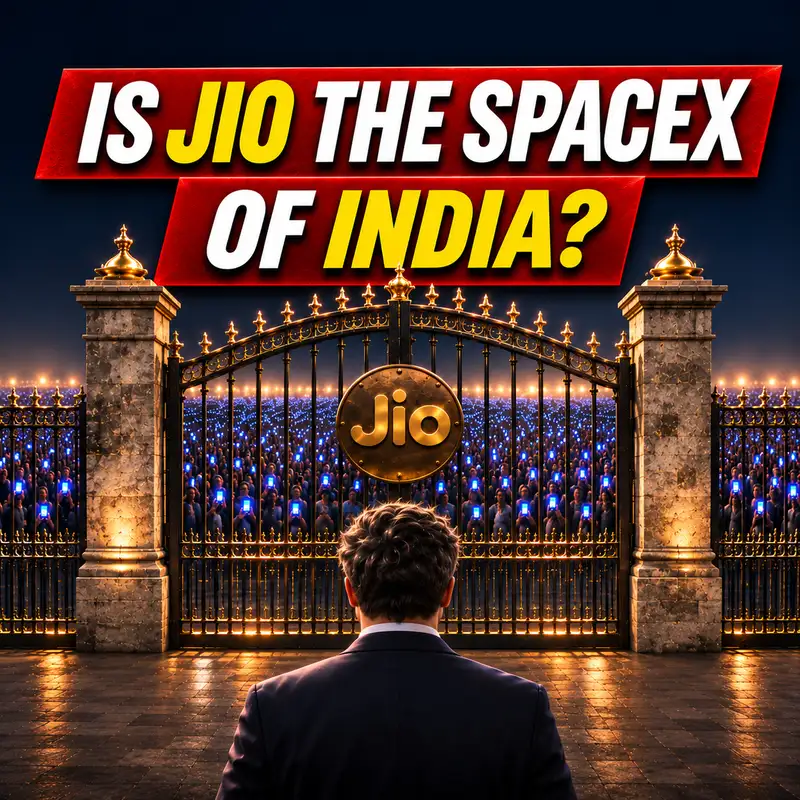
Click here to watch a video of this episode.
The Jio IPO raised $3.2 billion, the biggest listing in Indian history, and nobody sold a single share. Three weeks earlier Elon Musk had asked whether Mukesh Ambani is "the real boss of India".
On 28 October 2026 Jio Platforms listed in Mumbai at 1,358 rupees a share, 21% above its issue price, a value of about $130 billion. The Jio IPO was 22 times subscribed, yet retail investors, the people Dhirubhai Ambani built Reliance on, barely turned up. The twist came from Reliance itself: answering Musk's charge that oligarchs were blocking Starlink, it disclosed that Jio's own satellite service is waiting for the same security clearance.
Aman Narain and Zubin Vandrevala break down what the Jio IPO was really for, whether Jio is the SpaceX of India or its Bell System, and what a landlord with a listed share means for every fintech on its rails.
Key takeaways:
1. The Jio IPO was not a growth raise: nobody sold a share and most of the $3.2 billion repays debt, so what it really bought was a listed share price to spend.
2. Jio and SpaceX run the same playbook: win the allocation, collapse the unit cost, own the stack and let the cash machine fund the moonshot.
3. In structure Jio is closer to the Bell System than to SpaceX: one network, one country, one government, until the state changes its mind.
4. Musk alleges that Ambani is locking Starlink out of India, yet Jio's own satellite service is waiting on the same security clearance.
5. Every Indian fintech is a tenant on Jio's rails, and a landlord with a listed currency does not raise the rent. He buys the tenants.
Questions answered:
- What is the Jio IPO? India's largest: Jio Platforms raised 30,213 crore rupees (about $3.2 billion) in new shares and listed on 28 October 2026.
- Why is Starlink not available in India? It has its licence. What it lacks is a Home Ministry security clearance, the same one Jio's satellite service is waiting for.
- Is Jio the SpaceX of India? In ambition and in its dealings with the state, yes. In structure it is closer to the old Bell System.
Topics covered:
- The listing: 21% up on day one, 70 times subscribed by institutions, under three times by retail
- Why 42 times earnings only works if revenue per customer keeps rising
- How a non-compete that expired on 23 May 2010 let Mukesh Ambani back into telecoms
- Four moves Jio shares with SpaceX, and Zubin's case that it is really the Bell System
- The satellite spectrum fight Jio lost in 2024, and Musk's three posts in October 2026
- Whole or parts, and the bet: Jio or Airtel by November 2027
Enjoying A2Z Fintech? Leave a rating and review on Apple Podcasts. It is the single biggest signal to the Apple algorithm and how new listeners in our world find us.
Chapters:
Referenced in this episode: the Jio Platforms IPO, 21 to 28 October 2026; Elon Musk's posts on X, 7 to 9 October 2026; the Indian government's reply and Reliance's statement of 16 October 2026; Airtel and Jio second-quarter results; the 2010 broadband spectrum auction and Infotel Broadband; India's 2024 decision to allocate satellite spectrum without an auction; the 1984 break-up of the Bell System.
Corrections: Reliance's statement was issued on 16 October 2026, not 9 October. The IPO was 22.19 times subscribed overall and 2.72 times by retail investors, not 21 and 2.76. Dhirubhai Ambani died in 2002; the brothers divided the group in 2005.
Related episodes: S2E25, UPI at 10; S2E17, SpaceX's $2 Trillion IPO vs the AI Listing Race.
Hosted by:
Aman Narain writes at amanwhoblogs.substack.com. Zubin Vandrevala is your payments provocateur.
For information and entertainment only. Not financial advice.
Transcript:
The Jio IPO raised $3.2 billion, the biggest listing in Indian history, and nobody sold a single share. Three weeks earlier Elon Musk had asked whether Mukesh Ambani is "the real boss of India".
On 28 October 2026 Jio Platforms listed in Mumbai at 1,358 rupees a share, 21% above its issue price, a value of about $130 billion. The Jio IPO was 22 times subscribed, yet retail investors, the people Dhirubhai Ambani built Reliance on, barely turned up. The twist came from Reliance itself: answering Musk's charge that oligarchs were blocking Starlink, it disclosed that Jio's own satellite service is waiting for the same security clearance.
Aman Narain and Zubin Vandrevala break down what the Jio IPO was really for, whether Jio is the SpaceX of India or its Bell System, and what a landlord with a listed share means for every fintech on its rails.
Key takeaways:
1. The Jio IPO was not a growth raise: nobody sold a share and most of the $3.2 billion repays debt, so what it really bought was a listed share price to spend.
2. Jio and SpaceX run the same playbook: win the allocation, collapse the unit cost, own the stack and let the cash machine fund the moonshot.
3. In structure Jio is closer to the Bell System than to SpaceX: one network, one country, one government, until the state changes its mind.
4. Musk alleges that Ambani is locking Starlink out of India, yet Jio's own satellite service is waiting on the same security clearance.
5. Every Indian fintech is a tenant on Jio's rails, and a landlord with a listed currency does not raise the rent. He buys the tenants.
Questions answered:
- What is the Jio IPO? India's largest: Jio Platforms raised 30,213 crore rupees (about $3.2 billion) in new shares and listed on 28 October 2026.
- Why is Starlink not available in India? It has its licence. What it lacks is a Home Ministry security clearance, the same one Jio's satellite service is waiting for.
- Is Jio the SpaceX of India? In ambition and in its dealings with the state, yes. In structure it is closer to the old Bell System.
Topics covered:
- The listing: 21% up on day one, 70 times subscribed by institutions, under three times by retail
- Why 42 times earnings only works if revenue per customer keeps rising
- How a non-compete that expired on 23 May 2010 let Mukesh Ambani back into telecoms
- Four moves Jio shares with SpaceX, and Zubin's case that it is really the Bell System
- The satellite spectrum fight Jio lost in 2024, and Musk's three posts in October 2026
- Whole or parts, and the bet: Jio or Airtel by November 2027
Enjoying A2Z Fintech? Leave a rating and review on Apple Podcasts. It is the single biggest signal to the Apple algorithm and how new listeners in our world find us.
Chapters:
- (00:00) - Cold open: Musk, X, 8 October 2026
- (00:21) - India's biggest IPO, and nobody sold a share
- (01:41) - Disclaimer
- (01:54) - The listing: 21% up on day one
- (02:20) - Why the small investor sat this one out
- (03:18) - Nobody sold: what the $3.2 billion is for
- (04:06) - 2005 to 2010: how Mukesh got back into telecoms
- (05:14) - A $1 billion purchase, hours after the auction
- (06:26) - Is Jio the SpaceX of India? Four moves
- (07:25) - Zubin's rebuttal: Bell System, not SpaceX
- (08:47) - The satellite fight: Jio is getting Jio'd
- (09:52) - Musk's three posts and New Delhi's reply
- (10:59) - Musk and Ambani in the same queue
- (12:12) - Why fintech should care: landlord and tenants
- (13:13) - What Jio buys first: lender, AI or satellite?
- (13:52) - Closing wagers: Jio or Airtel by November 2027?
- (14:47) - Where we land: the state as co-founder
Referenced in this episode: the Jio Platforms IPO, 21 to 28 October 2026; Elon Musk's posts on X, 7 to 9 October 2026; the Indian government's reply and Reliance's statement of 16 October 2026; Airtel and Jio second-quarter results; the 2010 broadband spectrum auction and Infotel Broadband; India's 2024 decision to allocate satellite spectrum without an auction; the 1984 break-up of the Bell System.
Corrections: Reliance's statement was issued on 16 October 2026, not 9 October. The IPO was 22.19 times subscribed overall and 2.72 times by retail investors, not 21 and 2.76. Dhirubhai Ambani died in 2002; the brothers divided the group in 2005.
Related episodes: S2E25, UPI at 10; S2E17, SpaceX's $2 Trillion IPO vs the AI Listing Race.
Hosted by:
Aman Narain writes at amanwhoblogs.substack.com. Zubin Vandrevala is your payments provocateur.
For information and entertainment only. Not financial advice.
Transcript: