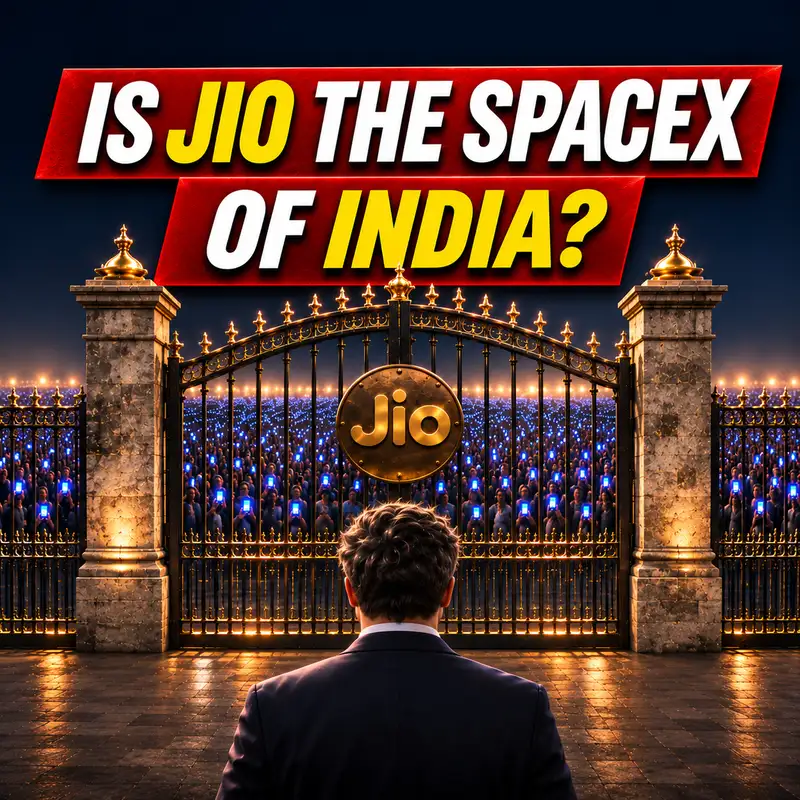
Aman: Zubin, on the 8th of October,
Elon Musk ended a post on X with seven
words: Is Ambani the real boss of India?
Zubin: Elon has spent the last five years
waiting for a licence to sell satellite
internet in India. He has one in 165
other countries or so he says.
Aman: Three weeks later, four generations
of the Ambani family stood on the floor
of the National Stock Exchange in Mumbai
and watched Jio Platforms list.
30,213 crore raised.
That's about 3.2 billion US dollars,
the biggest IPO in Indian history,
and the stock market opened up 21%.
And the best bit nobody
sold a single share.
Zubin: And here's a bit that nobody
clicking on the listing story is being
told. The man who runs the most valuable
rocket company on earth and the man who
runs India's most valuable IPO
are running the same playbook.
And the man accusing Ambani
of locking the doors is standing next
to Ambani outside the locked door.
Aman: So today, how Mukesh
Ambani took his father's company,
which drilled from a cloth shop all the
way down to an oil refinery and turned it
inside out, whether Jio really
is the SpaceX of India and why
this month Jio is getting Jio'd.
[Opening titles]
This is A2Z Fintech.
Zubin: All right, quick housekeeping.
You could probably read the disclosure
at the bottom of the screen.
We're ex-bankers, ex big tech,
two dudes who love talking.
And we have nothing to do with this deal.
Nothing here is advice.
Now let's jump into it.
Aman: So the listing listed on 28th
October at 1,358 rupees a share.
The market value 12.5 lakh crores.
That's about $131 billion.
And past 13 lakh crores, about $140
billion by the close of trading.
Oversubscribed 21 times. Institutions 70.
Zubin: And retail?
Aman: 2.76 interestingly.
Zubin: Hold that number.
Dhirubhai Ambani built
this company on the small investor.
1977, 5,000 or 58,000,
I should say, of them.
And his AGMs filled cricket stadiums.
His son's record listing comes around,
and the small investors showed up at under
three. The equity cult sat this one out.
Aman: Price 42 times earnings.
Airtel earns about 271 rupees a month
per customer. That's under $3.
Jio earns 219 rupees, about a fifth less.
Retail looked at the price and waited.
Zubin: And 42 times only works
if that number keeps climbing.
The gigabyte was never free,
it was deferred. Now who sold?
Aman: Well nobody, not Mukesh,
not Meta, not Google, not KKR,
and of the 30,000 odd crore raised,
27,500 crore, about 2.9 billion,
repays the borrowings made
by the Reliance Jio Infocomm.
Zubin: So it's not a growth raise, it's a
balance sheet getting washed and blow-dry,
I guess before the photographs. So
Aman: Which tells
you what this IPO is for.
Zubin: A currency, and you do not
need an exchange to find 3.2 billion
when your father is Mukesh Ambani.
You need one for a share price
you can spend on data centres, on AI,
or whatever the next
Disney turns out to be.
Aman: Hold the word currency.
First, how a man legally banned
from telecoms ended up owning it.
Zubin: Banned by his own family, right?
So let's go back to 2005,
Dhirubhai Ambani passes,
the brothers split their business,
Anil took telecom,
and a non-compete kept Mukesh out.
Anil's Reliance Communications ended
in bankruptcy, worth I think what,
230 crore rupees at the end.
That's about a little under 30 million.
The non-compete dies on 23rd May 2010.
Aman: And and the date
is why 2010 matters.
It's the day Mukesh
was allowed to go wide.
His father went deep cloth,
yarn, polyester, petrochemicals,
and at Jamnagar, the oil,
which was the sort of mainstay.
In fact, you know, Zubin, if you take
the word Jio and you squint because the J
and the L kind of look the same,
it's oil spelt backwards.
Zubin: Hmm. Interesting.
Aman: The son went wide.
Zubin: That's interesting.
I didn't pick that up in our research.
Good one, good one.
I missed that completely.
Well, weeks later, India
auctions the 4G spectrum.
The only bidder to win every circle
in the country is Infotel Broadband,
share capital 3 crore,
which is about $650,000.
Turnover was about 16 lakh, about $35,000.
Aman: Yeah.
Hours after the auction closes,
Reliance buys 95% of it for 4,800
crore, a billion dollars.
Zubin: Hours. Hours.
Aman: Yeah, note the mechanics
because they matter later.
Infotel won at auction, then
the government allowed voice calls on data
spectrum for a small fee.
The auction got him the airwaves.
A rule change afterwards made them
worth a fortune. Hold that shape.
Zubin: Then six years of concrete, right?
More than 1.5 lakh crores,
let's put that in perspective.
That's roughly about $25 billion
before a single paying customer.
September 2016, free voice, data
at close to nothing. This is not pricing.
This is a siege.
Aircel, Telenor, Tata Docomo all gone.
Alright, right, the thesis
you have been dying to say all week.
Jio is the SpaceX of India. Come on, Aman.
Aman: Same same playbook, and I'll give
you four moves. One, win the allocation.
A NASA contract saved SpaceX in 2008.
A spectrum decision made Jio in 2010.
Two, was a collapse. The unit costs.
SpaceX cut the price of a kilo to orbit
by more than an order of magnitude.
Jio cut a gigabyte from 225 rupees
to a rounding error. Three, own the stack.
Picture a day on Jio. A JioPhone,
Google help design, the IPL on JioStar,
groceries on JioMart, work on JioCloud.
542 million people Zubin, one
company from the SIM to the stadium.
Zubin: Valid point.
Let's talk about the fourth one, right?
Let the cash machine fund the moonshot
and turn your rivals into shareholders.
Meta and Google paid for Jio. But hold on.
Move 2 is not SpaceX, SpaceX invented
reusable boosters. Jio did not invent 4G.
It bought it off-the-shelf kit and
deployed it in with more money than anyone
else dared. And in using analogies,
this is a very good general
contractor with a pretty rich dad.
Right, and and move three
is the wrong company, right?
SpaceX competes with Ariane, with China.
Jio competes with Airtel in one
country under one government.
Yeah, that's is more a Bell System.
And for anyone under 50, basically AT&T.
Right, one network,
one government partner,
a phone in nearly every American
home, every outsider frozen out.
Until the state itself
breaks it up in I think what,
1984. So the question isn't whether
Jio is SpaceX, it is who breaks up Jio.
Aman: Fine. Well well on structure,
I'll hand you that, Zubin.
On ambition and on the state, it's SpaceX.
And there is one test nobody has run.
Put the two of them in the same room.
Zubin: Which is exactly
what happened in October.
And if you are new here, this is the
moment to stay. Subscribing costs nothing.
And it tells YouTube to show this to
the next person like you. Now, October.
Aman: Yeah, the Musk
collision, if you'd like.
If you rewind to 2024, India must decide
how to hand out the satellite spectrum,
auction it or allocate
it administratively,
a set price with no bidding.
Zubin: Yeah, and and Musk
wanted it administratively,
as most of the world does it, right?
Jio and Airtel wanted an auction.
In October 2024 the government
sided with Musk. Jio lost.
Aman: It's the same shape.
In both cases the entrant won
on the rule and not the bid.
And the man complaining about a level
playing field in 2024 is the man who
benefited from the rule in 2010.
Zubin: Yeah.
So Jio is getting Jio'd, right?
Move on the playbook, win the allocation.
Mukesh wrote that move.
Elon is reading it back to him
with an American accent.
Aman: So back to October,
Wednesday seventh to be precise.
"Unfortunately, we are being blocked
by certain oligarchs in order to maintain
their monopolistic chokehold
on the Indian people."
Thursday, another one for Musk:
"Is Ambani the real boss of India?"
Friday 'cause he doesn't stop:
"Dear Prime Minister Ambani,
with humble apologies for not realising
that you are the real boss of India."
Zubin: Which he is, by the way.
Aman: That yeah. Now now the other side.
The Ministry of Communications
that same Wednesday in writing,
the framework is fair and
non-discriminatory and claims are baseless
and misconceived. The Minister of State,
Chandra Sekhar said in October that the
issue is pending with the Home Ministry
for security clearance and it
has nothing to do with one company.
And and and government sources in an ANI
report on the sixth of November say
Starlink filed its security
paperwork last.
So on ninth of October,
Reliance issues a statement.
It did not name Musk, it welcomed
Starlink's competition and and one line:
"Jio's own satellite
services await clearances."
Zubin: Hang on, hang on, hang
on, hang on. Read that again.
Aman: Jio's own satellite
services await clearances.
Zubin: So as of early November 2026,
the oligarch and the rocket man are in
the same queue for the same clearance
from the Home Ministry.
And and the man accusing Ambani of locking
the door is standing right next to Ambani
outside the locked door.
Aman: That Zubin
is the non-obvious insight.
And as of early November, the documented
thing holding up Starlink is a clearance
that is also holding up Mukesh Ambani.
If there is a hidden hand,
it has locked out its own man.
Zubin: Or the most elegant kind, the rules
are identical. The costs are not.
Jio can sit that queue for years.
Starlink has one product.
A level playing field is not level
when one player doesn't need to play.
Aman: So why should anyone in fintech
care about a telecom queue?
Because here's the thing: every Indian
fintech is a tenant of these rails.
And on October 28 the landlord
got a listed share.
Zubin: A landlord with a currency does
not raise the rent. He buys the tenants.
Jio Platforms is now worth what about 13
lakh crores, approximately $140 billion,
and Mukesh can spend it. Here is where
we disagree, and I say parts, right?
It is a telco, a media
empire, a cloud business,
and an AI ambition in one wrapper.
And conglomerates do not get acquired.
They get harvested.
As we said in our Stripe episode.
List the telco, list JioStar, list
the AI piece the day it has revenue.
Aman: I say whole for now. You do not
break the balance sheet before the build.
One big currency funds
the AI infrastructure,
three small ones get
picked off one at a time.
Zubin: Yeah, cheap data scaled
UPI for comparison, right?
We were at Google Pay
when the gigabyte went to zero.
UPI did not scale on policy
alone, it scaled on price.
Aman: And Jio Financial
Services spun out in 2023.
It's where the group lends,
the company that just listed.
The lending sits next door.
So what does Jio Platforms buy
first with its new currency?
A lender, an AI stack, or a satellite?
Zubin: I would say a lender.
Shares buys a loan book faster
than I guess a licence buys a satellite.
Aman: Yeah, as the satellite,
the one his father would have bought,
the layer if you'd like underneath.
Zubin: All right, then the bet.
In November 2027 I'm gonna go on limb
and say Airtel is worth more than Jio.
Aman: I say Jio is worth more.
Loser buys filter coffee.
Zubin: In Mumbai. I'm not paying $9
Aman: Yeah.
Zubin: in San Francisco
for a coffee. You lost.
Aman: Three things to watch.
The first is the tariff rise,
the deferred gigabyte coming due,
the day the Home Ministry clearance
lands, and for whom the queue.
The first deal paid for in Jio
Platforms stock, which is the currency.
Zubin: Pin yours below, whole
or parts, what he buys first,
and name a number for Jio
against Airtel in November 2027.
We read the best at the top of the next
episode and settle a coffee on air.
And of course, subscribe so you
are here when one of us Aman pays.
Aman: Okay. In 1977, Dhirubhai Ambani sold
the Indian middle class a share and taught
a country, if you'd like, how to invest.
In 2026, his son sold
the world a pipeline.
The Indian middle class mostly
watched from the stands.
Elon Musk believes Jio is the thing
that's standing between him and a billion
customers. He is wrong about the door.
But he is right about the building.
So here is where we land.
SpaceX ambition, Bell System structure.
Jio is the SpaceX of India because it
worked out a decade before Musk did
that in a market of a billion people,
the state is not your regulator,
it's your co-founder. And it is the Bell
System of India because the same
co-founder decides when it stops.
The father drilled down
to hit oil, the son is building
out until he hits the sky.
And in India, structure wins until
the state, of course, changes its mind.
Zubin: Stay curious, my friends.
Aman: Stay purposeful.
Zubin: And of course, stay drip.
And if you want to know what rode
on top of that free gigabyte,
UPI at 10 is on the screen now.
[Closing titles]
This is A2Z Fintech.